

Where the 6 Ton Excavator Fits Between Mini and Midi
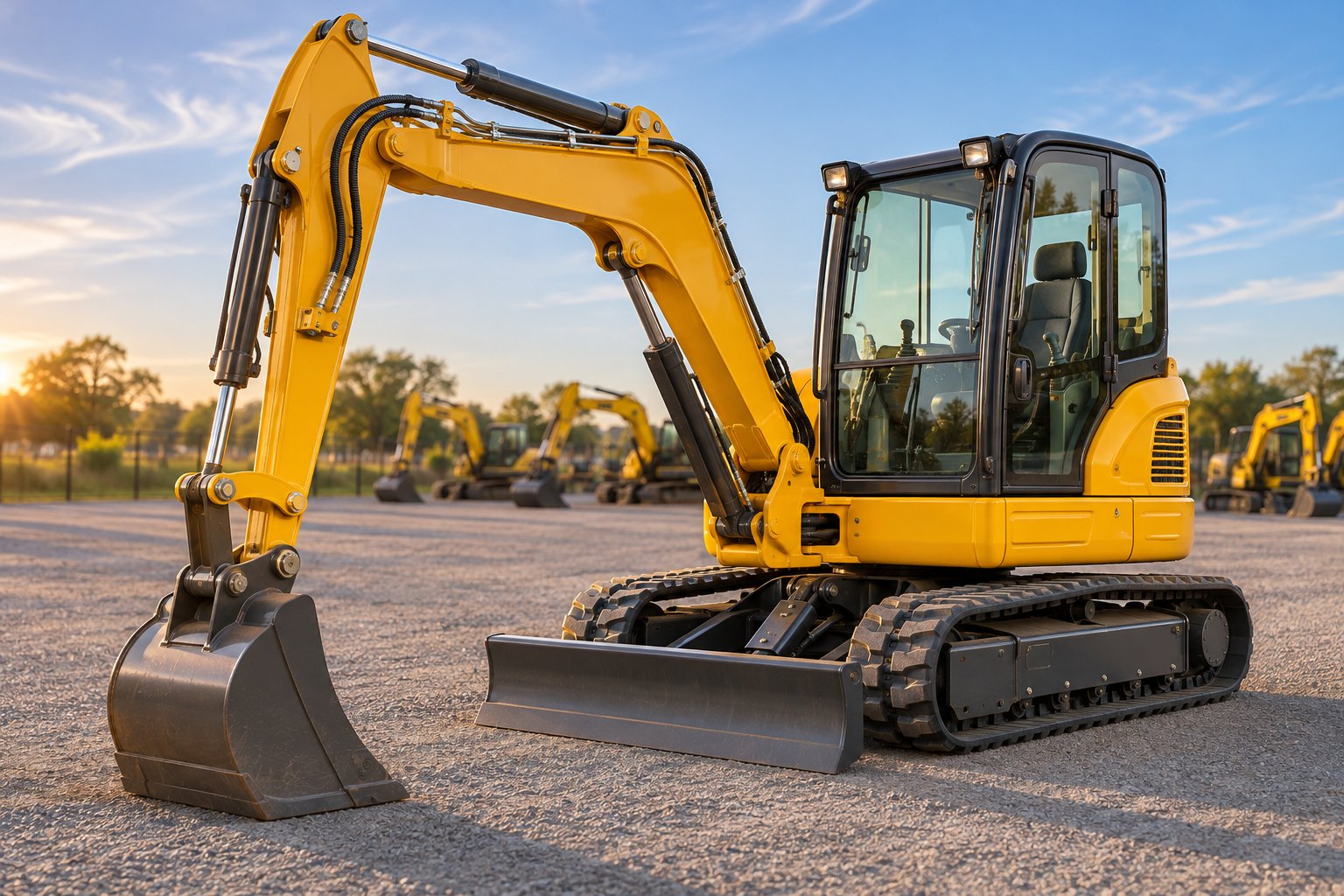
Quick definition: A 6 ton excavator is a tracked digging machine with an operating weight of about 6 metric tons, or roughly 6,000 kg (about 13,228 lb). Operating weight includes fluids, an operator, and standard equipment. Because it sits right on the line between the mini and midi classes, the same machine can be filed under different labels on different websites.
Ever run the same search on two sites and gotten completely different results? You're not imagining it. The confusion is built into how this class is labeled.
What Counts as a 6 Ton Excavator
Weight is the industry's yardstick because it is a better gauge of power and digging capability than height or width, as EquipmentShare explains. In the US, you'll usually see operating weight in pounds, while global manufacturers often publish metric tons. One metric ton is about 2,205 lb. Watch the unit, though. If a seller means US short tons (2,000 lb each), "6 tons" works out to only 12,000 lb.
Mini, Compact, or Midi and Why Labels Conflict
No single body sets the class boundaries, a point TrueBrady makes plainly. Some marketplaces stop the mini class at 5 tons, while others stretch it past 6. SANY even calls 6 to 10 ton machines "small" rather than midi.
| Class Label | Weight Range Assigned | Where a 6 Ton Machine Lands |
|---|---|---|
| Mini (narrow definition) | 1-5 t (about 2,205-11,023 lb) | Above the class |
| Mini (broad definition) | Up to 6 t, or under 6.6 t (about 14,550 lb) | Top edge or inside the class |
| Midi | 6-10 t (about 13,228-22,046 lb) | Bottom edge of the class |
| Midi (alternate definition) | 7-10 t (about 15,432-22,046 lb) | Below the class |
Real listings show the same overlap. TreeTrader's mini excavator listings run from about 3.8 tons (8,487 lb) to about 6 tons (13,368 lb). On that site, a 6-ton unit sits at the very top of the mini category. On another site, the same machine might open the midi section instead.
Using Operating Weight to Browse Compact Excavators for Sale
The fix is simple: ignore the label and filter by the number. When you browse compact excavators for sale or small excavators for sale, try these steps:
- Set a weight window of about 12,000 to 14,500 lb (roughly 5,400 to 6,600 kg). This catches machines advertised in either short or metric tons.
- Check both the mini excavator sale pages and the midi pages, since 6-ton units can appear in either.
- Confirm the unit on the spec sheet, not just the listing title.
Key takeaway: search by operating weight first, and treat mini, compact, or midi labels as hints rather than definitions.
A weight filter tells you which machines belong in the 6-ton class. What it can't tell you is whether that class is the right fit for the trench, foundation, or backyard waiting for you.
Matching a 6 Ton Excavator to the Right Jobs
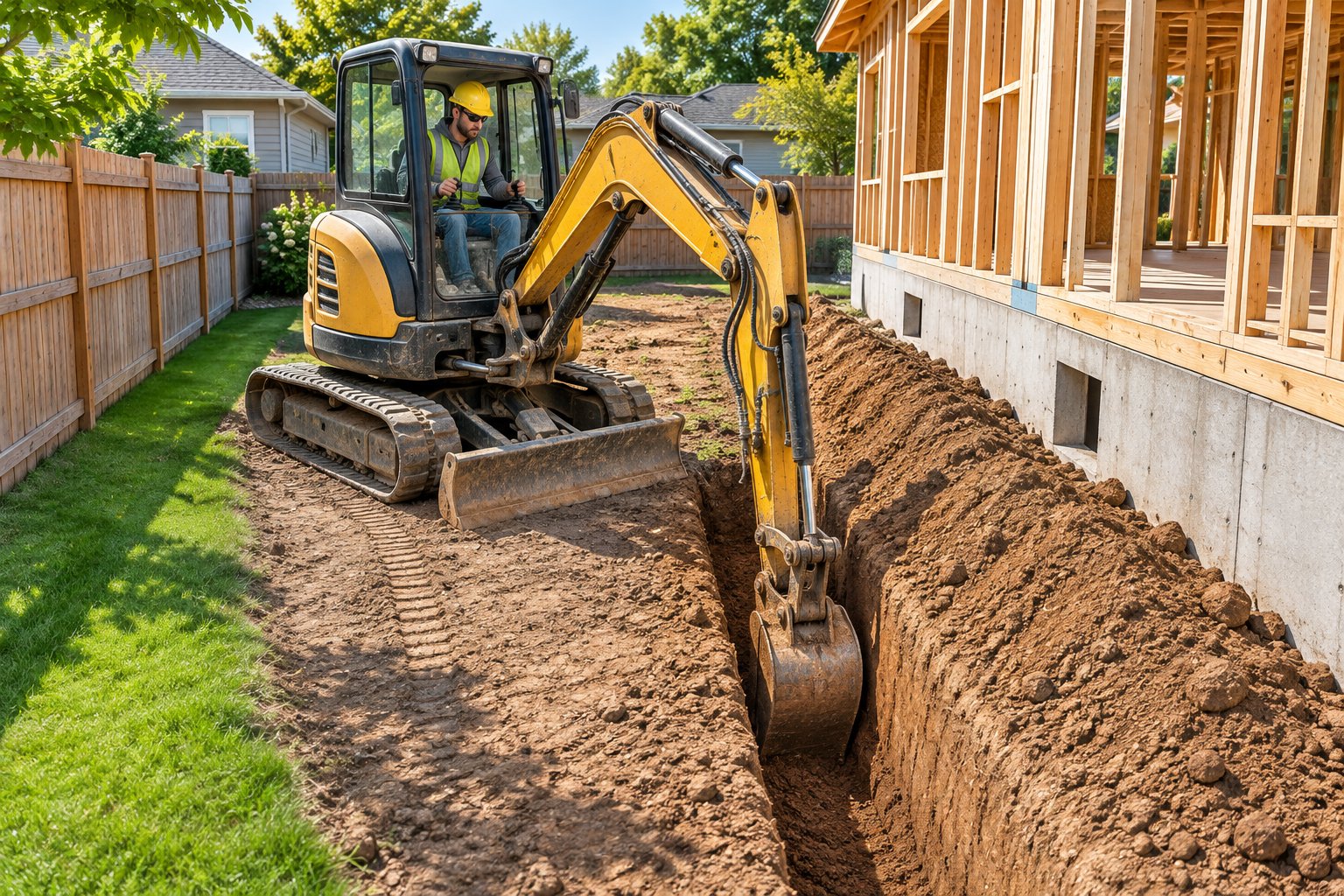
Imagine hauling a machine across town, only to find it can't fit through the side gate. Or it fits, but it bogs down in compacted clay by noon. Sizing mistakes are expensive. Rubbl puts it bluntly: undersize and you fight the machine all day, oversize and you pay for capacity and hauling you don't need. Before you shop, make sure 6 tons truly fits your work.
Jobs a 6 Ton Machine Handles Well
A machine in this class sits at the heavy end of compact equipment. It carries more mass and stability than smaller units, yet stays nimble enough for many residential and light commercial sites. Here's where that balance pays off:
- Residential foundations: These digs typically run 4 to 8 feet deep, well within compact-class territory. The extra weight helps the machine stay planted while it loads spoil.
- Utility trenching: Sewer laterals and water lines usually fall between 4 and 12 feet deep. A heavier compact unit gives you steadier passes along a long trench line.
- Landscaping: Grading, pond and pool digs, and stump removal all benefit from 360-degree rotation and a good mix of power and control.
- Small demolition: Heavier machines absorb hydraulic hammer impacts better, which helps when breaking slabs or pulling old footings.
Dig depth and reach vary by model and arm option. Pull those numbers from each manufacturer's spec sheet rather than trusting a class average.
When a Smaller Excavator Makes More Sense
Sometimes less machine is the smarter buy. If most of your work happens in tight backyards, start with 3 ton excavators for sale. Many minis fit through a standard 36-inch gate. Width matters too. Construction Business Owner notes that a 3- to 4-ton conventional-tail machine is about 60 inches wide, while a zero-tail-swing unit with similar performance runs about 70 inches.
A 5 ton excavator for sale can be a sensible middle ground when you want more muscle but lighter hauling. Some marketplaces list the same units as a 5 ton mini excavator for sale, so check both labels.
| Class | Site Access | Transport | Typical Tasks |
|---|---|---|---|
| 3 ton | Tightest spaces, narrow gates, finished lawns | Lightest and simplest to tow with a properly rated setup | Small trenches, landscaping, backyard work |
| 5 ton | Most residential lots | Moderate; confirm truck and trailer ratings | Utility lines, general site prep, residential trenching |
| 6 ton | Open residential and light commercial sites | Heaviest of the three; may need a heavier tow setup | Foundations, longer trench runs, light demolition |
Signs You Need to Size Up
Some jobs simply outgrow the compact class. Watch for these signals:
- Your dig spec goes beyond about 12 feet, which pushes into midi territory.
- You're working in clay or compacted fill that demands more breakout force.
- You need to place heavy pipe or forms at a long working radius. Check rated lift capacity at that exact reach.
- You're breaking rock or concrete all day with a large hammer.
Picking the right class narrows the field, but two 6-ton machines can still perform very differently in the same trench. Those differences hide in the spec sheet.
Reading the Specs That Matter on a Compact Excavator
Does a spec sheet ever read like a wall of numbers? Each figure actually answers a simple jobsite question. Learn to read them, and you can judge any compact excavator for sale in minutes.
Breakout Force and Digging Performance
Breakout force tells you how hard the bucket or arm can push into material and tear it loose. It matters most in hard clay, compacted fill, and rocky ground. A machine with modest breakout force still handles loose soil well. In tough material, though, you'll notice it scraping and stalling. Spec sheets often list bucket and arm figures separately, so compare like with like.
Operating weight works hand in hand with digging force. More mass keeps the tracks planted while the bucket pulls, which helps stability when digging and lifting. The tradeoff shows up on the road, because every extra pound affects your trailer and tow vehicle.
Zero Tail Swing vs Conventional Tail Swing
The difference comes down to the counterweight. A zero-tail-swing machine keeps its upper body within or at the width of the tracks as it rotates. A conventional model uses a larger counterweight that swings well past the tracks, as Gregory Poole explains.
Zero Tail Swing Pros
- Works tight against fences, walls, and property lines without repositioning
- Safer near live traffic, since the tail won't swing into adjacent lanes
- Lower risk of property damage and damage claims
Zero Tail Swing Cons
- Can have reduced maximum lifting capacity
- Slightly less stable on slopes and grades
Conventional Tail Swing Pros
- More leverage for heavy lifts and steep-grade work
- Can offer greater dig depth and reach
- Lets you work harder on open sites without watching clearance
Conventional Tail Swing Cons
- Needs more swing clearance for safe rotation
- Awkward near structures, utilities, and traffic
Here's a simple rule: pick the design that matches the site you work on most often. Mostly urban lots and utility corridors? Go zero tail. Mostly open ground, truck loading, or slopes? Conventional usually wins.
Hydraulic Flow and Attachment Compatibility
Auxiliary flow sets how fast an attachment works, while pressure sets how much force it delivers. A mismatch causes slow trouble. Fluid Power World describes augers that stall in clay and breakers that hit weakly and run hot. Too much flow can overspeed a motor and build heat.
The circuit type matters too. Thumbs, grapples, and reversing augers need a two-way circuit. Breakers work best on a one-way circuit that returns oil straight to tank. Some motor-driven tools also need a separate case drain. Before buying any small excavator for sale, ask the seller for:
- Rated auxiliary flow at working engine speed
- Relief pressure settings
- One-way or two-way plumbing, plus any case drain port
Rubber vs Steel Tracks
Rubber tracks give a smoother ride and protect pavement and finished surfaces. However, they can wear faster in extreme conditions. Steel tracks excel on rough, soft, or uneven terrain, but they cost you surface-friendliness and operator comfort. Rubber pads that bolt, chain, or clip onto steel tracks offer a middle path, as TVH notes. There are also no international standards for track measurement, so source replacements by make and model.
Treat every figure on a listing as a claim to verify against the manufacturer spec sheet and dealer documentation before you buy any excavator equipment.
Specs only come alive when you line real machines up side by side, and the 6-ton class has no shortage of contenders.
Popular 6 Ton Excavator Models Worth Comparing
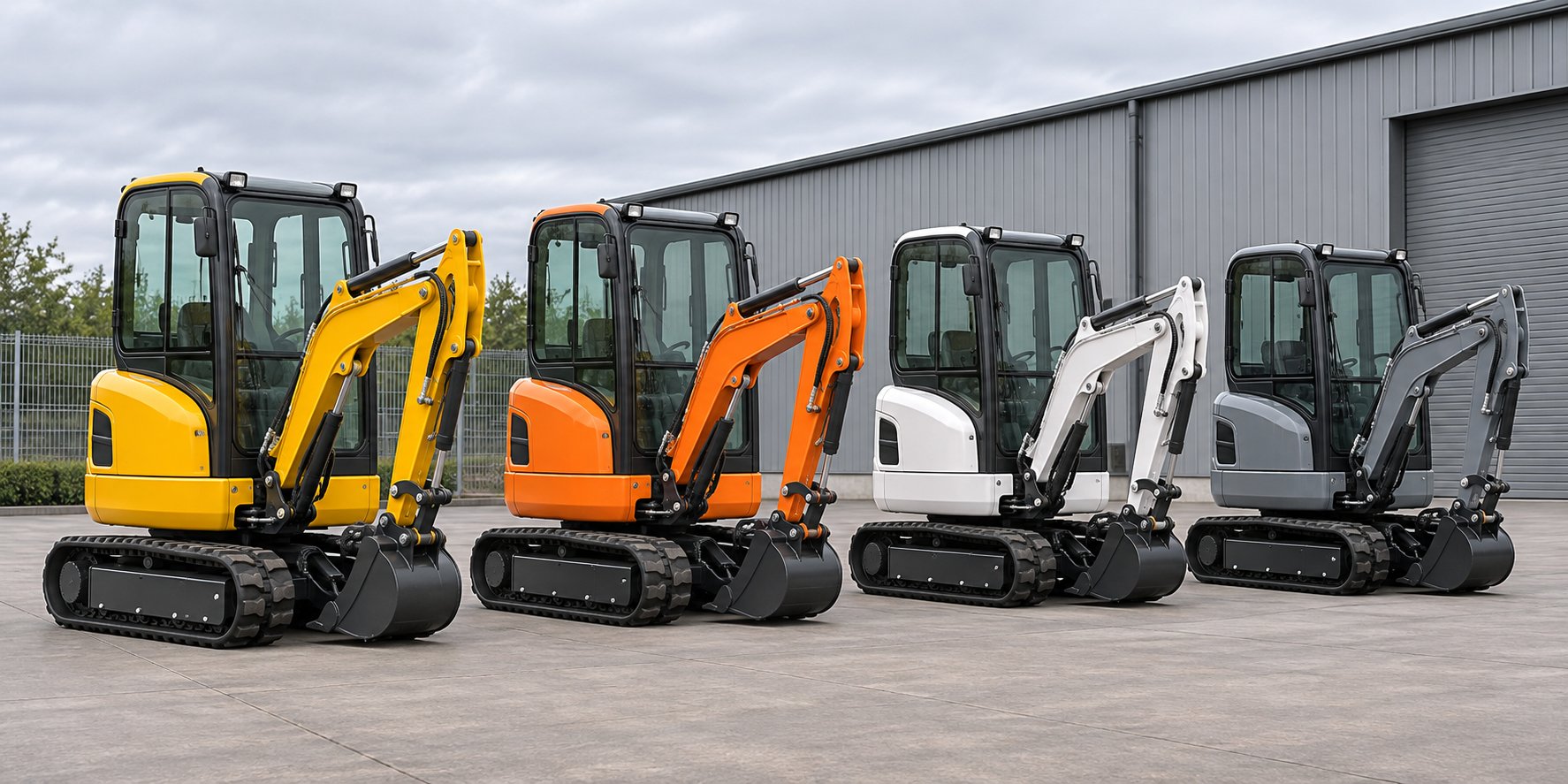
Ever notice how every brand says its 6-ton machine is the one to beat? With more than a dozen serious contenders, a side-by-side view saves you hours of tab-switching. The table below groups popular models by tail-swing design and general character. Use it to build a shortlist, then confirm the details on each spec sheet.
Popular 6 Ton Excavator Models Compared
Here's a handy clue: model suffixes often hint at tail-swing design. Letters like CR, MR, SR, and ECR generally signal a compact or reduced swing radius, while ViO is Yanmar's zero-tail line. Treat these as starting points, not guarantees.
| Model | Tail-Swing Type | Notable Characteristics | Where to Verify Specs |
|---|---|---|---|
| Sunward SWE60E (used unit offered by JIUHONG) | Confirm on the specific unit | Listed at 6,000 kg operating weight with a 0.22-cubic-meter bucket. As a used machine, condition varies by unit. | JIUHONG product page plus unit-specific documents from the seller |
| Cat 306 / 306 CR / 306.5 | Conventional on the 306; compact radius on the 306 CR; check the 306.5 | Several configurations within one family, backed by a broad dealer network | Cat dealer spec sheets |
| Kubota KX057-5 | Conventional | Sits just under 6 tons; the rear counterweight adds stability on open sites | Kubota USA spec pages |
| Kubota U55-5 | Zero tail swing | Kubota's tight-space option in a similar size range | Kubota USA spec pages |
| Bobcat E60 | Conventional | A conventional-tail choice at the upper end of Bobcat's compact lineup | Bobcat dealer spec sheets |
| John Deere 60G / 60P | Reduced tail swing | Two generations, so features differ by model year | John Deere dealer spec sheets |
| Takeuchi TB260 | Conventional | Suited to open ground and truck loading | Takeuchi dealer spec sheets |
| Yanmar ViO55 / SV60 | Zero tail on the ViO55; compact swing on the SV60 | Two different designs that share a similar size class | Yanmar dealer spec sheets |
| Komatsu PC55MR | Minimal swing radius | Sits just under 6 tons; built for tight urban work | Komatsu dealer spec sheets |
| Volvo ECR58 | Compact radius | Short-swing design for confined sites | Volvo dealer spec sheets |
| Kobelco SK55SRX | Short radius | Designed to work close to walls and traffic | Kobelco dealer spec sheets |
| Case CX60C | Minimum swing radius | Tight-tail design in the 6-ton range | Case dealer spec sheets |
Notice how the KX057-5 and PC55MR come in just under 6 tons? That's why a weight window beats a strict "6 ton" search term. Even within one brand, sizes spread widely. Kubota's KX Series spans machine weights from 2,315 to 18,280 lb.
Curious about the Kubota KX057-5 price? Kubota lists its MSRP as low as $88,140, which excludes tax, dealer fees, and optional equipment. That figure applies to a new excavator for sale, so used units will land elsewhere. The SWE60E offers a different path. Its product page handles inquiries about condition, current pricing, and ocean or land freight. Just confirm the actual unit's condition and specs before you commit.
How to Verify Specs Before You Shortlist
Brochures round numbers, and listings sometimes copy the wrong generation. Before any machine earns a spot on your list, run these checks:
- Download the spec sheet for the exact model and generation, not just the family name.
- Match the configuration. Cab or canopy, arm length, and track type can all shift operating weight.
- Check that the serial number and model year line up with the spec sheet you're reading.
- Compare units carefully, since some sheets publish pounds and others kilograms.
- Ask dealers in mini excavator sales for written documentation rather than verbal claims.
A spec sheet tells you what a machine can do. It won't tell you what that machine should cost, and two units of the same model can carry very different price tags.
What Drives the Price of a 6 Ton Excavator
How much do excavators cost? The honest answer is "it depends," but what it depends on is surprisingly predictable. Learn those factors, and you can tell a fair mini excavator price from an inflated one in a few minutes.
New vs Used 6 Ton Excavator Pricing Factors
Published list prices give you a useful anchor. Bobcat's E60, at 12,315 lb, carries a suggested list price of $94,376 for the base model. That figure leaves out freight, pre-delivery inspection, taxes, options, and attachments, and the local dealer sets the final price. So how much is a small excavator in general? Bobcat's mini lineup runs from $31,950 to $141,406, and the price climbs with operating weight.
Used machines change the math. Used minis can offer 30-50% savings over new while keeping 70-80% of their useful life, figures highlighted by Ironmart.
| Factor | New | Used |
|---|---|---|
| Upfront cost | Highest, plus freight and dealer fees | Lower, but varies widely by condition |
| Warranty | Full manufacturer coverage | Limited, dealer-certified, or none |
| Financing | Often easier terms and promotions | A lender may ask for a bigger deposit, especially on high-hour units |
| Depreciation | Steepest in the first few years | Much of the early drop already absorbed |
| Condition risk | Minimal | Depends on inspection and records |
How Hours, Age, and Attachments Shift Value
Here's a surprise from auction data: a 2019 Bobcat E35 sold for $34,000 in the same month a 2023 unit brought only $20,900. The model year alone tells you little. These factors, ranked roughly by impact, explain most price gaps:
- Engine hours: Minis are typically designed for 5,000-10,000 hours before major components need replacing. Units under 1,000 hours with full logs command a premium.
- Undercarriage and tracks: Rubber track replacement alone can run $2,000-4,000.
- Maintenance records: Complete service histories can appraise 10-15% higher.
- Age: Annual depreciation often runs 8-12% for the first three years, then 5-8% after that.
- Attachments: A quick coupler can add $2,000-4,000, and a quality thumb $3,000-6,000.
- Brand and parts availability: Well-supported brands with deep dealer networks tend to hold value better.
- Region and timing: Strong local markets slow depreciation, while winter listings may need a 5-10% discount to sell.
Benchmarking a Fair Price
Never rely on one quoted number. Instead, build a price range from several sources:
- Check valuation guides such as NADA Guides or Black Book for the model and year.
- Pull recent auction results, which show what machines actually sold for rather than what sellers hope to get.
- Compare three or more current listings with similar hours, attachments, and track condition.
- Get two written dealer quotes with every fee and attachment on its own line.
A fair price is a range backed by comparable sales, not a single figure from one seller.
Every adjustment in that range depends on details printed right in the listing, and those small fields are where most buyers skim too fast.
How to Read a Used Excavator Listing Like a Pro
When you scroll past a used small excavator for sale, the photos grab your attention first. The real story sits in the short spec fields below them. Each field is a clue, and each clue should prompt a question for the seller.
Decoding Used Mini Excavator Listing Fields
Marketplaces such as TreeTrader break listings into structured fields. Here's what each one tells you and what to ask next.
| Listing Field | Why It Matters | Ask the Seller |
|---|---|---|
| Hours | Shows how hard the engine and hydraulics have worked. Stribling Equipment considers under 2,000 hours low for a well-maintained mini and says anything above 4,000 deserves extra scrutiny. | Is the hour meter original? Has it ever been replaced? |
| Drive | Describes how the machine travels, including any travel-speed options. | Do all travel functions work smoothly in both directions? |
| Horsepower | Engine output, which should match the spec sheet for that model and generation. | Is the engine original to this machine? |
| ROPS | Confirms rollover protection and whether you get a canopy or an enclosed cab. | Has the structure been damaged, drilled, or modified? |
| Track type | Rubber or steel, which affects the surfaces you can work on. | When were the tracks last replaced? |
| Auxiliary hydraulics | Determines which attachments the machine can run. | Is it one-way or two-way plumbing? What is the rated flow? |
| Bucket width | Sets the trench width you cut per pass. | Which buckets and attachments are included in the price? |
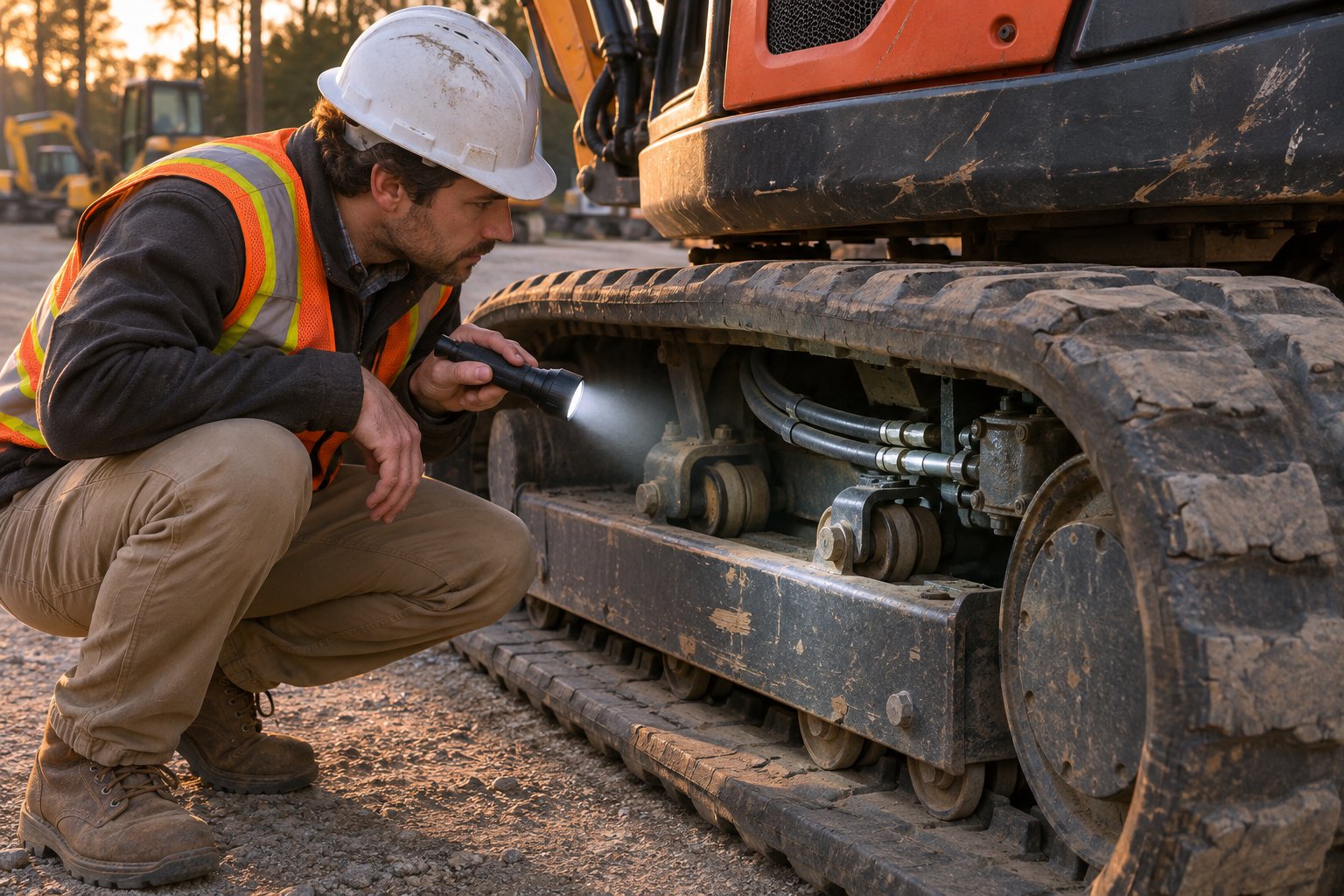
| Track % remaining | Estimates tread life left. Undercarriage replacement is one of the most expensive excavator repairs. | How was it measured? Can you send close-up photos? |
Questions to Ask the Seller
Field-level questions cover the basics. A few broader ones reveal how the machine actually lived:
- Why are you selling it?
- What major repairs or component replacements has it had?
- Was it used heavily with a breaker or for demolition?
- Can I watch it start from cold?
- Are there any warning lights or stored error codes?
Pre-Purchase Inspection Checklist
Whether you're browsing used compact excavators nationwide or searching for used mini excavators near me, walk through these checks in person:
- Hydraulic leaks: Inspect cylinders, hoses, and fittings. Run every function under load. Sluggish or jerky movement points to hydraulic trouble.
- Swing bearing play: Watch for wobble in the upper structure while digging. Listen for grinding, popping, or clicking during swings. A tilt test with a dial indicator measures clearance against the manufacturer's wear limit.
- Pin and bushing wear: Excessive play at the boom, arm, and bucket pins signals deferred maintenance.
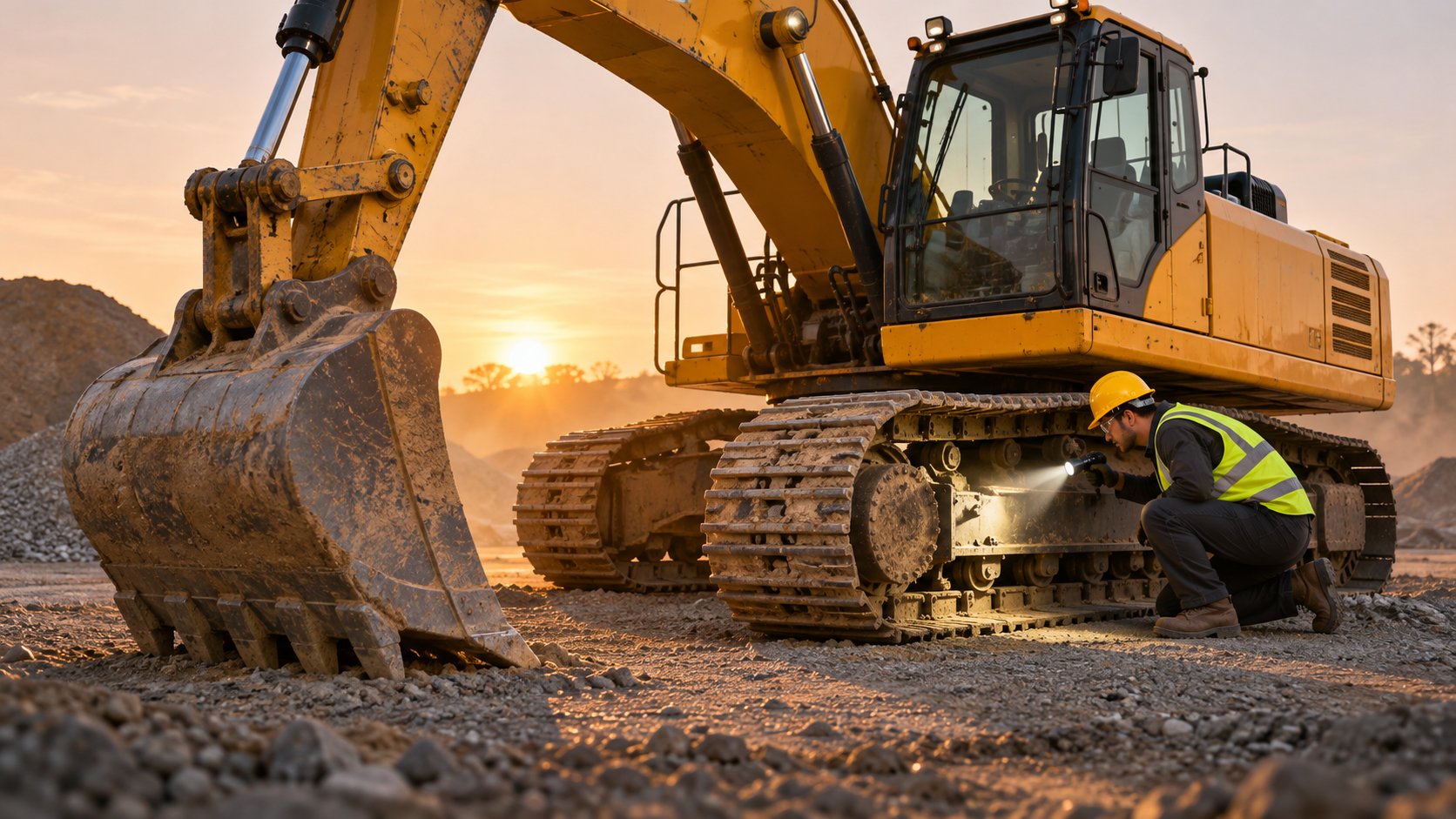
- Undercarriage wear: Check tracks, rollers, and sprockets closely.
- Engine start and smoke: Listen for knocking or grinding, and watch the exhaust as it warms up. Check the oil for contamination and confirm coolant levels.
- Service records: Look for regular oil changes and note any major repairs.
- Serial number verification: Match the serial plate to the paperwork, the model year, and the spec sheet generation.
Request service records and serial plate photos, and whenever possible, have a qualified independent technician inspect the machine before any money changes hands.
A clean inspection answers what the machine is. It doesn't answer who stands behind the sale, and that depends heavily on whether you buy at auction, from a dealer, or through an online aggregator.
Where to Buy an Excavator in the 6 Ton Class
Where should you buy an excavator? You have more options than ever, and each one handles risk differently. A low auction price, a dealer warranty, and a huge online inventory each solve one problem while creating another. The right channel depends on how much risk you can absorb and how much legwork you're willing to do.
Auctions vs Dealers vs Aggregators
At an auction, competitive bidding sets the price, and you decide your maximum bid. Central Auction Group points out the catch: skip your due diligence and you risk buying a poor machine, and bidding wars can push prices higher than planned. Mini excavator auctions on platforms like GovPlanet, part of the Ritchie Bros. family of sites, also list shipping, financing, and an IronClad Assurance program in their buyer resources. Dealers usually charge more, but they offer quality assurance, longer warranties, and financing. Aggregators such as Machinio gather listings from dealers, auctioneers, and brokers into one search, and the platform is free for buyers.
| Channel | Pros | Cons | Buyer Protections |
|---|---|---|---|
| Auctions (GovPlanet, Ritchie Bros.) | Market-driven prices, wide brand mix, you set your bid ceiling | Bidding competition, limited time to inspect, mostly as-is sales | Pre-bid inspection where offered; check each platform's assurance and dispute terms |
| Dealer marketplaces (Tractor Zoom) | Browse many dealers' inventory at once | Pricing and terms vary by dealer | Depends on the selling dealer's warranty and return policy |
| Aggregators (Machinio, TreeTrader, MyLittleSalesman) | Largest selection, weight and model filters, saved searches | You still vet each seller separately | Mostly seller-dependent; the platform connects you rather than guaranteeing the sale |
| Local dealers | See the machine in person, service support nearby | Higher prices, limited inventory on the lot | Warranties, inspections, and the consumer protections tied to dealer licensing |
| Direct sellers and exporters | Access to units and pricing outside local markets | Distance, freight, and import rules add complexity | Written contracts, unit documentation, and independent inspection you arrange |
Filtering Marketplaces by Operating Weight
Most category pages mix 6-ton machines with much smaller or larger units. A few habits give you cleaner results:
- Set a weight filter of about 12,000 to 14,500 lb instead of trusting a size label.
- Search by model name, such as KX057-5 or E60, to catch listings filed under mini, compact, or midi.
- Run the same search in each category, since one machine may sit in different places on different sites.
- Save searches and turn on email alerts so new listings come to you.
- Use location and radius filters when you want excavators for sale near me, then widen the radius to compare prices.
- Review past auction results to see what similar units actually sold for.
Which Brands Have the Deepest Used Market
Listing volume is a useful signal. Machinio's manufacturer counts show Caterpillar with 2,925 listings, Komatsu with 1,239, John Deere with 1,236, and Yanmar with 1,073. These totals cover many sizes and change constantly, so read them as a measure of brand depth rather than 6-ton inventory.
Why does depth matter? A brand with a large used fleet usually has more dealers stocking filters, pins, and undercarriage parts, plus a healthy supply of used and aftermarket components. That familiarity also supports resale value, because more future buyers will recognize the machine when you sell it. A less common brand can still be a bargain, but check parts lead times before you commit.
Pick your channel based on the protection you need, then filter by weight and model so the label never hides a good machine.
Finding the right machine is only half the deal, though. A bargain listed three states away still has to get onto a trailer and down the highway legally.
Transporting a 6 Ton Excavator Safely and Legally
You found the right machine at a fair price. So how does it get home? Hauling is the part of a mini excavator purchase most buyers plan last, yet it can decide whether a deal still makes sense. That's why shoppers browsing compact excavators for sale near me often widen their search radius only after they price the move.
How Operating Weight Affects Hauling
Start with four numbers from the spec sheet or data plate: operating weight, transport height, width, and length. Then add every attachment to the weight. A 6-ton machine already lands around 13,000 lb before extra buckets or a thumb. That puts it above the 10,000 lb mark where several federal hauling rules start to apply.
Height adds up quickly too. All State Towing gives a simple example: an 8-foot machine on a 3-foot deck makes an 11-foot load. Check that total against bridge clearances on your route and your state's height limit. Exceed a width or height limit and you'll need an oversize permit. Nevada, for instance, sets legal width at 102 inches, but every state sets its own rules.
Trailer and Towing Considerations
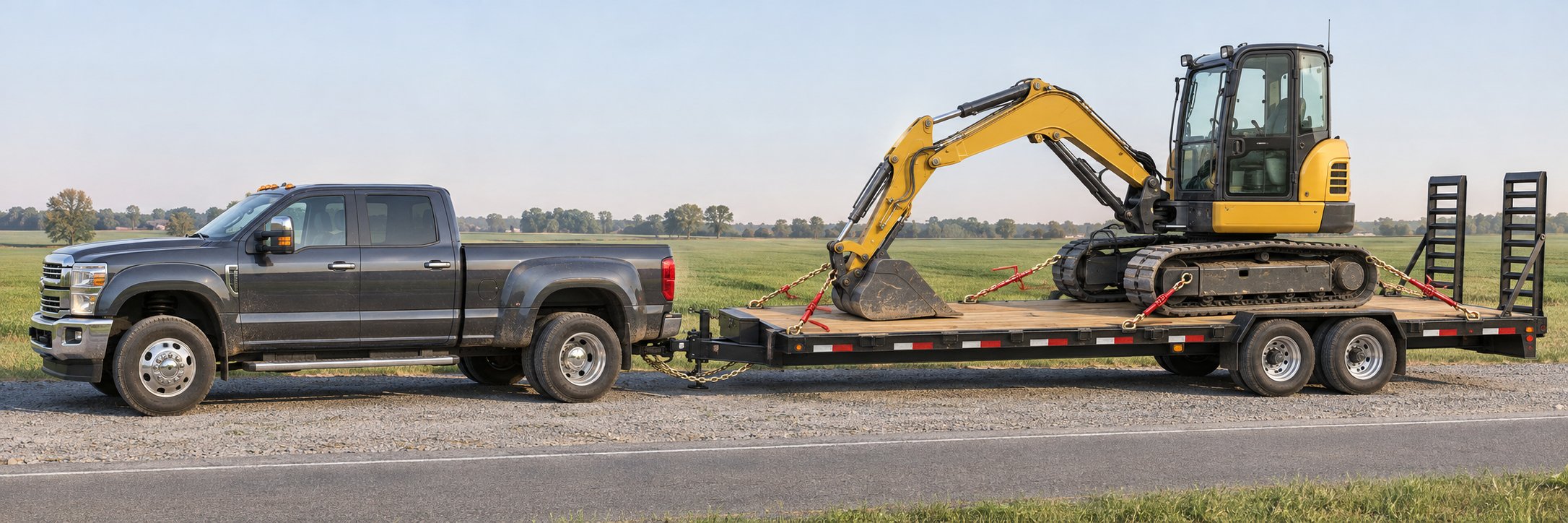
Can a pickup tow it? Sometimes, but only if every rating clears the full load. The machine, attachments, and empty trailer must stay under the trailer's GVWR. Truck, trailer, and load together must stay under the truck's GCWR. On a bumper-pull trailer, expect tongue weight of roughly 10 to 15 percent of the load. Heavier compact machines or big attachments may call for a gooseneck setup.
Licensing is the next hurdle. A Class A CDL applies at a combined rating of 26,001 lb or more with a trailer rated over 10,000 lb, under 49 CFR 383.91. For securement, commercial carriers hauling equipment of 10,000 lb or more need at least four chains and binders, one near each corner, at the manufacturer's tie-down points. The FMCSA also requires an aggregate working load limit of at least half the cargo's weight. Lower the boom, bucket, and blade flat, and engage the swing lock before you roll.
Shipping Options for Long-Distance Purchases
For domestic moves, a qualified hauler is often the safer bet. TreeTrader, for example, promotes FR8Star shipping alongside its listings. Ask every hauler for a written quote that spells out permits, escorts, and insurance, plus a certificate of insurance with an adequate cargo limit.
Imports add ocean freight. A trailer first moves the machine to port. From there, Sinotraffic notes that compact excavators often ship in 20GP or 40HC containers, while RoRo suits operable machines on fixed routes. Used units may also face age, emissions, inspection, or import permit rules, so check them before the machine ships. The same thinking applies to any compact equipment for sale overseas.
Settle these questions before you pay:
- What is the total weight with every attachment included?
- Do my truck's GCWR and my trailer's GVWR cover that load?
- Will the loaded height and width need a permit on my route?
- Does my setup require a CDL or working trailer brakes?
- Do I have rated chains and binders for four-corner securement?
- Will I hire a hauler, and what does the quote include?
- For imports, which freight method fits, and what are the destination rules?
Generic figures are only a starting point, so confirm local road regulations and your trailer's rated capacity before the machine ever leaves the seller's yard.
Freight costs, permits, and trailer limits can quietly reshape which listing is truly the best value, which is exactly why every step of the buying process works best when you run it in order.
Putting It All Together Before You Buy
Feels like a lot to track? It is, but the steps fall into a natural order. Each one filters out bad options before you spend time on the next. That holds true whether you browse used mini excavators for sale online or walk a dealer's lot in person.
A Step-by-Step Buying Checklist
- Confirm the job fit: Size the machine to your heaviest routine task, not a rare one-off. A first-time buyer checklist makes the same point: a machine should not operate at its absolute limit every day.
- Filter by operating weight: Search a window of about 12,000 to 14,500 lb, and treat mini, compact, or midi labels as hints only.
- Compare specs against manufacturer sheets: Check breakout force, tail swing, auxiliary flow, and track type for the exact model and generation.
- Evaluate listing data: Question the hours, track percentage, and service records. Then inspect in person or hire an independent technician.
- Benchmark pricing: Build a fair range from comparable listings, auction results, and valuation guides.
- Plan transport: Confirm trailer ratings, permits, licensing, and freight costs before you pay.
A Used 6 Ton Option to Evaluate
A checklist proves its worth when you test it on a real machine. JIUHONG offers a used Sunward SWE60E, listed at a 6,000 kg operating weight with a 0.22-cubic-meter bucket. That places it squarely in the class this guide covers. The product page takes inquiries about the unit's condition, current pricing, and ocean or land freight, which maps neatly onto steps four through six.
Treat it like any other listing in compact excavator sales. Ask for unit-specific documents, serial plate photos, and service records, and confirm the actual specifications. Importing? Check destination-market rules first. In the US, the Clean Air Act prohibits importing nonroad engines and equipment that don't conform to EPA emission standards, whether new or used. Customs and Border Protection or the EPA can seize nonconforming goods at the port and levy fines.
The smartest way to buy mini excavators is to let the work, the weight, and the paperwork make the decision, so the price you pay matches the machine you actually get.
6 Ton Excavator Buying FAQs
1. Is a 6 ton excavator considered a mini excavator or a midi excavator?
It can be either, depending on the website. There is no official standard for excavator classes. Some marketplaces cap the mini class at 5 tons, others extend it to just under 6.6 tons, and midi is described as starting at either 6 or 7 tons. A 6-ton machine therefore sits on the boundary and may show up under mini, compact, or midi labels. The reliable approach is to search by operating weight. A window of roughly 12,000 to 14,500 lb (about 5,400 to 6,600 kg) captures units advertised in metric or US short tons. Also confirm whether a seller means metric tons (about 2,205 lb each) or short tons (2,000 lb each), since that changes the real weight.
2. How much does a 6 ton excavator cost new and used?
New 6-ton machines from major brands commonly carry list prices in the high five figures to around $100,000 before freight, dealer prep, taxes, and attachments. For example, Kubota lists the KX057-5 from $88,140 MSRP and Bobcat lists the base E60 at $94,376. Used units can save roughly 30 to 50 percent, but the final number depends on engine hours, undercarriage condition, service records, included attachments like a thumb or quick coupler, brand support, and local demand. Model year alone is a weak guide, so build a price range from valuation guides, recent auction results, and at least three comparable listings instead of trusting a single quote.
3. Can I tow a 6 ton excavator with a pickup truck?
Sometimes, but only if every rating covers the full load. A 6-ton machine weighs around 13,000 lb before extra buckets or attachments, so the machine, attachments, and empty trailer must stay under the trailer's GVWR, and the truck, trailer, and load combined must stay under the truck's GCWR. Many setups need a heavy-duty or gooseneck configuration. You also need to check whether your combination triggers a Class A CDL, confirm loaded height and width against permit limits on your route, and use rated chains and binders at four corners. When in doubt, hire a qualified hauler and get a written quote that includes permits and insurance.
4. Should I choose a zero tail swing or conventional tail swing 6 ton excavator?
Match the design to the sites you work on most. Zero tail swing models keep the upper body within the track width while rotating, which makes them ideal for urban lots, work along fences and walls, and jobs next to live traffic. The tradeoff can be lower maximum lift capacity and slightly less stability on slopes. Conventional tail swing machines use a larger counterweight that extends past the tracks, giving more leverage for heavy lifts, truck loading, and grade work on open ground, but they need more clearance. Model suffixes such as CR, MR, SR, or ViO often hint at a reduced or zero tail design, but always confirm on the spec sheet.
5. What should I verify before buying a used or imported 6 ton excavator?
Start with documentation: service records, serial plate photos, and a match between the serial number, model year, and the spec sheet generation. Then inspect or have an independent technician check hydraulic leaks, swing bearing play, pins and bushings, undercarriage wear, cold start behavior, and exhaust smoke. For imports, confirm destination rules first, since the US Clean Air Act bars nonconforming nonroad engines, new or used. As one example, JIUHONG offers a used Sunward SWE60E listed at a 6,000 kg operating weight with a 0.22-cubic-meter bucket, and its product page handles inquiries about condition, pricing, and ocean or land freight. Apply the same checks and confirm the actual unit's specs before purchase.