

What a John Deere Motor Grader Is and Why Buyers Seek One
Ever watched a road crew shape a rutted gravel road into a clean, even crown and wondered which machine did the work? Chances are it was a motor grader.
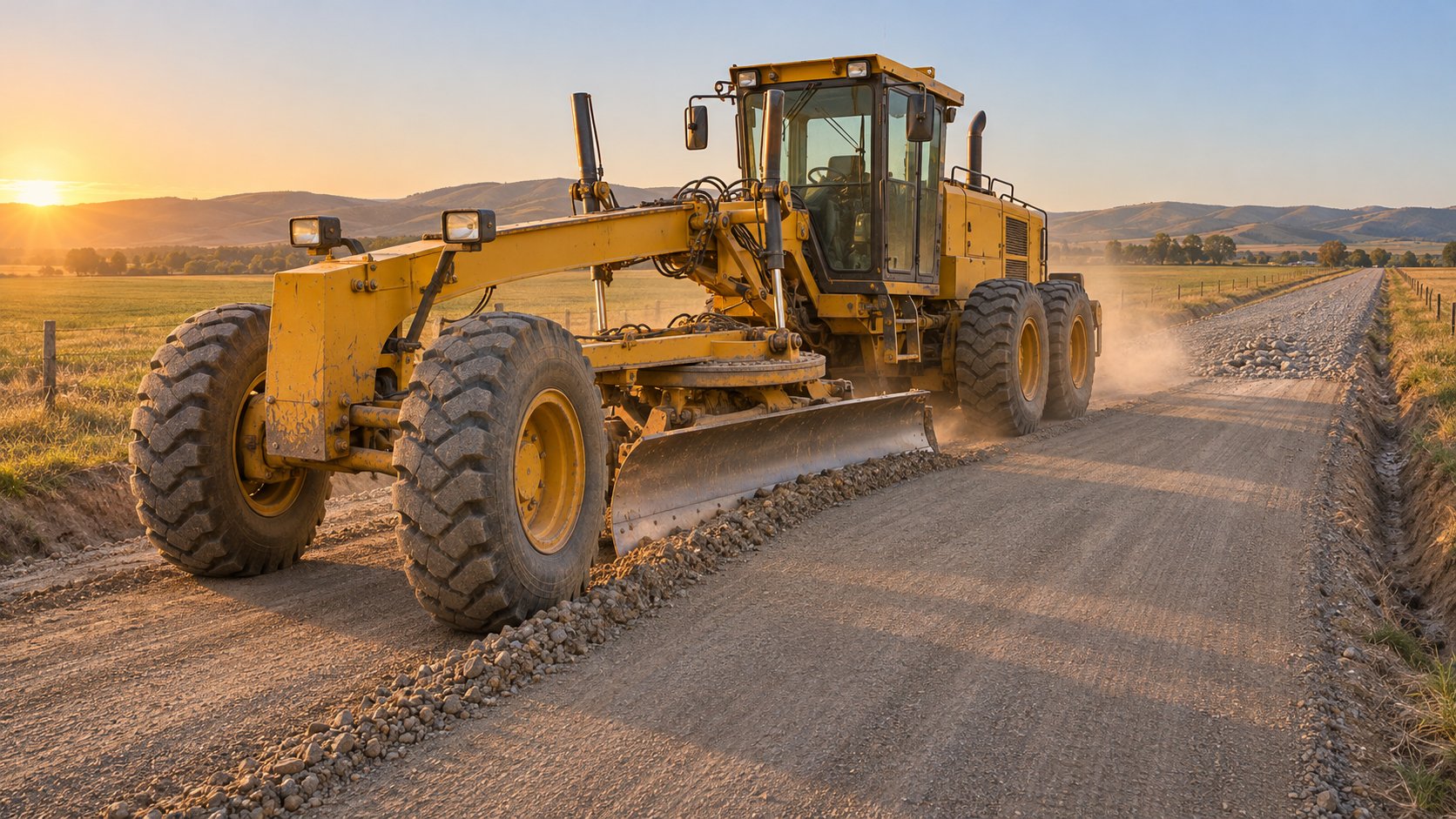
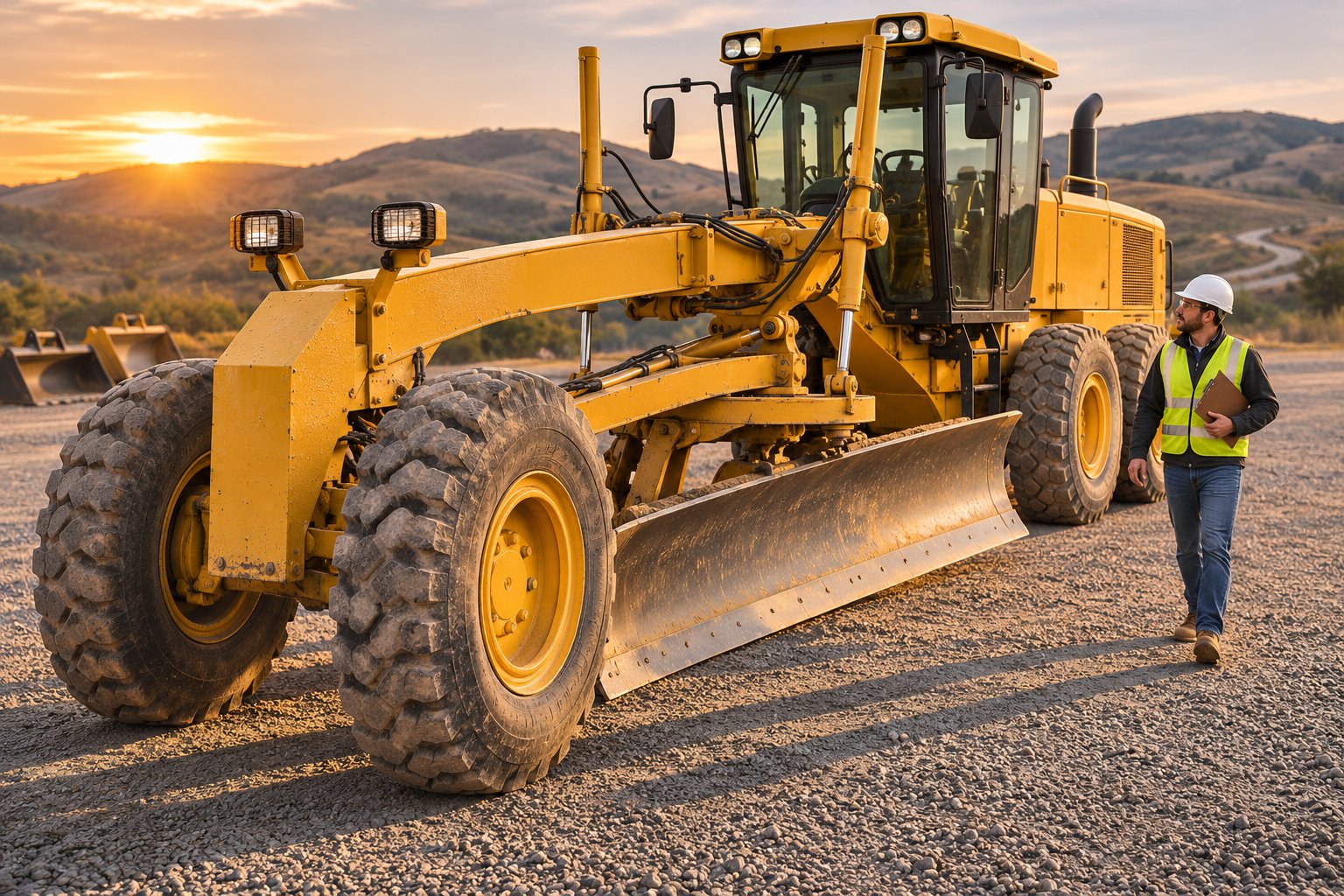
A motor grader is a self-propelled heavy machine with a long, adjustable blade called a moldboard mounted between its front and rear axles, used for fine grading, road building, ditching and road maintenance.
What a Motor Grader Does on a Job Site
The operator controls the moldboard hydraulically from the cab. It can be angled, tilted and shifted side to side, which gives precise control over how material is cut and spread. Most graders run on three axles, with tandem rear axles driving the machine. On a typical grader machine, blade widths range from about 8 to 24 feet, notes Skidsteers.com. You'll see graders handle jobs like these:
- Finish grading subgrade and base layers before paving
- Road building, including shaping the crown for drainage
- Cutting V-shaped drainage ditches along roadsides
- Maintaining gravel and dirt roads by filling ruts and redistributing material
- Snow removal with front blades or wings
Why the John Deere Motor Grader Holds Its Place in the Used Market
Buyers tend to look at Deere for practical reasons. A broad dealer network makes parts, service and machine records easier to track down. The lineup is also deep. John Deere's motor grader lineup runs from the 620 and 622 through the 670, 672, 770 and 772, up to the 870, offered in G-Tier and P-Tier versions. That range means earlier G-Series and older-generation units regularly turn up in resale listings, giving you plenty of options at different budgets.
What This Guide Covers Before You Browse Listings
Inventory sites assume you already know what a 672G is, whether the hours make sense and which wear points hide expensive repairs. This guide fills that gap. Think of it as the homework you do before the listing pages. Imagine finding two graders that look nearly identical in photos, yet one is priced several times higher than the other. That difference often starts with the model name itself, and learning to read it is where a smart purchase begins.
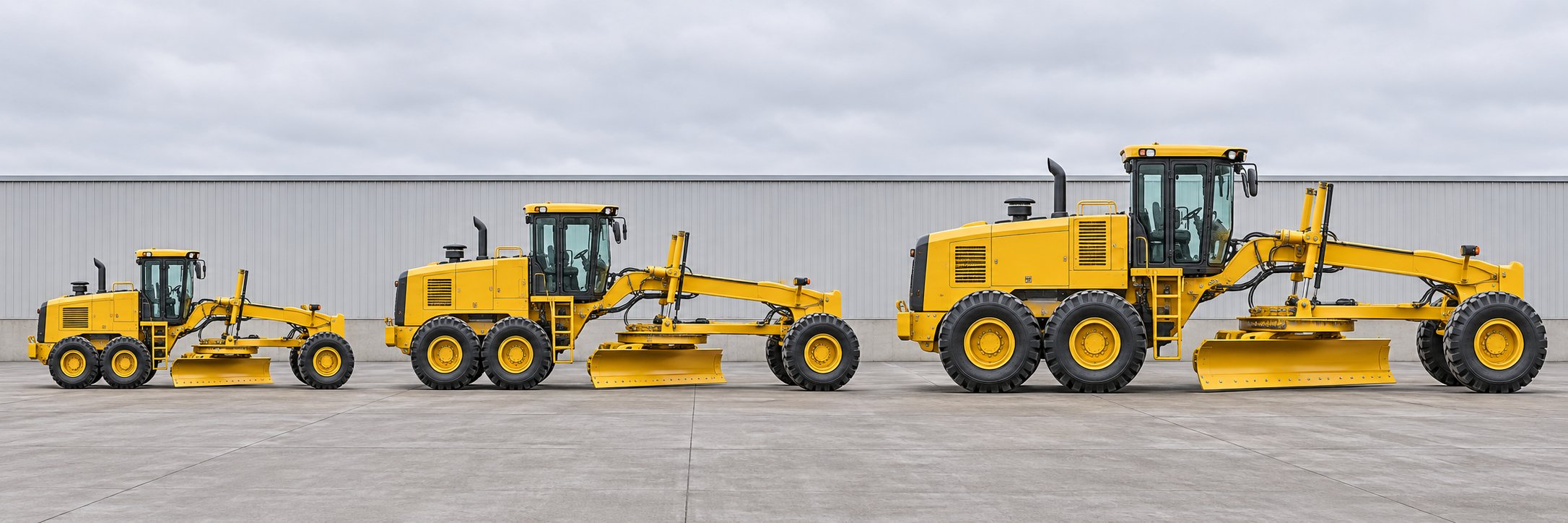
Decoding the John Deere Grader Lineup and Model Names
Scroll through MachineryTrader, IronPlanet or Fastline and you'll see names like 670G, 772GP and 770D stacked side by side. Sounds like alphabet soup? Each digit and letter tells you something about the machine's size, drive system and generation. Once you can read them, you can sort listings in seconds.
Reading Model Numbers Like John Deere 620, 670 and 770
The first digit marks the size class. The 6-series machines are the smallest Deere graders, the 7-series step up, and the 8-series sit at the top. Within a class, the middle digit separates lighter and heavier versions. For example, Deere added the 620G and 622G as lighter, more fuel-efficient options below the John Deere 670 and 672, rated at 215 and 225 net hp from a 6.8L engine, as Heavy Equipment Guide reported. Across the eight G-Series models, net power runs from 215 to 300 hp.
What the Deere 672G Naming Tells You About Drive Configuration
Watch the last digit. A model ending in 0 drives through its rear tandems. A model ending in 2, such as the 622, 672, 772 or 872, adds six-wheel drive, sending power to the front wheels too. Deere's 672 G-Tier page describes a hydrostatic front-wheel drive with a precision mode that propels the machine on the front wheels only. You'll notice the payoff in blade pull. The Deere 672G lists 49,500 lb, while the John Deere 770 lists 34,173 lb, even though both are rated at 255 net hp.
Letter suffixes matter just as much:
- G marks the G-Series generation, which Deere now sells as G-Tier.
- D and earlier letters point to older generations, such as a 770D.
- GP stands for Grade Pro, which adds control options like fingertip controls or dual joysticks.
Naming conventions can shift between generations and regions, so confirm any model you're considering on John Deere's official product pages or with a dealer.
Spec Attributes to Pull From Official Sheets
Many listings skip key specs entirely. Use this table as your template. The filled rows come from official John Deere pages for current G-Tier machines. For any other unit, collect each figure from the spec sheet for that exact generation.
| Model | Operating Weight | Net Horsepower | Moldboard Width | Blade Pull | Engine Model | Top Speed |
|---|---|---|---|---|---|---|
| 770 G-Tier | 43,294 lb | 255 hp | Check spec sheet | 34,173 lb | John Deere PowerTech PSS 9.0L | 28.3 mph |
| 672 G-Tier | 44,613 lb | 255 hp | Check spec sheet | 49,500 lb | John Deere PowerTech PSS 9.0L | 28.3 mph |
| 620G | 40,350 lb | 215 hp | Check spec sheet | Check spec sheet | John Deere 6.8L | Check spec sheet |
| Unit you're evaluating | Collect | Collect | Collect | Collect | Collect | Collect |
Searching for john deere 770 specs? The figures above come from the 770 G-Tier spec page and apply to that current machine only. Top speed reflects eighth gear on 14.0-R24 tires. An older 770D or early 770G may differ, so pull the sheet that matches the generation of the unit in front of you. That generational gap matters for more than paperwork, because it often explains why two 770s listed on the same site can be priced worlds apart.
Legacy Versus Current Generation John Deere Graders for Budget Buyers
Working with a tight budget? An older grader can look like a steal. Sometimes it is. Sometimes it's a money pit with fresh paint. The difference usually comes down to what changed between generations and how those changes affect your daily work.
Older Deere 770 Units Versus the G-Series
Here's a real-world spread. On Lumbermenonline, an older 770D was listed at $69,900, while a current-generation 672G was listed at $405,000. That gap sits inside a much wider market, where graders range from around $8,000 for an older used unit to $450,000 or more for a new model, notes MachineryTrader. Age alone doesn't explain the price. Before you weigh an older Deere 770 against a G-Series machine, investigate these areas:
- Cab and operator controls: Layout, visibility and control style can differ a lot between generations.
- Engine and emissions: Most current grader engines meet EPA Tier 4 Final standards and use exhaust aftertreatment. Older engines may be built to earlier tiers, which matters if your contracts or region require Tier 4 Final equipment.
- Electronics and diagnostics: Newer platforms can support telematics and grade-control technology such as John Deere SmartGrade. Older machines may need different diagnostic tools.
- Parts availability: Some components for older generations may be slower or harder to source.
Don't rely on listing descriptions for these details. Give the serial number to a John Deere dealer and ask them to confirm exactly what that generation includes.
When a Legacy John Deere 570 Grader Still Makes Sense
Imagine you maintain a few miles of private gravel road and run the machine a handful of weekends each year. A legacy John Deere 570 grader or older 770 could cover that work without tying up serious capital. For a contractor grading to tight tolerances every day, the math often looks very different.
Pros of Buying a Legacy Unit
- Much lower upfront cost
- Less money tied up in a machine you use occasionally
- Plenty of older units appear in resale listings
Cons of Buying a Legacy Unit
- No factory warranty and higher repair risk if records are thin
- Possible emissions limits on regulated job sites
- Fewer modern technology and diagnostic options
Pros and Cons of a Current-Generation Unit
- Pro: Latest technology, your choice of options and a full factory warranty when bought new
- Con: A significant price premium that may not pay off for light or seasonal work
Parts and Service Questions for Older John Deere Graders
Ask your local dealer these questions before committing to an older unit:
- Can you still source major components for this generation?
- Do you have service records tied to this serial number?
- Can your diagnostic tools read this machine's systems?
- Are rebuilt or aftermarket parts commonly used for this model?
Still, a well-priced generation is only half the decision. A bargain grader that's too light for your workload, or far bigger than your jobs require, costs you money either way.
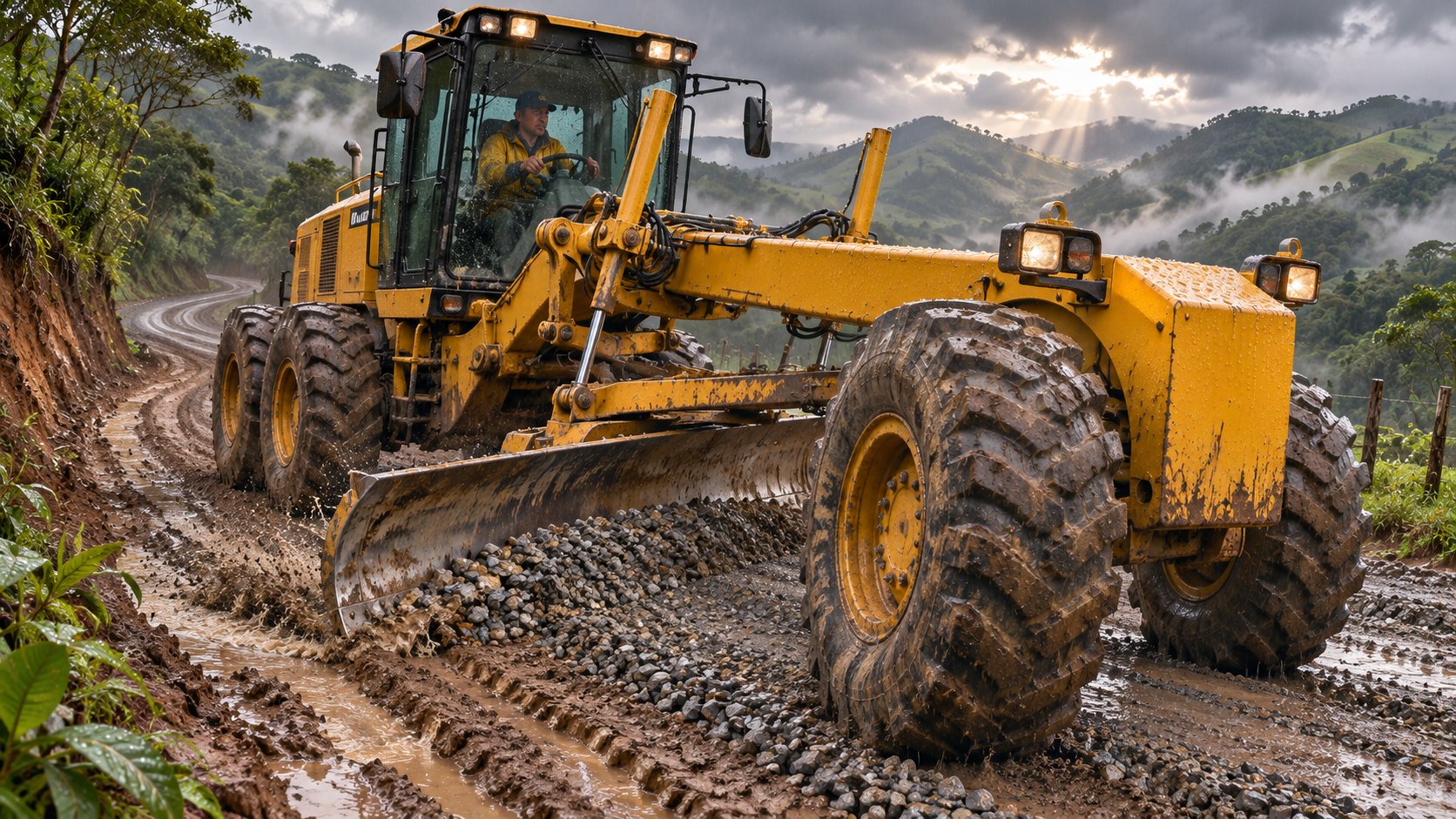
Which Construction Grader Class Fits Your Job Size
Buy too much grader and you pay for fuel, transport and capital you never use. Buy too little and every job takes extra passes on a machine that struggles. So where do you land? Start with the work, not the listing.
Matching Construction Grader Size to Your Workload
Answer these questions before you open a single inventory page:
- What's the main job? Light maintenance and finish grading, or road building and heavy material moving?
- What ground will you work on? Firm, dry base, or mud, loose gravel, snow, sand and steep grades?
- How tight is the site? Open roads, or cul-de-sacs, parking lots and confined pads?
- How will you move it? Larger machines can mean heavier trailers and oversize permits.
- What's your real budget? Count running and repair costs, not just the asking price.
Then use your answers with the table below. Treat it as a starting point, and confirm exact weight, power and moldboard figures on John Deere's official spec sheet for each model.
| Application | Suggested Class | Drive Option |
|---|---|---|
| Gravel road maintenance and finish grading on firm ground | 6-series (620, 670) | Rear tandem drive |
| Similar work on soft, slippery or hilly ground | 6-series (622, 672) | Six-wheel drive |
| General road building and site preparation | 7-series (770) | Rear tandem drive |
| Road building with heavy material, poor traction or winter snow work | 7-series (772) | Six-wheel drive |
| Large-scale grading with wide moldboards and heavy attachments | 8-series (870, 872) | Match to ground conditions |
When a Small Motor Grader Is Enough
Smaller road graders move easily in tight spaces but may need more passes, while larger machines push wider blades yet use more fuel and are harder to maneuver, explains United Rentals. That guide places small graders at 80 to 150 horsepower and medium units at 150 to 300. Here's the catch. Deere's G-Series runs from 215 to 300 net hp, so even a 620 counts as mid-size by that yardstick. If your work is closer to landscaping or small-lot leveling, a true small motor grader sits below Deere's current lineup, and a 6-series may be more machine than you need.
Is Six-Wheel Drive Worth the Premium
Picture a county crew grading spring mud and plowing winter snow on hilly roads. Front-wheel drive keeps that machine moving and steering when rear tandems alone would spin. United Rentals recommends all-wheel drive for mud, gravel, snow or sand for exactly that reason. You'll also recall the blade pull gap from the spec table, where the 672 G-Tier out-pulls the 770 G-Tier despite equal horsepower.
Now picture a contractor finishing compacted base on dry, flat sites. That traction rarely pays off. Six-wheel drive adds front drive components, which means more parts to inspect, maintain and eventually repair. That extra hardware shows up in asking prices too, and it's one reason two graders from the same class can carry very different numbers.
Price Context and What Drives Grader Cost
Ever searched motor graders for sale and found one priced like a used pickup and another priced like a small house? You're not misreading the screen. Price is the widest-ranging number on almost any grader listing, and knowing why helps you avoid overpaying or chasing a bargain that isn't one.
What Motor Graders for Sale Are Listing At
The figures below are asking prices observed on public listing sites. Treat them as illustrative examples, not valuations. Listings change frequently, so expect different numbers by the time you search.
| Source | Model or Generation | Listed Price |
|---|---|---|
| Equipment Trader | All grader listings (average) | $95,500 |
| Equipment Trader | All grader listings (range) | $11,861 to $492,500 |
| Fastline | Newer 672G | $295,000 |
| Fastline | 672G, two model years older | $199,000 |
| Lumbermenonline | Older 770D | $69,900 |
| Lumbermenonline | Current-generation 672G | $405,000 |
Look at the two Fastline entries. Same model name, roughly $96,000 apart, with only two model years between them. Age clearly isn't the whole story.
Why Grader Cost Varies So Widely
Two machines with the same make, model and year can sell for significantly different prices depending on condition, hours, maintenance history, attachments and market demand, notes TAC Auction Services. For motor graders, these factors drive most of the spread:
- Generation: A 770D and a current G-Tier machine differ in cab, emissions and electronics.
- Size class: 8-series machines generally sit above 6-series units.
- Drive configuration: Six-wheel drive models carry extra front drive hardware.
- Hours and condition: Wear on major components can outweigh a low meter reading.
- Documented service history: Records reduce uncertainty, and buyers pay for that.
- Attachments: Rippers, scarifiers, snow wings and grade-control gear add value only if you need them.
- Location: Regional demand and transport distance shift what sellers ask.
- Seller type: Dealer asking prices may reflect reconditioning, warranties or financing that a private sale won't include.
Using Price Spreads to Set a Realistic Budget
An asking price is not a selling price. Completed sales and auction results usually tell you more about what buyers actually paid. Try this approach:
- Compare only machines in the same class, drive configuration and generation.
- Check completed sales alongside current asks.
- Budget for delivered-ready cost, which My Equipment defines as purchase price plus repairs, attachments, technology work, transport, taxes, fees and initial servicing.
- Hold back a reserve for problems an inspection may uncover.
The cheapest listing is only a bargain if its condition and history justify the number.
Of course, you can only judge that if the listing tells you enough. Many don't, and the details sellers leave out often explain a price better than the ones they include.
How to Read a John Deere Grader Listing Before You Call the Seller
You find a listing that looks right. The photos are sharp, the price seems fair and the model fits your work. But how much does it actually tell you? Often less than you think. A listing is a sales pitch, not a condition report.
What a John Deere Grader for Sale Listing Often Leaves Out
Before you get attached to a machine, check whether the listing covers these basics:
- Service records: Fluid changes and major repairs, ideally logged with dates and hours.
- Hours verification: Whether the meter is original and how the seller confirmed the reading.
- Serial number: The full PIN, not just model and year.
- Wear photos: Close-ups of cutting edges, the circle, tires and the articulation area, not just a glossy side shot.
- Attachment details: Ripper, scarifier, snow wing or grade-control hardware, and whether each is included.
- Ownership history: How many owners and what kind of work the machine did.
Work history matters more than you might expect. A machine used for light grading has a very different wear profile than one that spent years on a demolition site, notes Ditch Witch ACE. A missing detail isn't proof of a problem, but it is a question that needs an answer.
How to Use the Serial Number to Verify a Deere Motor Grader
MachineryTrader displays serial numbers on many listings but doesn't explain what to do with them. Here's why they matter. A John Deere operator's manual breaks the 17-digit PIN into parts that include a world manufacturer code, the machine model, a check letter, a year-of-manufacture code and a sequential manufacturing number. In practice, that number lets you:
- Confirm the exact model and generation with a John Deere dealer
- Ask whether dealer service records exist for that unit
- Match the frame plate to the listing, so the machine you inspect is the one being sold
- Run a lien search tied to that specific unit
Treat dealer records and John Deere's official spec pages as your reference points. Listing data is typed in by a seller, and typos or guesses are common.
Questions to Ask Every Seller
What should you ask before buying any used grader for sale? Start here:
- Can you share maintenance and repair records?
- Where does the hour reading come from, and has the meter ever been replaced?
- What repairs were made in the past year, and are there known issues or error codes now?
- When were cutting edges, tires and other wear parts last replaced?
- Are there any liens, and can you provide the bill of sale and payoff letters?
- Can I or a third-party inspector see the machine start and run?
Don't skip the lien question. A blanket lien from a seller's unrelated business loan can cover equipment they own outright, and the lender may repossess it after you buy, warns ForConstructionPros. A UCC search lowers that risk but can't guarantee a clean title, especially with private sellers.
Solid answers narrow your shortlist fast. Still, paperwork only describes the past. The steel, pins and seals on the machine itself are what reveal how expensive its next thousand hours could be.
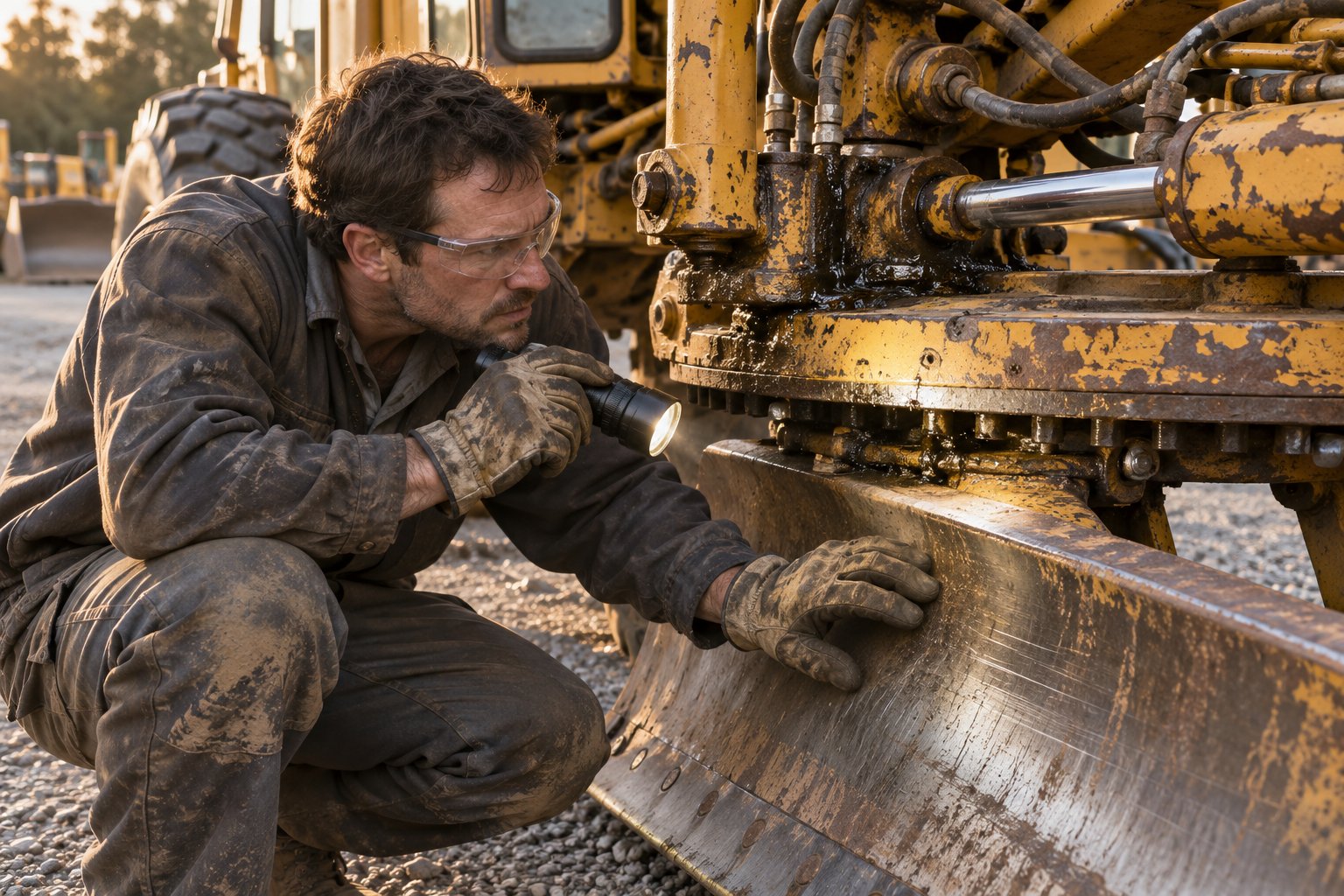
Inspecting a Used Motor Grader Component by Component
Imagine two graders with identical hour meters. One spent its life maintaining county gravel roads on a strict service schedule. The other cut ditches in rocky ground with spotty records. On paper they match. Under the paint, they are very different machines.
How Many Hours Is Too Many on Used Motor Graders
There is no universal cutoff. Hours tell you how long the engine ran, not how hard the machine worked or how well it was cared for. A higher-hour unit with documented fluid changes and recent wear-part replacement can be a safer bet than a low-hour grader with no records at all. When you compare used motor graders, weigh the meter against three things:
- Maintenance history: Regular service logged with dates and hours.
- Application: Light road maintenance wears a machine differently than heavy ripping or ditching.
- Component condition: What the steel, seals and fluids actually show today.
That last point is where an inspection earns its cost.
Inspecting the Circle, Moldboard and Articulation Joint
A grader's value lies in precision. A bent moldboard or drifting circle can leave a surface that looks fine from the cab but fails the next grade survey, as HVI's motor grader inspection checklist points out. Start with these precision systems on any used motor grader:
- Circle and drawbar: Rotate the circle both directions and listen for rough spots. Check gear teeth for wear. With the blade lowered and the engine at idle, watch for drift. Then lift the blade slightly and look for play at the drawbar ball socket.
- Moldboard and cutting edges: Run a straightedge across the full moldboard to find bends from rock or curb strikes. Check edge thickness, bolts and end bits. Worn-through end bits let the moldboard corners hit the ground, and a moldboard costs roughly ten times as much to replace as end bits. Neglected cutting edges can account for about 25% of a grader's lifetime cost.
- Articulation joint: Look for cracks, worn pins, excess play and hydraulic hoses rubbing where they route through the joint.
Drivetrain, Hydraulics and Cab Checks on Used Road Graders
Next, walk the systems that keep used road graders moving and their operators safe.
| Component | What to Look For | Why It Matters |
|---|---|---|
| Tandem drive housings and chains | Oil leaks at the housings, unusual noise, low or dirty oil | Internal chain and bearing repairs are labor-intensive |
| Transmission | Smooth shifts through all gears, forward and reverse, with no slipping or delayed engagement | Shifting problems often signal expensive internal wear |
| Hydraulic cylinders | Scored rods, seal weeps, uneven left and right lift speeds | Leaks and uneven response cause blade drift and unintended tilt |
| Tires | Cuts, uneven wear, matched sizes and even pressure across all six | Uneven pressure tilts the machine and affects grade on long passes |
| Cab and ROPS | Cracks, welds or modifications to the ROPS, working seat belt, horn, backup alarm and gauges | A damaged ROPS compromises operator protection in a rollover |
| Electronics | Active and stored diagnostic codes, warning lights, display function | Codes reveal problems a short test drive can hide |
Don't judge fluids by looks. The human eye only detects particles of about 40 microns or larger, while clearances in hydraulic pumps and valves can be as small as 0.5 to 5 microns, explains Equipment World. A lab can measure particle counts, viscosity and oxidation that a quick glance would miss.
For any serious purchase, hire a third-party inspector or John Deere dealer technician and pull fluid samples before you sign.
Of course, how much access you get depends on where the machine is sold. A dealer lot will usually welcome your mechanic and sample bottles, while an online auction may offer little more than photos and a short preview window.
Buying Channels, Ownership Costs and Motor Grader Rental Versus Buying
Where you buy shapes what you can verify. The same John Deere road grader can be a careful purchase on a dealer lot and a gamble at an auction you can't attend in person. So which channel fits your budget and your tolerance for surprises?
Dealer, Auction and Classified Channels Compared
IronPlanet lets shoppers filter used graders for sale by format, including online auction, on-site auction, Buy Now and Make Offer. Each format trades price against certainty in a different way.
| Channel | Inspection Access | Warranty Potential | Price Negotiation | Risk |
|---|---|---|---|---|
| Dealer retail | Full access, test runs common | Possible, plus parts and service support | Some room, but premium pricing is standard | Lowest |
| Classifieds | Depends on the seller | Rare from private sellers | Most room to negotiate | Moderate to high; verify liens and records yourself |
| Online auction | Photos, reports and a limited preview | Rare | None; bidding sets the price | Higher; sales are typically final |
| On-site auction | Walk-around during preview, rarely a load test | Rare | None; bidding sets the price | Higher; sales are typically final |
| Buy Now | Whatever the listing and platform provide | Rare | None; fixed price | Moderate; speed can rush your due diligence |
| Make Offer | Whatever the listing and platform provide | Rare | Yes, through the offer process | Moderate |
At many auctions you can't test a grader under load before bidding, and all sales are final, warns JumboBee. Some platforms narrow that gap. IronPlanet has financially backed its inspection reports through its IronClad Assurance program, so buyers can file a claim if a report misrepresents the machine, as FleetOwner reported. Confirm the current terms before you bid, and remember that protection hinges on what the report actually says.
Total Cost of Owning a John Deere Road Grader
The asking price is just the entry fee. Budget for these categories too:
- Transport and permits: North American highway rules generally cap load width at 8 feet 6 inches before permits apply, and wide graders can require pilot cars, restricted travel hours and route planning.
- Pre-purchase inspection: Third-party or dealer inspection fees plus fluid analysis.
- Wear parts: Cutting edges, end bits and tires. A set of six premium radial grader tires can cost $15,000 to $25,000 or more.
- Financing: Lenders often require professional appraisals and inspections before funding used equipment bought across borders.
- Maintenance and insurance: One rent-versus-buy guide suggests planning 5 to 10% of the purchase price each year for maintenance and 1 to 3% of value for insurance.
- Parts availability: Older generations may mean longer waits and more downtime.
New versus used comes down to depreciation and protection. Heavy machinery typically loses 20 to 30% of its value in the first year, the same guide notes. A new grader brings a factory warranty, while a used one lets someone else absorb that early drop.
Motor Grader Rental Versus Buying
Will the machine work enough days to justify owning it? That same guide names motor graders among specialized machines that rarely pay off for occasional use. Fewer than 150 to 180 working days a year generally favors rental, while more than 200 favors ownership. Picture a contractor who needs a grader for one subdivision or a single snow season. Motor grader rental avoids storage, insurance and depreciation, and rental rates typically include maintenance.
Sometimes the math clearly says buy, yet the right Deere unit simply isn't listed in your size class, price range or delivery window. That gap is where many buyers start widening the search beyond a single brand.
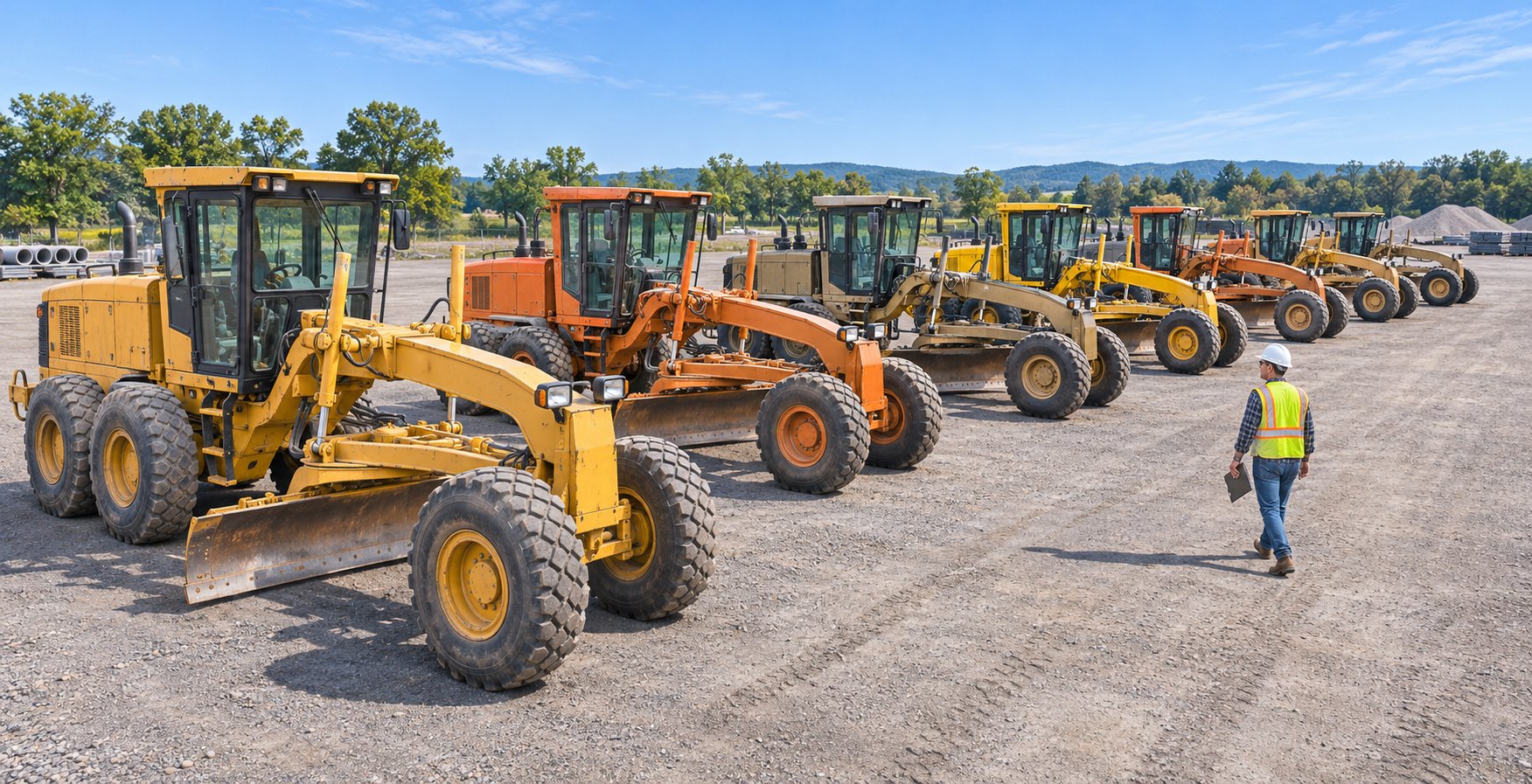
Alternative Road Graders for Sale and Availability Inquiries
What if the right Deere just isn't out there right now? Maybe the 672 you want is above budget, or the only clean 770 is three states away with a two-month wait. You can keep waiting, or you can widen the search. Widening only works if your standards stay exactly the same.
Comparing Alternative Road Graders for Sale
Several manufacturers build graders for the same road-building and maintenance work. JIUHONG's used motor grader collection, for example, features SDLG G9220, SANY and LiuGong 4180D listings, and buyers can request machine-specific specs, condition information and current quotes. These are not John Deere machines, so compare them on numbers, not names. The LiuGong 4180D is rated at 190 hp with a 3,960 mm blade, 86 kN of drawbar pull and a 15,500 kg operating weight, according to Heavy Equipment Guide. Its Tier 2 / Stage II emissions rating matters if your contracts require Tier 4 Final equipment.
| Sourcing Route | Brands Offered | How to Verify Specs | Best Use Case |
|---|---|---|---|
| JIUHONG used motor grader collection | SDLG, SANY and LiuGong listings; John Deere and mini-grader availability must be confirmed by inquiry | Request the machine-specific spec sheet and condition information, then cross-check against the manufacturer's published specs | Comparing alternative used graders for road work, or submitting a model-specific availability inquiry |
| John Deere dealers | John Deere new and used units | Official spec pages and dealer service records tied to the serial number | Buyers who want Deere parts support, records and possible warranty |
| Online auctions | Mixed brands and generations | Inspection reports, photos and a serial number check before bidding | Experienced buyers comfortable with final sales |
| Classifieds | Mixed brands and generations | Seller records plus an independent inspection | Negotiated deals on nearby machines |
Searching for a Mini Grader or Small Road Graders for Sale
United Rentals places small graders at 80 to 150 horsepower, which sits below Deere's current G-Series. So if you need a mini grader for landscaping or tight lots, a Deere search may never turn one up. Filter small road graders for sale by horsepower and blade width instead of trusting the word "mini," since sellers use it loosely. Note that the 190 hp 4180D falls in the medium class by that same yardstick, so it is not a mini grader. JIUHONG's reviewed collection doesn't verify mini-grader stock either, so ask about a specific size before assuming a match.
How to Request Specs, Condition Reports and Quotes
Send every seller, any brand, the same request:
- Full serial number and the official spec sheet for that model
- Hour reading and how it was verified
- Service and repair records
- Recent close-up photos of the circle, moldboard, articulation joint and tires
- Emissions tier and local parts and service availability
- A written quote stating what's included, such as transport and paperwork
Then hold every answer to the inspection and verification steps covered earlier. A cheaper alternative brand with thin records is still a money pit. With dealers, auctions, classifieds and alternative collections all on the table, the real risk becomes losing track of which checks you've actually completed.
A Final Checklist Before You Buy John Deere Motor Graders for Sale
Feeling a little buried in model codes, price spreads and inspection notes? That's normal. The fix is simple. Turn everything into one list you can carry from the first listing to the final handshake.
Your John Deere Grader Buying Checklist
- Define the application. Finish grading, road building, ditching or snow work, and on what kind of ground.
- Pick a class and drive configuration. Match 6-, 7- or 8-series size to the workload, and add six-wheel drive only if traction demands it.
- Set a budget from observed price spreads. Compare like for like, and plan around delivered-ready cost rather than the asking price.
- Collect official John Deere specs. Pull the sheet for the exact generation, not the seller's summary.
- Verify the serial number and service records. Confirm model, generation, dealer records and lien status.
- Inspect or commission an inspection. Cover the circle, moldboard, articulation joint, drivetrain, hydraulics and fluid analysis.
- Compare buying channels. Weigh inspection access, warranty potential, negotiation room and risk.
- Calculate total ownership cost. Add transport, permits, wear parts, financing, maintenance and insurance, then test the total against renting.
Verifying Before You Commit to John Deere Motor Graders
Some findings should end a deal no matter how good everything else looks. My Equipment's buying scorecard flags unresolved ownership, serial number or lien concerns, major structural or safety defects and unpriced steering or drivetrain problems as reasons to pause or walk away. Strong marks elsewhere can't offset a critical failure. It also helps to tag each item on your list as verified, partial or seller-stated. A high rating built on a seller's word alone is still a risky buy.
Documented condition and verified history matter more than the asking price alone.
Next Steps for Comparing Used Motor Graders
Run every shortlisted unit through the same list, whether it comes from a dealer, an auction or a classified ad. When John Deere graders for sale don't fit your size, timing or budget, JIUHONG's used motor grader collection lets you compare alternative brands such as SDLG, SANY and LiuGong, or submit a model-specific inquiry about John Deere availability. Treat any reply as a lead to verify, not a confirmed match. Then let the evidence, not the price tag, choose your next grader.
John Deere Motor Grader Buying FAQs
1. What does the last digit in a John Deere grader model number mean?
The final digit tells you the drive setup. Models ending in 0, such as the 670 or 770, push the machine through the rear tandem wheels only. Models ending in 2, such as the 622, 672, 772 or 872, add hydrostatic front-wheel drive, giving you six driven wheels. That extra traction usually shows up as higher rated blade pull and better performance in mud, snow or on hills, but it also adds front drive components you will need to inspect and maintain. Letter suffixes add another layer: G points to the G-Series generation, D marks an older generation, and GP indicates Grade Pro control options. Always confirm the exact configuration with John Deere's official product pages or a dealer using the serial number.
2. How many hours is too many on a used John Deere motor grader?
No single hour reading makes a grader a good or bad buy. The meter only records engine run time, not how hard the machine worked or how well it was serviced. A unit with higher hours, consistent logged maintenance and recently replaced wear parts can carry less risk than a low-hour machine with no paperwork. Judge hours alongside the type of work the grader did, the service history and what an inspection reveals about the circle, moldboard, articulation joint, tandems, transmission and hydraulics. Fluid analysis from a lab adds an objective look at internal wear that a visual check cannot provide.
3. Why do used John Deere motor graders vary so much in price?
Asking prices for graders can range from the price of a used pickup to several hundred thousand dollars because many factors stack together. Generation is a big one, since a legacy 770D differs from a current G-Tier machine in cab, emissions equipment and electronics. Size class, six-wheel drive, hours, component condition, documented service history, attachments such as rippers or snow wings, location and seller type all shift the number. Dealer prices may include reconditioning or warranty coverage that private sales lack. To set a realistic budget, compare machines of the same class, drive type and generation, check completed sales rather than only current asks, and plan around delivered-ready cost plus a reserve for repairs.
4. Should I rent or buy a motor grader for my project?
It depends on how many days the machine will actually work each year. For a single subdivision, a short road job or one snow season, renting usually wins because you avoid depreciation, storage, insurance and most maintenance, which rental rates often cover. Ownership starts to make sense when a grader will run steadily through most of the working year and you can keep it busy. When you calculate the buy side, include transport and oversize permits, pre-purchase inspection, cutting edges and tires, financing, insurance, routine maintenance and parts availability, not just the purchase price.
5. What can I do if no suitable John Deere grader is available in my budget or size?
Widen the search while keeping the same verification standards. Other manufacturers build graders for road building and maintenance, so compare machines on horsepower, blade width, operating weight, drawbar pull, emissions tier and parts support rather than brand name. JIUHONG's used motor grader collection features SDLG G9220, SANY and LiuGong 4180D listings, and you can request machine-specific specs, condition information and current quotes. These are not John Deere machines, and John Deere or mini-grader availability there must be confirmed through a model-specific inquiry. Whatever brand you consider, ask for the serial number, service records, hour verification and recent wear photos, and arrange an independent inspection before you commit.