

What Counts as a Small Bulldozer
Search for "small dozer" and the results put a 9-ton Cat crawler right next to a backyard machine built for weekend projects. Both are sold as small. A few plain definitions will tell you which one fits your land.
What Is a Small Bulldozer
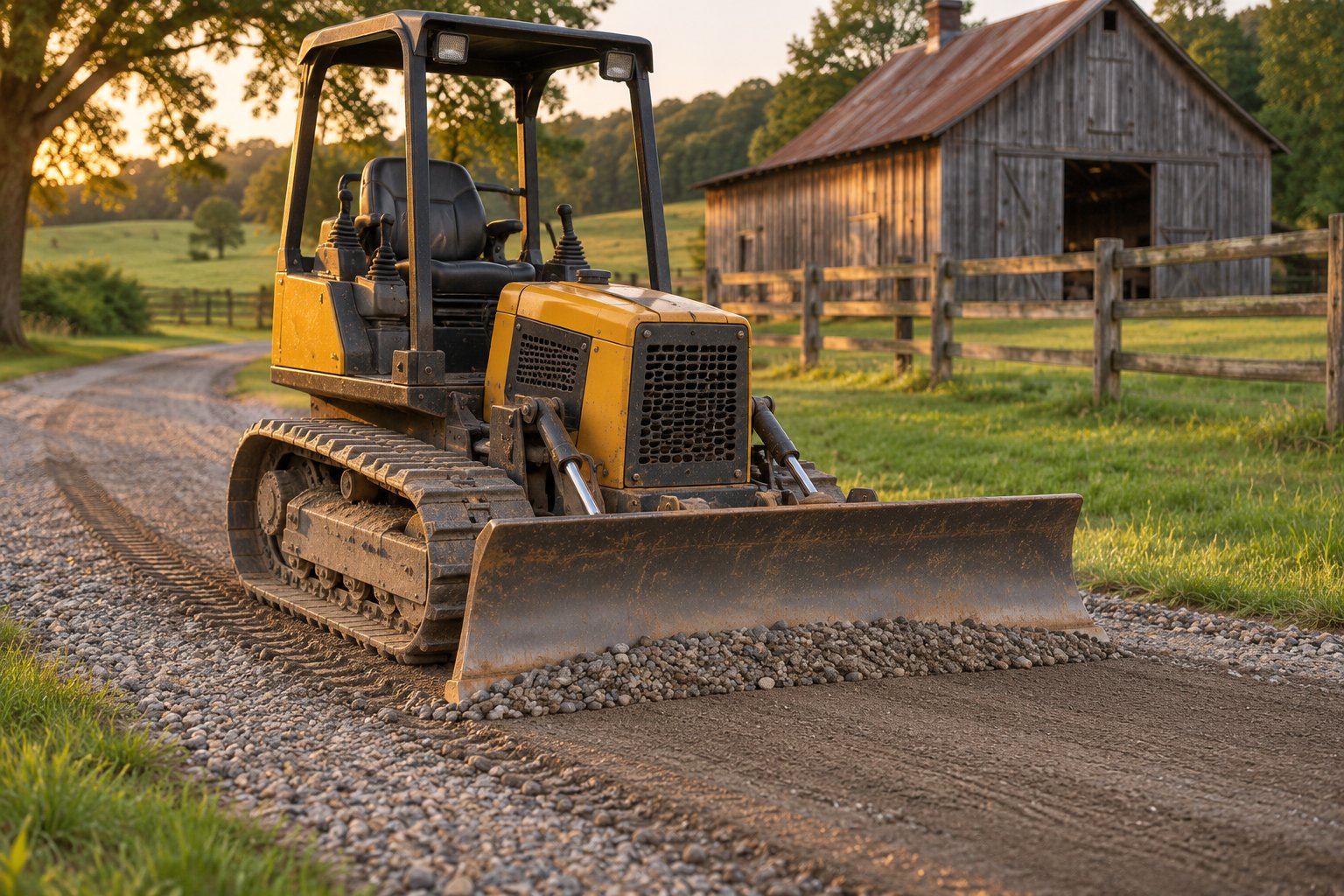
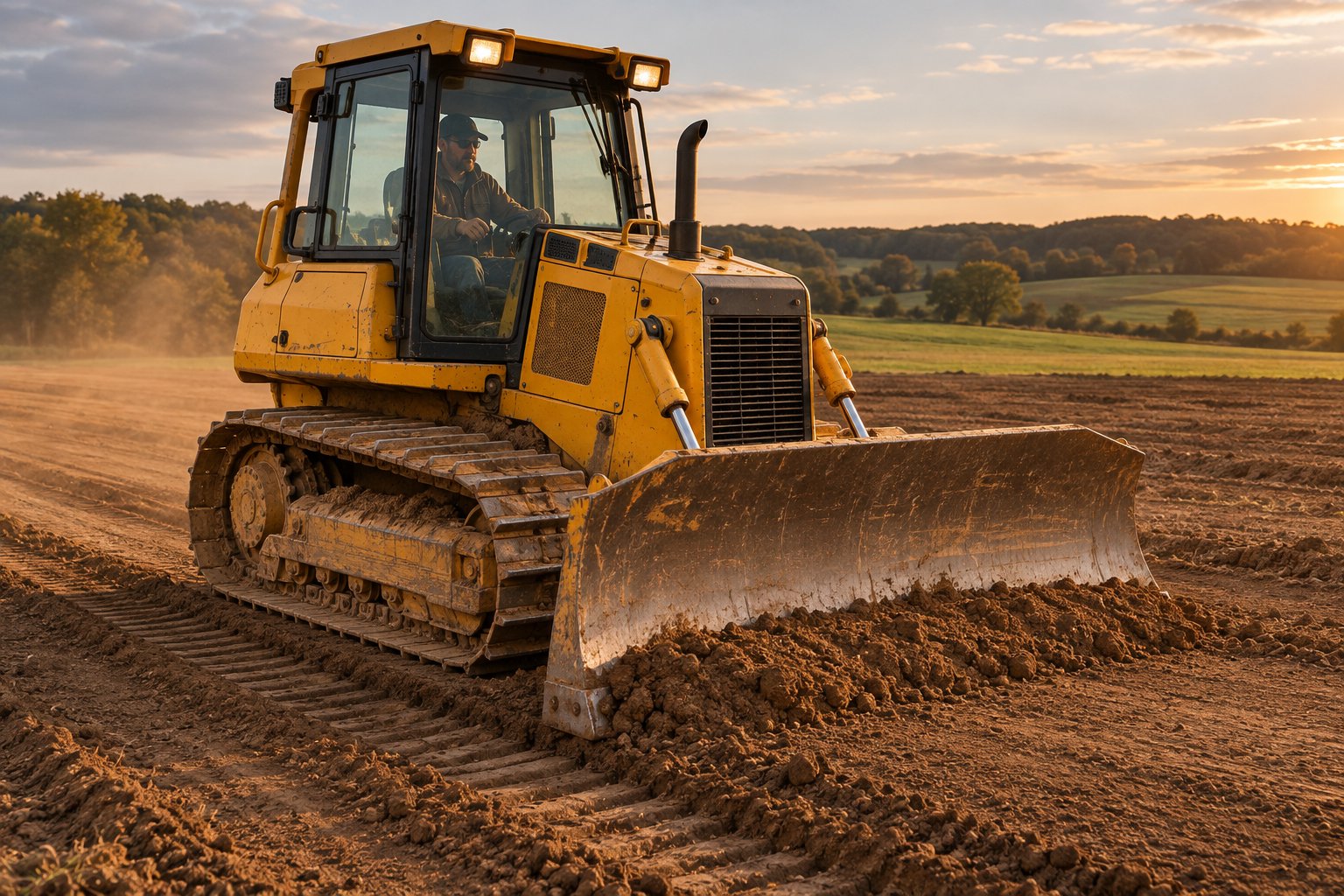
A small bulldozer is a tracked machine with a front blade used for pushing, spreading, and grading material, sized below the mid-range production dozers used on large earthmoving jobs.
Dozer Sizes and Bulldozer Size Classes Explained
Two specs decide a dozer's class: operating weight and engine horsepower. Weight affects pushing power, ground pressure, and the trailer you'll need. Horsepower sets how hard the machine can push through heavy material.
A common rule of thumb from DOZR's size chart calls anything under 30,000 pounds small, 30,000 to 100,000 pounds medium, and over 100,000 pounds large. Manufacturers draw their own lines. Caterpillar puts the D1 to D3 in its small group, the D4 to D7 in medium, and the D8 to D11 in large. Rank the Cat lineup from smallest to largest and the D1 comes first, with 80 hp and an operating weight of roughly 9 tons. The D3 is the biggest of the small group, with 104 hp and 10 to 10.5 tons.
Other brands follow a similar pattern. People who search for a "JD 650 tractor" usually mean the John Deere 650 crawler dozer. DOZR lists the 650 P-Tier at 22,484 pounds and 104 hp, well inside the small class. The John Deere 950K weighs 73,700 pounds, which puts it in medium territory.
The mini/micro class sits below all of these machines. No industry standard sets its limits, so check each maker's spec sheet. Model generations change, so confirm current numbers with a dealer.
| Size Class | Typical Users | Typical Jobs |
|---|---|---|
| Mini/micro | Homeowners, hobbyists, landowners with occasional projects | Food plots, trails, gravel spreading, light yard grading |
| Small | Landscapers, residential builders, small contractors | Light construction, landscaping, residential site work |
| Medium | Commercial and road contractors | Site development, roadwork, commercial land clearing |
| Large | Mining and heavy civil operations | Mining and large-scale bulk earthmoving |
Why Small Dozer Definitions Vary by Brand
Cat sells its D1, D2, and D3 under a "small dozer" category. These are production machines built for contractors. Struck and online marketplaces use the label "mini dozer" for much smaller ride-on machines aimed at homeowners and hobbyists. The two labels sound alike, but the machines behind them differ a lot in weight, power, and intended workload. Even dealers mix the terms. One Cat dealer's guide describes mini dozers as compact machines for residential work and links that description to its small-dozer lineup.
When a listing says "small" or "mini," find the operating weight and horsepower before you read anything else. A wide range of machines sits between a homeowner's ride-on unit and a 9-ton D1, and most buyers belong somewhere in that range.
The Small Dozer Spectrum From Kits to Pro Machines
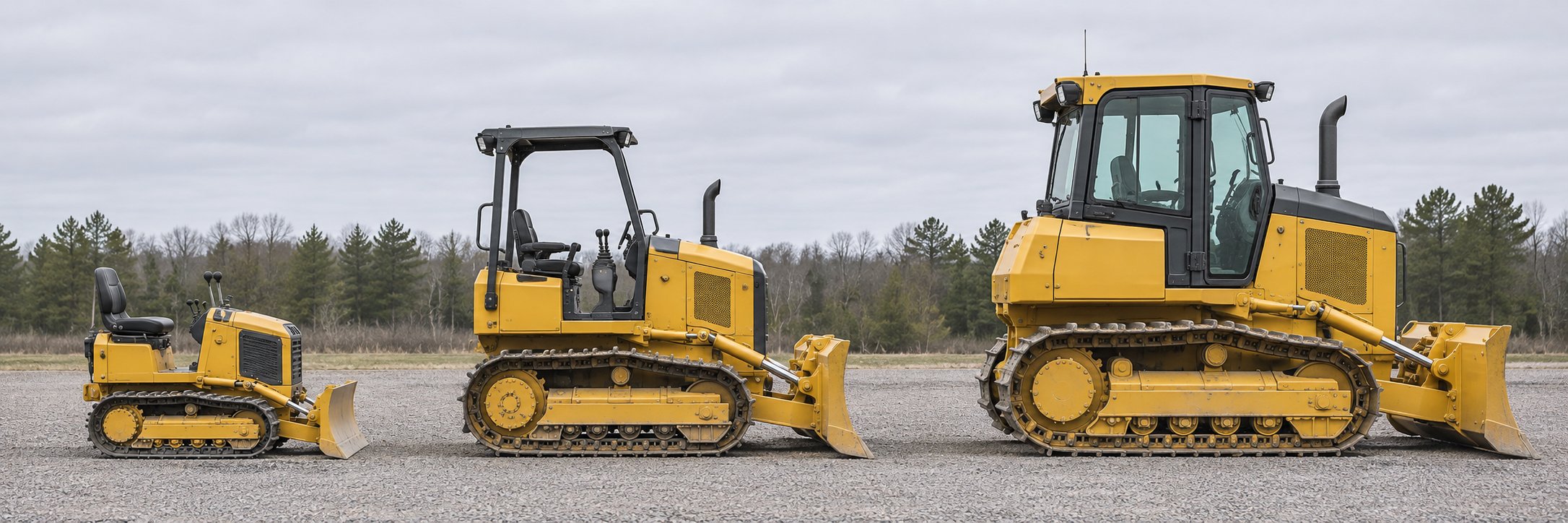
Where do you fit between a weekend kit and a 9-ton crawler? Most buyers land in one of five tiers. Each tier up brings more weight, a heavier workload, and more dealer support.
From Mini Dozer Kits to Ride-On Mini Bulldozers
- DIY mini dozer kits and hobbyist builds. These buyers are tinkerers and collectors who enjoy the build as much as the dirt work. Expect light yard jobs. Help usually comes from owner groups, not a service shop.
- Homeowner ride-on mini dozers. The Struck S-Series is a good example. Equipment World reports it uses a 6.5 or 10 hp Vanguard gas engine with a centrifugal clutch. Struck says the machine is meant for pulling smaller logs, making a garden, grading a driveway, and plowing snow. Struck sells direct from its factory, mostly through its website, so you won't find a local dealer.
- Budget imported mini dozers sold online. These appeal to buyers on a tight budget who have occasional jobs. Dealer support is often thin or missing, so questions about parts and warranty matter more in this tier than in any other.
- Compact crawler dozers. These are assembled machines such as Struck's Magnatrac B-Series, which weighs about 1,500 pounds, and the larger D-Series, rated at 3,000 to 4,000 pounds. The B-Series uses hydrostatic drive and can run hydraulic attachments like a six-way blade or backhoe. Buyers tend to be acreage owners and small landscapers who need more pushing force than a ride-on mini can give.
- Professional small dozers. The Cat D1, D2, and D3 and the John Deere 450 to John Deere 650 range are production machines built for contractors. Authorized dealers sell and service them, stock parts, and send technicians to the job site. A legacy JD 450 bulldozer is also a common used-market choice for this group.
The Struck Mini Dozer and the Hobbyist Revival
The kit tier goes back decades. Charlie Struck founded his company in 1959, and its mail-order mini dozer kits became known through ads in Popular Mechanics. The company nearly closed after 66 years. New owner Greg Linsmeyer kept it open and redesigned the lineup for 2025, and the S-Series replaced the original MD196K kit. Owners still trade repair advice and parts leads in Facebook groups. In this tier, much of the support comes from other owners.
Where Compact Dozers and Professional Small Dozers Fit
The jump from tier 4 to tier 5 is bigger than it looks. Linsmeyer told Equipment World that the smallest dozers on the market weigh about 12,000 pounds and that the major manufacturers left the compact dozer market years ago. That leaves few choices between hobby machines and contractor equipment.
Model numbers can also mislead you. Deere's crawler numbers keep climbing past the small class. A Deere 750 or John Deere 850 is a mid-size machine. A used listing with one of those numbers is a different class of dozer, not a slightly bigger small one.
Spec sheets in every tier use terms like hydrostatic drive, centrifugal clutch, and drawbar pull. Those terms tell you more about what a machine can do than the word "small" does.
A mini dozer and a small production dozer are not interchangeable, even though both are marketed as small, so match the tier to your workload and the support you need.
Small Dozer Terms Explained in Plain English
Have you ever read a dozer listing and gotten stuck on "6-way VPAT, LGP, hydro"? Spec sheets pack a lot into a few letters. You'll see the same terms on a Deere 450 dozer, a JD 650, or a ride-on mini. Each one tells you how the machine will behave on your ground.
Blade and Track Terms on a Crawler Dozer
| Term | Plain-English Meaning | Why It Matters for Small Dozer Buyers |
|---|---|---|
| VPAT blade | A blade the operator adjusts from the seat in three ways. Pitch tips the blade forward or back, angle swings it left or right, and tilt raises one end. It is often called a 6-way blade. | It gives finer control for grading, ditching, and spreading. UK hire firm M O'Brien says its 6-way-blade Cat D2 is its most popular machine for fine grade control. |
| LGP tracks | Low ground pressure tracks. Wider track shoes, a wider stance, and a longer track frame spread the machine's weight. | The machine sinks and ruts less in mud, sand, and soft fields. The trade-offs are faster undercarriage wear on hard ground and a wider machine to haul. LGP machines also need wider blades so the tracks don't drive over the material the blade pushes aside. |
| XL tracks | Extra-long tracks. The track frame is longer than standard, so more track touches the ground, usually without LGP's extra width. | XL is a middle option. It gives more stability for grading than standard tracks without LGP's full width. |
| Ripper | One or more rear-mounted shanks that tear up hardpan, rock, or roots before the blade pushes. | A ripper helps on compacted or rocky ground. Ask the dealer whether the model you're considering can take one. |
An LGP tag on a used John Deere 750 or John Deere 850 dozer listing means the machine was set up for soft ground. Ask where it worked. Years on hard, rocky ground wear out the pins, bushings, rollers, and idlers faster.
Drivetrain Terms Hydrostatic Drive and Centrifugal Clutch
| Term | Plain-English Meaning | Why It Matters for Small Dozer Buyers |
|---|---|---|
| Hydrostatic drive | The engine runs hydraulic pumps, and the pumps power motors that turn the tracks. There are no gear shifts and no clutch pedal. | Speed and direction change smoothly, which helps in tight spaces and during finish grading. Makana notes that hydrostatic drive is more common on compact dozers, while most large dozers use mechanical powershift transmissions. |
| Centrifugal clutch | A clutch that engages on its own as engine speed rises and releases at idle. | It is common on simpler mini machines such as the Struck S-Series. It is easy to run, but you get less fine speed control than with hydrostatic drive. |
| Drawbar pull | The pushing or pulling force a machine delivers before its tracks spin. | It shows real pushing ability better than horsepower alone, because it depends on traction as well as engine power. |
Ground Pressure and Low Profile Dozer Designs
| Term | Plain-English Meaning | Why It Matters for Small Dozer Buyers |
|---|---|---|
| Ground pressure | Operating weight divided by the area of track touching the ground, usually measured in PSI (pounds per square inch). | It tells you whether a machine stays on top of soft ground or sinks into it. Hengwang puts standard mid-size dozers at 6 to 9 PSI and LGP versions at roughly 3 to 5 PSI. |
| Low-profile design | A machine built lower to the ground, with less overall height and a lower center of gravity. | A low machine fits more easily under tree limbs and into sheds, and a low center of gravity makes it steadier on slopes. If your site has low clearance, check the overall height on the spec sheet. |
Lower ground pressure isn't always better. On hard clay, an LGP machine spreads its weight so thin that the grousers, the raised bars on the track shoes, can't dig in. The tracks spin and the machine loses pushing power. Picture a food plot in soft bottomland next to a driveway cut into hardpan. Each site calls for a different track setup.
Cat, Deere, Komatsu, and Case all print these terms on their spec sheets. That lets you compare their small models directly.
Comparing Established Small Dozer Models Across Brands
Comparing a used Cat D2 with a JD 650 dozer? The major brands build their small dozers to similar weight and power levels, but each brand numbers its models differently. The figures below come from manufacturer releases and published spec charts. Model generations change, so confirm current specs with a dealer before you buy.
Cat Smallest Dozers D1 D2 and D3
The smallest Caterpillar dozer is the D1. Cat's Next Gen release lists it at 80 hp and 18,240 to 18,390 pounds. The D2 makes 92 hp. The D3 makes 104 hp and weighs up to 21,150 pounds. All three use the Cat C3.6 engine. They replaced the D3K2, D4K2, and D5K2, so older used listings may still carry those names. Cat also dropped the XL designation with this series, and the machines now come with either a standard or an LGP undercarriage.
John Deere 450 and 650 Dozer Families
Deere's current small dozers are the 450, 550, and 650 P-Tier models. Equipment World lists the 450 at 71 hp, the 550 at 92 hp, and the 650 at 104 hp, with operating weights from 17,816 to 22,484 pounds. All three use hydrostatic transmissions. The 450 P-Tier has no DEF (diesel exhaust fluid) system, so there is one less fluid to keep topped up. The earlier K models perform much like the P-Tier machines, although DOZR lists the 450K at 80 hp compared with 71 hp for the 450 P-Tier.
Older lettered models such as the 450C still get a lot of searches on the used market. Before you trust the numbers in one of those listings, ask the seller for the serial number and match it against the original operator's manual or a Deere dealer's records.
Watch the model numbers. A John Deere 750 dozer is a mid-size machine: DOZR lists the 750L at 40,040 pounds and 175 hp. A JD 1050 P-Tier weighs about 94,580 pounds, roughly five times as much as a 450.
Small Komatsu Dozer and Case Options
Komatsu's small models are the D37 and D39. DOZR's size chart lists the D37 at 20,503 pounds and 89 hp and the D39 at 22,817 pounds and 105 hp. In Komatsu model names, PX marks a low ground pressure version and EX marks a standard one.
Case's smallest model is lighter than any of the others. The 68 hp Case 650M weighs 16,839 pounds, the lightest machine in DOZR's chart. The Case 750M weighs 20,666 pounds and makes 92 hp. That makes the Case 750 a small dozer, while a John Deere 750 dozer weighs nearly twice as much.
| Brand/Series | Category | Typical Use | Where to Verify Specs |
|---|---|---|---|
| Cat D1, D2, D3 | Small production | Finish grading, residential and light commercial site work | Cat dozer pages and a local Cat dealer |
| John Deere 450, 550, 650 (P-Tier, K, legacy 450C) | Small production | Site prep, grading, landscaping | Deere dozer pages, a Deere dealer, and the serial number for legacy units |
| Komatsu D37, D39 | Small production | Site prep and grading, with LGP options for soft ground | Komatsu dozer pages and a Komatsu distributor |
| Case 650M, 750M | Small production | Light construction, landscaping, residential projects | Case dozer pages and a Case dealer |
| Struck S-Series and Magnatrac | Mini and compact | Gardens, driveways, small logs, snow | Struck directly, since it sells from the factory |
| Low-cost imports | Mini | Light, occasional yard work | The seller's written documentation |
How Mini Dozers Compare to Production Small Dozers
A Struck mini dozer such as the S-Series runs on a 6.5 or 10 hp gas engine. The production machines above make 68 to 105 hp and weigh 8 to 11 tons. For budget imports sold online, the only spec sheet you get is whatever the seller posts, so get the engine, weight, and track details in writing.
On paper, many of the small production models sit within a few thousand pounds of each other. On your land, the soil, the site access, and how often you'll run the machine decide which one makes sense.
Matching the Right Small Dozer to the Job
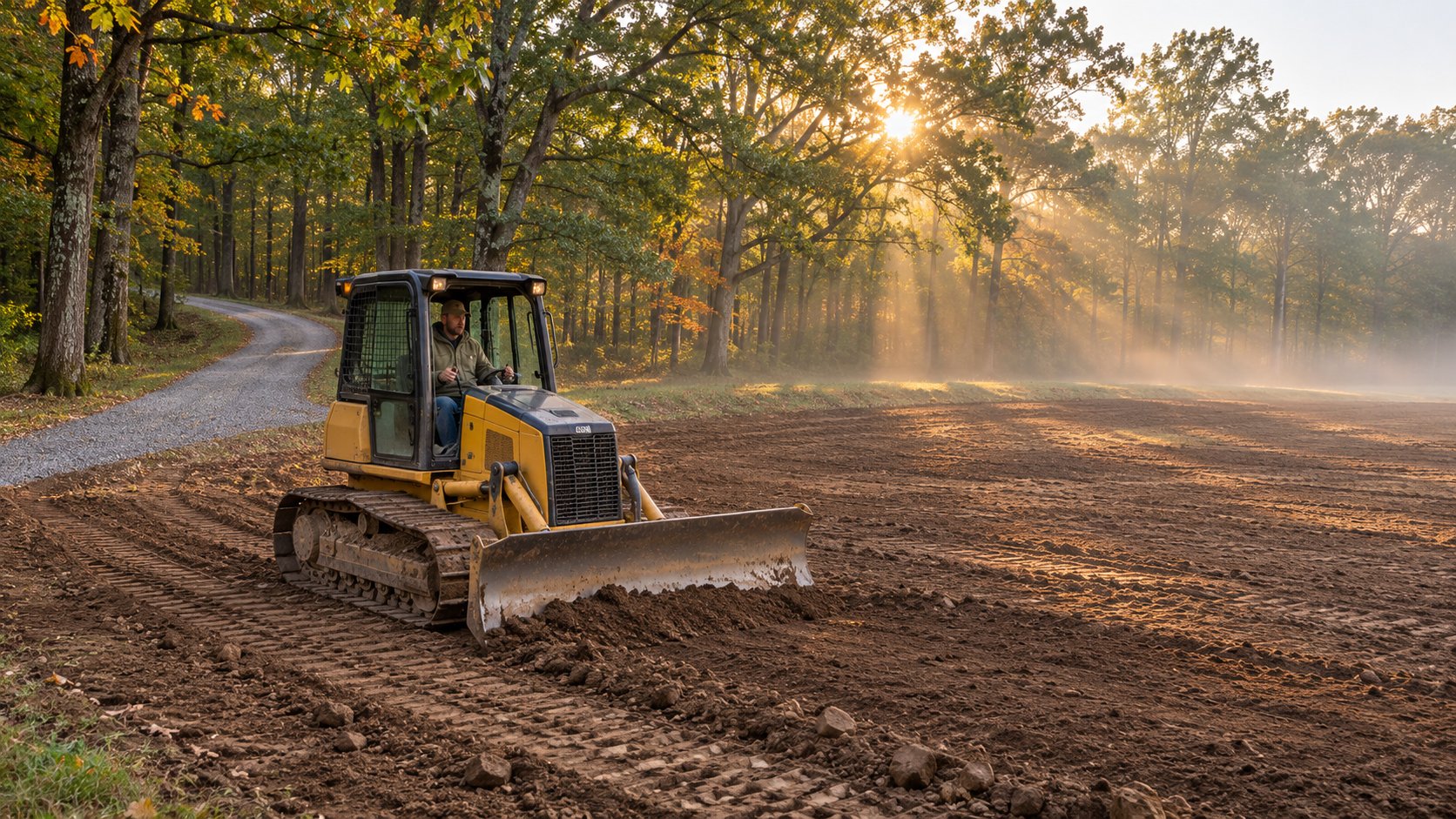
What will the machine spend most of its hours doing? Answer that before you look at your acreage. Komatsu India gives the same advice for land clearing: choose the dozer for the job, the terrain, and the material, not for the size of the property. Four questions narrow the choice. What is the soil like? How will you get the machine onto the site? How precise does the blade work need to be? How often will you run it?
Little Dozer Jobs for Food Plots and Driveways
Most homeowner machines are built for food plots and gravel driveways. A ride-on mini dozer from tier 2 can level a plot, cut a trail, and spread a load of gravel. WhatPond describes the smallest mini dozers as weighing no more than about 2,000 pounds and suited to tight spaces, trails through the woods, and dragging logs. Soft bottomland calls for wider tracks and lower ground pressure. If a long driveway needs a crown, a six-way blade helps a lot, and that usually means stepping up to a compact crawler from tier 4.
When Land Clearing Calls for a Compact Bulldozer
Brush and saplings call for a compact crawler at minimum. Once you get into stumps, rooted trees, or rocky ground, you need a professional small dozer such as a JD 450 dozer or a used John Deere 450C dozer, ideally one that can carry a ripper. WhatPond also says any dozer that pushes over trees should have ROPS (a rollover protection structure) to protect the operator if a tree falls on the machine.
Ponds and drainage ditches are usually tier 5 work. Wet soil costs traction, and WhatPond warns that a dozer can slide sideways on a wet dam. For this work, look for an LGP undercarriage and a machine heavy enough to stay stable on slopes.
Grading and Landscaping With Small Dozers
For finish grading, look for hydrostatic drive and a VPAT blade, since both give you finer control. A compact crawler can handle a small yard. House pads and long grading runs call for a production small dozer. Landscaping often comes down to access. Narrow gates, existing lawns, and low tree limbs favor a narrow, low-profile compact machine that won't tear up the turf.
| Job | Suggested Machine Tier | Key Features to Look For | When to Size Up |
|---|---|---|---|
| Food plots | Tier 2 ride-on mini, or tier 4 compact crawler for larger plots | Low ground pressure, an angling blade | The plot is in wet bottomland or full of roots and rocks |
| Driveways and gravel spreading | Tier 2 for short drives, tier 4 for long ones | Six-way blade for crowning, smooth speed control | Long or steep drives, or a new base cut into hardpan |
| Light land clearing | Tier 4 for brush, tier 5 for stumps and rooted trees | ROPS, a ripper option, a solid undercarriage | Large root balls, rocky ground, or several acres to clear |
| Finish grading | Tier 4 for small yards, tier 5 for house pads and large areas | VPAT blade, hydrostatic drive, available grade control | Tight tolerances, large areas, or frequent paid work |
| Landscaping | Tier 4 for tight access, tier 5 for new home lots | Narrow width, low profile, turf-friendly ground pressure | Large cut-and-fill work or regrading a whole lot |
| Pond and drainage work | Tier 5 professional small dozer | LGP undercarriage, ripper for hardpan, stability on slopes | Large ponds, tall dams, or saturated sites |
Undersizing wastes hours on heavy clearing, while oversizing complicates transport and tight-site work, so size the dozer to the hardest job you will do often.
Bigger is not a safe default. A JD 950 or a Deere 1050 is built for commercial clearing and roadwork. On acreage, a machine that size brings trailer, permit, and access problems that the job rarely justifies.
Finish grading is where small production dozers differ most inside the cab. Many current models offer grade control and blade assist systems, and these systems reduce how much skill it takes to cut a smooth grade.
Grade Control Technology Without the Jargon
Have you ever watched a skilled operator cut a smooth pad in a few passes and wondered how they did it? Grade control systems handle part of that work for the operator. Dozer brochures list these features by brand name, so here is what each one does in plain terms.
Grade Control on a Cat Small Dozer in Plain Terms
Cat GRADE with Slope Assist holds the blade at a set slope. Cat's Slope Assist page says the system maintains cross slope (side to side) and mainfall (the slope along the direction of travel) without GPS, a laser, or a base station. In basic mode, the operator presses the auto button, sets the blade, and the system holds that position. Cat rates it accurate to within 1% of slope and notes that results vary with material, application, and machine model. Less experienced operators gain the most, along with anyone building pads, embankments, or drainage grades.
AutoCarry raises and lowers the blade by itself so the machine keeps a full load as it pushes. Cat's AutoCarry guide explains that the operator loads the blade by hand, releases the control, and the system takes over blade height. It fits long, repetitive pushes where operators get tired. Cat warns against using it for ripping, prying stumps, winching, or pushing other equipment.
Stable Blade works with the operator's own blade inputs to produce a smoother surface. It helps most during finish passes, when small hand movements show up as bumps.
Telematics and Blade Assist Features Explained
VisionLink is Cat's fleet management service. Telematics systems like it typically send machine data such as location, hours, and service needs to a phone or computer. A business running several machines gets real value from that data. A single owner with one machine on one property gets much less.
Other brands sell comparable systems under their own names. Komatsu's Intelligent Machine Control is installed at the factory, runs on 3D design data, and automates blade work from rough dozing to finish grade. Ask each dealer what its version is called and what the package includes. Features also vary by model. Cat's Slope Assist page currently lists the medium D4 through D8 as compatible models, so ask the dealer which features a specific D1, D2, or D3 actually offers.
Grade technology tends to justify its cost when:
- You do finish grading often, especially as paid work
- Less experienced operators run the machine
- You manage several machines and need to track their hours and locations
- Reworking a bad grade costs you material and time
When a Simpler Small Cat Dozer Is Enough
A machine without these options makes sense when:
- You run it a few weekends a year on your own land
- Most of the work is rough pushing, clearing, or spreading
- Exact slopes don't matter, as with trails and food plots
- Only one machine sits on one site, so tracking adds little
A mini bulldozer has none of these systems, and for gravel and food plots it doesn't need them. Technology alone is also no reason to move up a size class. If you notice yourself reading John Deere 950 specs for the feature list, go back to the job table above.
Grade control saves time on frequent precision work, but it adds little to occasional rough pushing on your own property.
An assist system can hold the blade at an angle, but it can't tell whether the slope is safe to drive on. Safety on a slope still depends on the operator's habits and the machine's condition.
Operating, Transporting, and Maintaining a Small Dozer
When you take delivery of a dozer, the riskiest moments often come before any real dirt work. They happen while you load the trailer, work a slope, or dig near a buried line. A few steady habits protect you and the machine.
Safe Dozer Operating Basics
Start every workday with a walkaround. Cat's Cat Inspect app includes daily safety walkaround forms for track-type tractors, and the checklist in your operator's manual does the same job. Look for leaks, loose hardware, damaged hoses, and debris packed into the tracks.
- Buckle up under the ROPS. A rollover protection structure protects you only if the seatbelt keeps you inside it.
- Work slopes carefully. Drive straight up and down a slope rather than across it, keep the blade low, and stay within the slope limits in your manual.
- Keep bystanders clear. Keep people and pets well back from the machine, because you can't see much behind a dozer.
- Locate utilities first. Have buried lines marked before you dig, rip, or cut a grade. In the US, calling 811 starts that process.
Trailering and Transporting Dozers
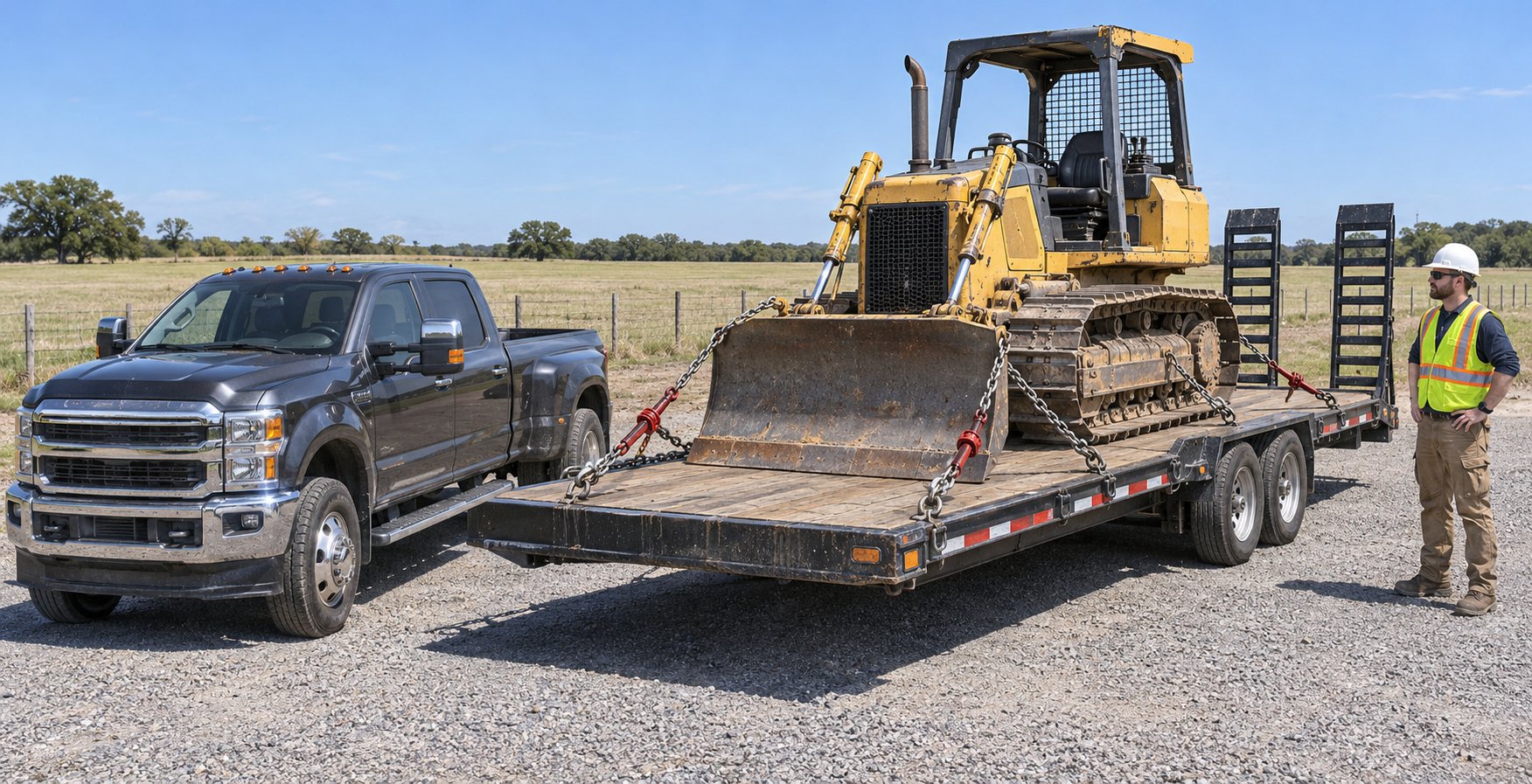
A small dozer can still be heavy. Neighbors Trailer notes that a Cat D3 weighs about 18,500 pounds with fuel and attachments, which is more than many standard equipment trailers can carry. Check the trailer's GVWR plate, axle ratings, and deck rating, leave a 15 percent safety margin, and make sure your tow vehicle is rated for the combined load.
Load on level ground and keep the ramp angle at 15 degrees or less. Lower the blade and any ripper onto the deck. Chain the machine to its factory tie-down points, never to a hydraulic cylinder, and re-check the chains after the first few miles. Permit, licensing, and tie-down rules vary by location and load, so confirm them with your local transport authority. A machine the size of a John Deere 1050 needs a commercial heavy hauler, not a rental flatbed.
Undercarriage Track Tension and Blade Wear Care
Cat dealer MacAllister Machinery estimates that the undercarriage makes up about 20% of a new machine's cost and around 50% of its maintenance budget. The dealer sums up undercarriage care in three rules: keep it clean, keep it greased, and keep it tensioned.
- Track tension: Tracks that are too tight strain every component, and loose tracks drift out of alignment. Measure track sag the way your manual describes.
- Undercarriage wear: Check the sprocket teeth and bolts, idlers, rollers, and links for wear, cracks, or loose parts.
- Cleaning: Clear out mud and rock at the end of each shift, before it hardens or freezes.
- Blade wear: Inspect the cutting edge and end bits, and flip or replace worn edges before the moldboard behind them starts to wear.
- Fluids and filters: Check engine oil, hydraulic fluid, coolant, and filters, and look for leaks at seals and hoses.
- Greasing: Learn your model's grease points. Fresh grease also pushes dirt out of pins and bushings.
Use the service intervals in your manufacturer's operator manual, not a generic schedule. A mini machine with a centrifugal clutch needs different care than a hydrostatic John Deere 450 dozer. How you drive matters too. Alternate your turn directions, avoid needless reversing, and don't spin the tracks.
This checklist also works when you're shopping. On a JD 450 dozer for sale, worn sprockets or a sagging track show how the machine was cared for. Any mini dozer for sale should come with a manual that lists its service intervals. Undercarriage wear adds up on the repair bills, and it is one of the biggest parts of what a dozer costs to own.
Small Dozer Costs
What does a small dozer really cost? The purchase price is only part of the answer. Transport, insurance, undercarriage wear, parts, and resale value all change what you pay while you own or rent the machine.
New vs Used Small Dozer for Sale Pricing Factors
New prices for production small dozers depend on the undercarriage, blade, and technology package. Dealers also update them often. Ask several dealers to quote the same configuration so you can compare the quotes fairly.
Used prices have more public data behind them. HeavyDutyYard's used bulldozer price guide puts used dozers under 100 hp at $16,000 to $105,000, with an average transaction near $48,000 based on IronPlanet listings. The guide treats $28,000 to $35,000 as a more realistic floor for a work-ready machine, because cheaper units often need $10,000 to $20,000 in repairs before they can be relied on. The same guide covers the other cost drivers:
- Undercarriage: A full replacement on a D3 or D4 size machine costs $5,000 to $10,000. The guide puts the expected life at 2,000 to 3,000 hours.
- Resale: Equipment Watch data shows dozers keeping about 60% of their value at 5,000 hours for Cat, 56% for Komatsu, 54% for Deere, and 47% for Case. A used JD dozer usually costs a little less than a comparable Cat and resells for a little less later.
- Where you buy: Auction prices typically run 15 to 25% below dealer prices, but auction machines sell as-is. Dealers usually inspect and service their machines, and many include 30 to 90 days of coverage.
- Timing: Ritchie Bros auction data shows dozers selling for 10 to 18% less from November through January than in peak season.
For used Caterpillar and Shantui machines, JIUHONG's used bulldozer collection is one place to request condition details, configuration information, and current quotes. Its listed inventory doesn't confirm that small or mini dozers are available, or any specific model such as a D5 dozer. Cat classes the D5 as a medium machine anyway. Ask directly before you plan around a listing. Treat any larger machines on the list as alternatives for bigger jobs, not as substitutes for a compact dozer.
Some mini dozer makers don't publish prices at all. Struck calls its S-Series its lowest-priced model but doesn't post a figure. Direct-sale prices can change with engine choice, attachments, and freight, so expect to request a quote. Then ask exactly what the quote covers, including shipping and any assembly.
Renting a Dozer vs Buying
BC Industrial Supply's rental price guide lists small dozers under 100 hp at about $250 to $500 per day, $1,000 to $1,800 per week, and $3,000 to $5,500 per month. Daily rentals cost the most per day. Monthly agreements cost less per day and often include maintenance support. Delivery adds $100 to over $1,000 depending on distance and machine size, and pickup is often billed separately. You also pay for fuel. Many rental companies require proof of insurance, and optional protection plans raise the total. Rates also rise in the busy warm-weather season, so book early.
Say you need two weekends to cut a food plot and regrade a driveway. Renting usually beats owning a machine that would sit idle for the rest of the year. Buying starts to pay off when you have steady work across seasons.
| Option | Upfront Cost | Flexibility | Maintenance Responsibility | Best For |
|---|---|---|---|---|
| Buy New | Highest. Get written dealer quotes. | You choose the exact configuration, but you own it whether it's busy or idle. | Owner, backed by warranty and dealer support | Frequent, year-round use |
| Buy Used | Lower. HeavyDutyYard puts used dozers under 100 hp at $16,000 to $105,000. | You're limited to what's for sale, and you can sell the machine later. | Owner, including undercarriage work that may be coming due. Auction sales are as-is. | Regular use on a budget, if you can inspect the machine or hire an inspector |
| Rent | Lowest. About $250 to $500 per day for small dozers, plus delivery. | Highest. You can pick the right size for each job. | Shared. You cover fuel and daily checks, and some agreements include routine maintenance. | Short projects and occasional use |
What to Request When Buying a Used Mini Bulldozer
Whether you're looking at a ride-on mini or a used Cat D2, ask the seller for:
- The hour meter reading, service records, and serial number
- Close-up photos of the sprockets, rollers, idlers, and track sag
- A list of recent repairs, especially undercarriage work
- The engine brand, the operator's manual, and any remaining warranty
- What the price includes for shipping, delivery, and attachments
HeavyDutyYard lists these warning signs: fresh paint on the underside, mismatched track shoes, scalloped sprocket teeth, and plates welded over frame cracks. Undercarriage history can also work in your favor. A higher-hour machine with a recently replaced undercarriage can be a better buy than a low-hour one still on its original tracks.
The cheapest dozer to own is the one whose undercarriage, paperwork, and support you can verify before you pay.
A dealer-sold machine with service records makes these requests easy to answer. Low-cost imports sold online are harder to check, because the listing may be the only documentation you get.
Buyer Beware With Low-Cost Imported Mini Dozers
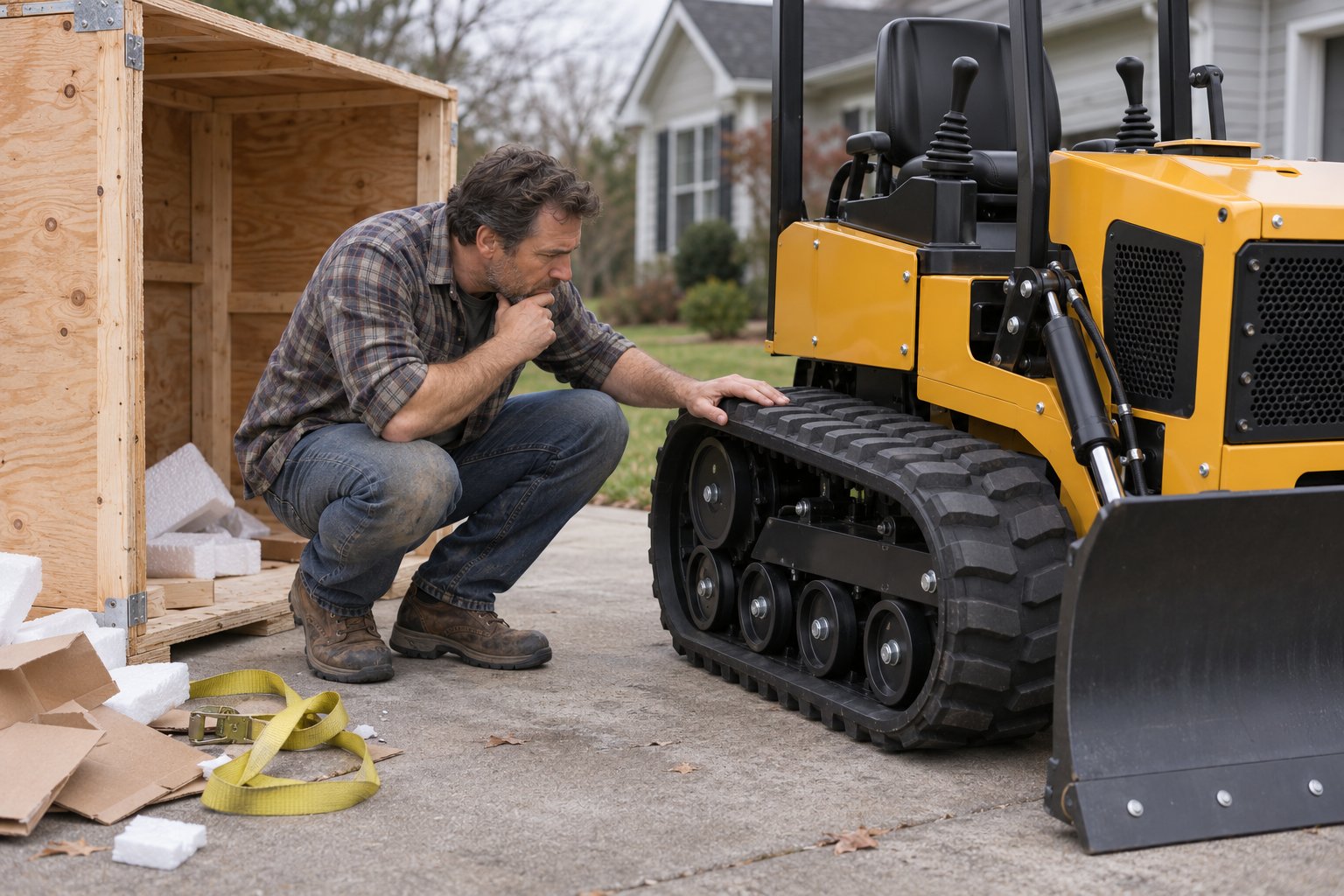
Have you ever searched for "mini dozer" and found a remote-control toy, a skid steer blade, and a full machine on the same results page? Marketplaces group all of them under the same keywords. Before you compare prices, make sure you know what each listing is actually selling.
Spotting Mislabeled Miniature Bulldozers for Sale
Sellers write listing titles to show up in searches, so a title often says little about the product. A search for "john deere dozer" can bring up die-cast scale models next to real machines. A "compact dozer loader" listing may turn out to be a blade attachment for a skid steer or tractor, not a tracked dozer. Look for the operating weight, engine horsepower, and track dimensions first, because a real machine lists all three. A scale ratio or battery voltage means you're looking at a toy or RC model. A list of compatible host machines means it's an attachment. If a listing uses a model name like Deere 650, ask the seller whether they are selling that machine, a part that fits it, or something else.
Parts Warranty and Support Checklist for Imported Mini Dozers
- Parts availability and supply lead times. Ask which parts are stocked in your country and how long tracks, hoses, and filters take to arrive.
- Dealer or service support in your region. Find out who can repair the machine near you and whether a local mechanic can get the service manual.
- Warranty terms and who honors them. A Chinese equipment maker's warranty guide tells buyers of imported machines to confirm whether the exporter, manufacturer, importer, or local distributor handles claims. Coverage may exclude normal wear, consumables, and modifications. Get the terms in writing, because a verbal promise won't help you when a part fails.
- Engine brand and emissions compliance. A well-known engine brand makes parts easier to find. Engines imported into the US must meet EPA emission requirements, and other agencies may add their own rules. Ask the seller for the emissions label or certificate.
- Build quality indicators. Request close-up photos of the welds, hydraulic hoses and fittings, track rollers, and sprockets. Uneven welds and hoses rubbing against the frame are warning signs.
- Shipping, import, and assembly responsibilities. Confirm who pays freight and import fees, where the machine will be delivered, and whether it arrives crated and needs assembly.
- Seller reputation. Look for a business address, a phone line that someone answers, and a track record of several years.
Reading Marketplace Reviews With a Critical Eye
Marketplace badges come from sales numbers and algorithms. Nobody earns them by testing a machine in the field. Wired reports that Amazon's Best Seller badges reflect sales and update hourly. Amazon says its Choice badge goes to "highly rated, well-priced products available to ship immediately," but it won't explain how it picks them. Neither badge tells you how the tracks hold up after a season or whether anyone answers a parts request. A review written the week a machine arrives also says little about durability. Look for reviews that mention months of use, repairs, or contact with customer support.
Before you pay, ask who stocks parts, who honors the warranty in writing, which engine powers the machine and whether it meets emissions rules, and who handles shipping, import, and assembly.
Sellers who answer these questions clearly and in writing are worth keeping on your shortlist. Sellers who can't answer them are easy to rule out, which leaves fewer sources to compare.
Next Steps for Finding the Right Small Bulldozer
Ready to start shopping? Take the decisions in order. Each step removes listings that were never going to fit, so you spend your time on machines worth a closer look.
Your Small Bulldozer Decision Checklist
- Define the job. Write down the hardest task you'll do often. Add your soil type, how the machine gets onto the site, and how many days a year it will run.
- Choose the size tier. Use the job table to pick a tier. Leveling a food plot and building a pond dam call for different machines.
- Decide between new, used, and rental. Rent for short projects. Buy used for regular work on a budget, and buy new for frequent, year-round use.
- Verify specs. Check the operating weight, horsepower, and undercarriage on the manufacturer's spec sheet, then confirm them with a dealer. Model numbers can mislead you. A John Deere 650 dozer is a small machine, but a Deere 850 is mid-size. A search for a John Deere 750 tractor can turn up an older compact farm tractor alongside the 750 crawler dozer.
- Inspect before buying. Cat dealer Gregory Poole suggests checking that the hour reading matches the wear on the pedals, joysticks, and seat. It also suggests asking where the machine worked, because sand speeds up undercarriage wear and rock stresses the frame. Al Marwan recommends starting the engine cold, because a warm engine can hide hard starting and smoke.
Where to Find Small Bulldozers for Sale
- Used equipment specialists. JIUHONG's used bulldozer collection lists Caterpillar and Shantui machines that contractors and fleet buyers can compare. You can request condition details, configuration information, and current quotes. If you need a true small or mini dozer, confirm availability with them directly. The larger dozers on the list are alternatives for jobs that justify a bigger machine. They are not substitutes for a compact dozer. Other used dealers and auctions also belong in this group.
- Authorized OEM dealers. These dealers sell new and used machines, stock parts, and send technicians for service.
- Rental yards. Renting lets you try out a size class before you commit to one.
- Specialty mini dozer makers. Makers such as Struck sell direct from the factory and usually price by quote.
Questions to Ask Before Requesting a Quote
- What are the hour reading and serial number, and do the service records match them?
- When was the undercarriage last replaced?
- Does the machine have a standard or LGP undercarriage, and which type of blade?
- What does the price include for delivery, attachments, and warranty?
- Who stocks parts near you, and how long do they take to arrive?
These questions hold at every size. Mideast Equipment Supply names the Komatsu D575A-3 SD, at about 150 metric tons, as the biggest dozer still working. Buyers at that scale ask about inspection records, parts lead times, and transport, and the same checks apply to a 9-ton D1. The biggest dozer your budget allows is rarely the best buy. A better choice is a machine that fits your hardest regular job and passes inspection.
Pick the job first, then the tier, then the machine, and pay only for what you can verify.
Small Bulldozer FAQs
1. What is the smallest Caterpillar bulldozer?
The Cat D1 is the smallest machine in Caterpillar's current dozer lineup. Cat's Next Gen release rates it at 80 hp, with an operating weight of about 18,240 to 18,390 pounds, or roughly 9 tons. The D2 (92 hp) and the D3 (104 hp) use the same Cat C3.6 engine, and the three models make up Cat's small dozer group. The D1 replaced the D3K2, so some older used listings still use that name. Cat dropped the XL label for this series, so each model now comes with a standard or LGP undercarriage. The D1 is a production machine built for contractors, and it is far heavier than a homeowner ride-on mini dozer. Confirm current specs with a Cat dealer before you buy.
2. What is the difference between a mini dozer and a small dozer?
The two differ in size, power, and support. A ride-on mini dozer such as the Struck S-Series has a 6.5 or 10 hp gas engine and a centrifugal clutch. It is built for gardens, driveways, small logs, and snow. Struck sells direct from its factory, so you won't find a local dealer. Small production dozers include the Cat D1 to D3, John Deere 450 to 650, Komatsu D37 and D39, and Case 650M and 750M. They make about 68 to 105 hp, weigh 8 to 11 tons, and are sold and serviced through authorized dealers. Compact crawlers such as Struck's Magnatrac fall between the two. Brands and marketplaces use 'small' and 'mini' loosely, so check the operating weight and horsepower on every listing.
3. How much does a used small bulldozer cost?
HeavyDutyYard's price guide puts used dozers under 100 hp at about $16,000 to $105,000. The average sale, based on IronPlanet listings, is near $48,000. For a work-ready machine, plan on $28,000 to $35,000, because cheaper units often need $10,000 to $20,000 in repairs. Undercarriage condition affects the price more than anything else. A full undercarriage replacement on a D3 or D4 size machine costs $5,000 to $10,000 and lasts about 2,000 to 3,000 hours. Auction prices usually run 15 to 25% below dealer prices, but auction machines sell as-is. Winter auctions from November through January often run 10 to 18% lower than peak season. JIUHONG's used bulldozer collection lists Caterpillar and Shantui machines, and you can ask it for condition details and quotes. Ask directly whether a true small or mini dozer is available, because the larger machines it lists are alternatives for bigger jobs, not compact dozers.
4. Is it better to rent or buy a small bulldozer?
Renting usually costs less for short or occasional jobs, such as cutting a food plot or regrading a driveway over a couple of weekends. BC Industrial Supply lists small dozers under 100 hp at about $250 to $500 per day, $1,000 to $1,800 per week, and $3,000 to $5,500 per month. On top of the rate, you pay for fuel and delivery, which runs from $100 to more than $1,000. Pickup is often billed separately, and many rental companies ask for proof of insurance. Buying makes more sense when the machine has steady work across seasons. A used machine also keeps resale value. Equipment Watch data shows Cat dozers keeping about 60% of their value at 5,000 hours and Deere about 54%. Renting first also lets you try a size class before you buy one.
5. What should I check before buying a cheap imported mini dozer online?
Start by making sure the listing is a real machine. A real dozer lists its operating weight, horsepower, and track dimensions. A scale ratio or battery voltage means a toy or RC model, and a list of compatible host machines means an attachment. Then ask the seller these questions: Which parts are stocked in your country, and how long do they take to arrive? Who near you can repair the machine? Who handles warranty claims, and can you get the terms in writing? Which engine brand does it use, and does it carry an EPA emissions label? Ask for close-up photos of the welds, hoses, rollers, and sprockets. Confirm who pays freight and import fees and whether the machine arrives needing assembly. Badges such as Best Seller come from sales numbers and say nothing about durability, so look for reviews written after months of use.