

What an Articulating Wheel Loader Is and Why It Matters
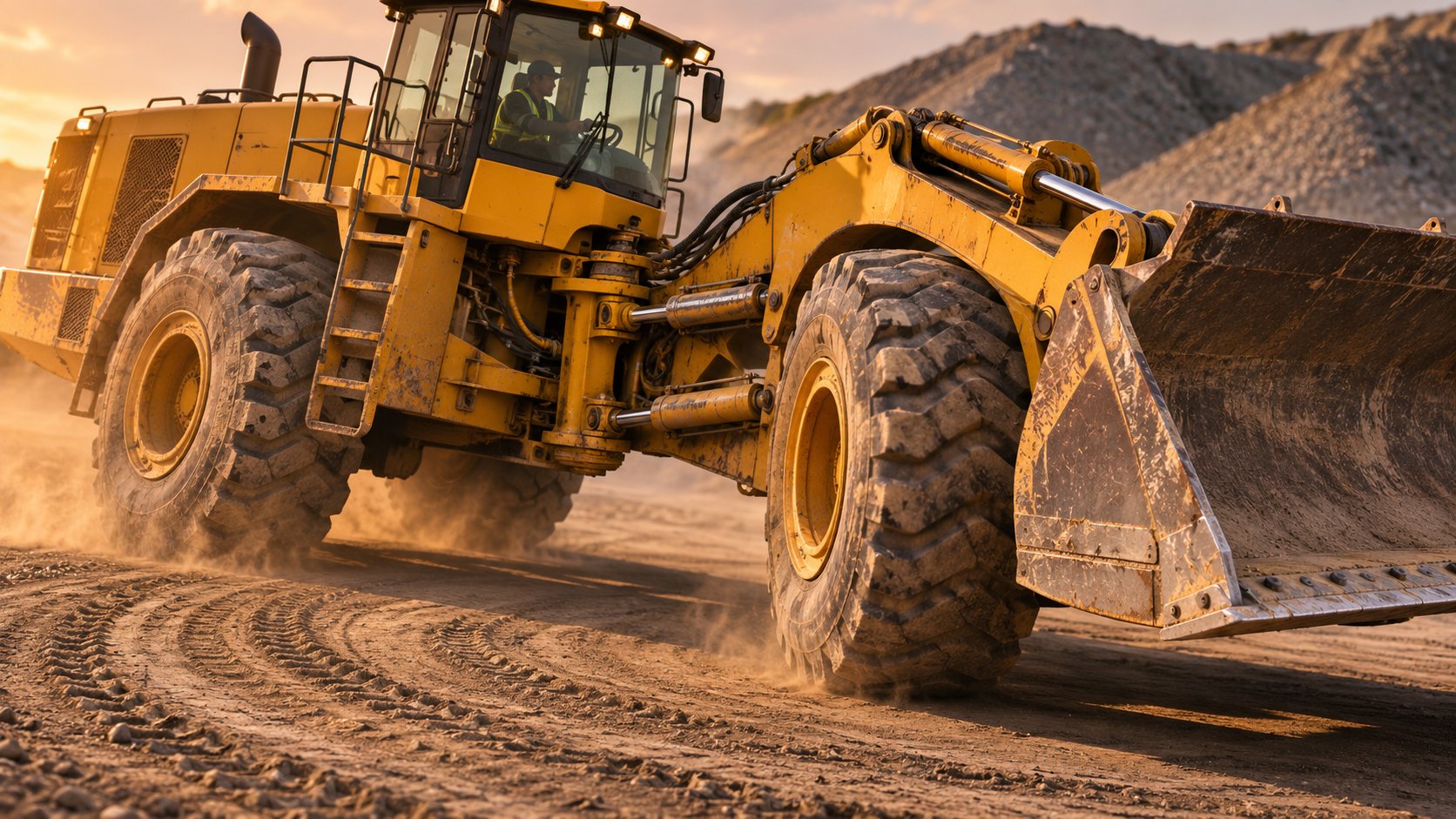
An articulating wheel loader is a wheeled loading machine whose front and rear frames are joined at a central hinge, so the whole machine bends in the middle to steer instead of turning its wheels.
Have you ever watched a loader fold around a tight corner the way a hinged door swings? That bend is the defining trait of this machine, and it shapes how the loader moves, what it can carry and, as you'll see later, how stable it stays.
Articulating Wheel Loader Definition in Plain Terms
Picture two short machines joined by a heavy pin. The front half carries the loader arms and bucket. On many designs, the rear half holds the engine and the operator station. When you steer, hydraulic cylinders swing the two halves around the hinge. Because the frames pivot at the center, the front and rear wheels follow the same path. LTMG notes that this shared wheel track reduces steering resistance and tire wear while helping the machine work in narrow or complex terrain.
Where It Fits Among Front End Loaders
So, what is a front end loader? It is any machine that mounts a bucket on lift arms at the front and uses it to scoop, lift, carry and dump material. The family is broad:
- Articulating wheel loaders steer by bending at the center hinge.
- Rigid-frame loaders keep a one-piece chassis and steer with their wheels or, like skid steers, by varying wheel speed on each side.
- Tractor-mounted loaders attach a loader frame to a farm or utility tractor.
Compact loaders show up in more than one of these groups, so a "compact loader" label alone won't tell you how a machine steers. Attachments can be confusing too. A skid loader grapple bucket may look similar to the grapple on a small articulated machine, yet the mounting interface and hydraulic needs can differ.
Pay Loader, Endloader and Other Names Explained
Job-site slang varies by region and trade. Plant & Equipment lists bucket loader, front loader, front-end loader, payloader and wheel loader as names for the same basic machine. "Pay loader" began as a trade name and stuck, while "endloader" is common in some regions. You may also hear "mini bobcat," which usually means a small skid steer rather than an articulated machine. And if a search for "top loaders" brings up washing machines top loaders, you have wandered into the wrong aisle. This guide is strictly about earthmoving.
In the sections ahead, you'll explore how the center pivot works, how size classes compare, which benefits come with real trade-offs, why stability changes when the machine bends, which attachments fit, how these loaders stack up against skid steers and other machines, and how to buy or rent wisely. Nearly every advantage traces back to that central hinge. So does the tipping risk many buyers miss, and it begins with what actually happens inside the joint the moment you turn the steering wheel.
How Center-Pivot Articulation Steering Works
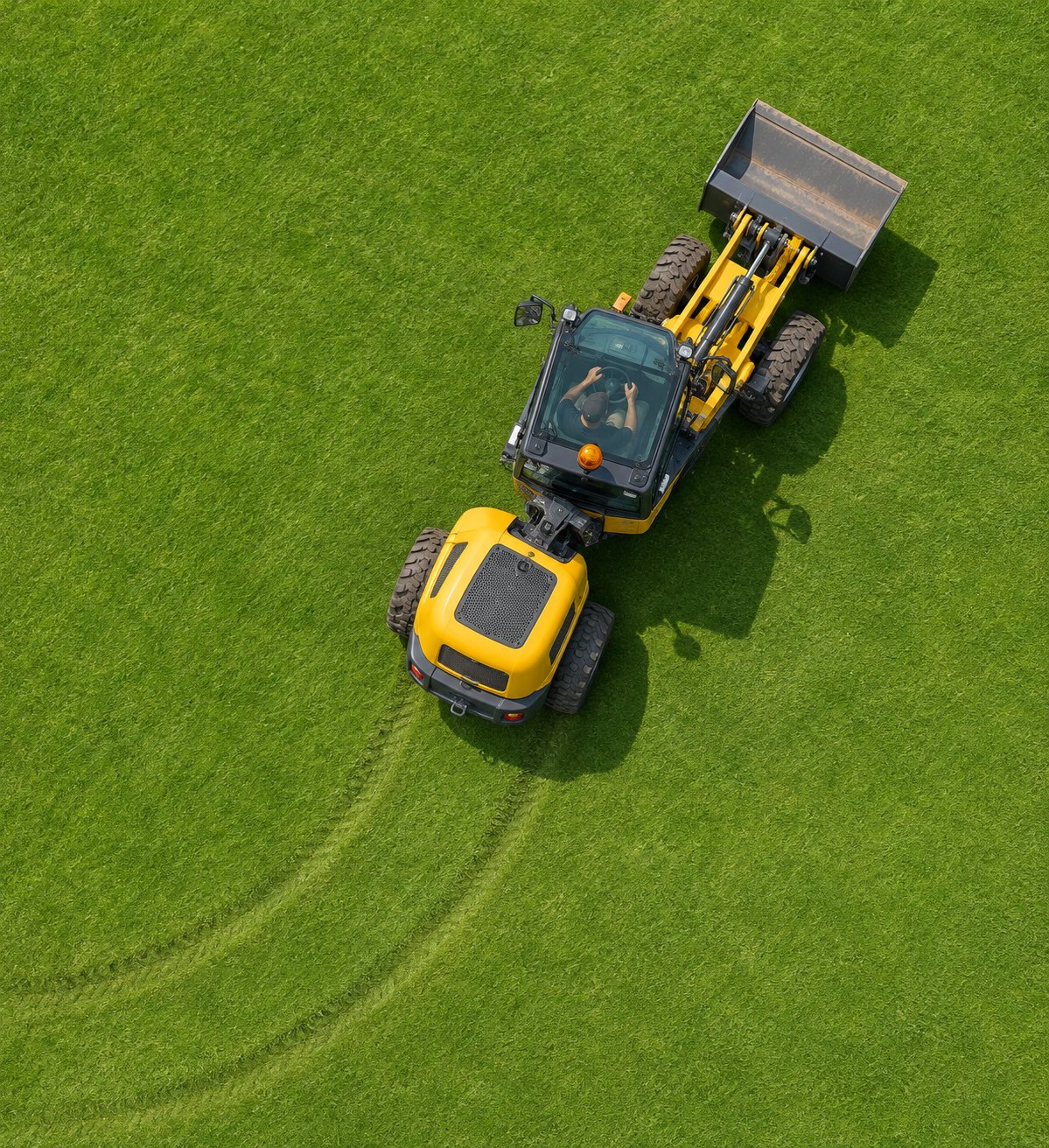
Sounds complex? It is simpler than it looks. When you turn the steering wheel on an articulating wheel loader, you are not pointing the tires. You are folding the whole machine at its middle.
The Center Pivot Joint and Hydraulic Steering
Here is what happens, step by step:
- Two frames, one hinge. The front frame carries the loader arms and bucket. On many designs, the rear frame carries the engine and operator station, and that weight helps counterbalance the load up front.
- Cylinders do the steering. Hydraulic steering cylinders push on one side of the joint and pull on the other, swinging the frames around the central pivot. The Mineloaders guide points out that the wheels stay parallel to the frame section they are attached to.
- The machine bends into the turn. Because the frames bend at the center, the rear wheels follow the path of the front wheels. That cuts tire scuffing and lets the loader slip through tight spaces.
Some compact designs, including the miniature front end loader styles common in landscaping, pair this pivot with a telescopic boom for extra reach.
Why Rear Wheels Track the Front
Imagine driving across a soft lawn. With path tracking, the rear tires roll in the same marks the front tires made, so you leave two ruts instead of four.
Compare that with skid steering. Bobcat explains that a skid-steer loader turns by driving each side at different speeds, which makes the tires slide across the surface. Mini bobcats work this way, and a tracked machine such as the Bobcat T76 compact track loader also steers by varying speed side to side. Sliding matters little on a brushy lot, which is why many a skid loader brush cutter for sale is pitched for land clearing. On finished turf, though, it can leave scars.
Rigid-frame machines take a third approach. Think of the smallest tractor with loader on a hobby farm: the front wheels turn while the rear wheels stay fixed, so the rear tires cut a tighter arc inside the front ones. The two axles never share one path the way they do on an articulated machine.
Rear-Frame Oscillation on Uneven Ground
Steering is only half the joint's job. Many articulated loaders also have an oscillation joint that lets the front and rear frames rock or twist relative to each other. The result? All four wheels keep contact with the ground on rocky or rutted terrain, which helps traction and gives a more predictable ride.
You'll notice one limit, though. Oscillation helps the tires grip, but it does not cancel out physics when the frame is bent and the bucket is full. The same hinge sits on machines that fit through a garden gate and on machines that feed quarry trucks, and how big a frame wraps around it changes almost everything else.
Size Classes From Mini to Full-Size Machines
When you shop for an articulating wheel loader, the first fork in the road is size. The same center hinge can sit on a machine narrow enough to slip through a backyard gate or on one built to load highway trucks at a quarry. Knowing where each class starts and stops keeps you from buying too little machine, or far too much.
| Size Class | Typical Users | Common Tasks | Transport Considerations | Power Options | Reference Spec Range |
|---|---|---|---|---|---|
| Mini articulated | Landscapers, nurseries, livestock farms, first-time loader buyers | Moving mulch, soil and feed, barn cleaning, tight-access hardscape work | Light enough to trailer behind a work truck; confirm trailer and hitch ratings | Small diesel or gas engines; battery-electric models for indoor work | About 0.5 to 1.5 t rated load (Harvelt) |
| Compact and small | Farms, contractors, municipalities, building-material yards | Loading trucks, stockpiling, snow clearing, site cleanup | Often trailerable, but heavier units may need a bigger trailer and tow vehicle | Mostly diesel, with a growing number of electric options | About 1.5 to 3.5 t rated load (Harvelt) |
| Full-size | Construction firms, aggregate producers, ports, bulk handlers | Feeding crushers, truck loadout, stockpiling, rehandling material | Usually moved on a lowboy by a commercial hauler | Diesel | 3 t and up rated load (Harvelt); 50,000 to 80,000 lb common in quarries (Heavy Equipment Guide) |
Mini Articulated Loaders for Tight Access Work
The smallest machines go by many names, but the trade press often calls them small articulated loaders. Equipment World defines the group as articulating machines under 6,000 pounds operating weight and 75 horsepower. Avant Tecno, Bobcat, Case, Intrepid, Wacker Neuson and Vermeer all sell in this space, and Kubota competes in the compact segment. Bobcat's L28, for instance, is marketed as a small articulated loader. Keep in mind that a search for a skid steer loader Bobcat model or a Bobcat crawler loader will turn up machines that steer by varying track or wheel speed, not by bending at a hinge.
Compact and Small Articulating Loaders
Here is where labels get slippery. Equipment World calls small articulated loaders a loose classification, sometimes sold as "subcompact wheel loaders," with manufacturers doing most of the naming. Many makers pitch them as a step up from stand-on mini skid steers, yet they keep growing, blurring the line with larger compact wheel loaders. Imagine two dealers each quoting you a "compact" loader: one might be a center-pivot machine, the other a rigid-frame skid steer. So skip the label and compare:
- Overall width, height and operating weight
- Rated capacity and lift height
- Steering configuration, confirmed in the spec sheet
Full-Size Articulated Wheel Loaders for Heavy Material Handling
At the top of the range, wheel loaders are the most popular machine in most quarries, where they feed crushers, build stockpiles and load trucks. Sizing here is about balancing production. A Caterpillar specialist quoted by Heavy Equipment Guide warns that a bucket needing 10 passes to fill a truck leaves customers waiting, which is why many aggregate operators aim for two-pass loading.
Bigger frames buy more capacity, but every class shares the same hinge. The perks that hinge delivers, from gentle turning to tight maneuvering, each come with a catch worth understanding before you sign.
Key Benefits Explained With Real Trade-Offs
Spec sheets love to list benefits. They rarely explain why each one exists or what it costs you. Every perk of an articulating wheel loader comes from the center hinge, and every perk carries a catch.
Low Ground Pressure and Turf-Friendly Turning
- How it works: The rear wheels follow the front wheels, so the tires roll through a turn instead of dragging sideways. Compact Equipment notes that articulation is easier on tires and turf than zero-turn skidding. Some machines go further. Bobcat's small articulated loaders switch to a turf-safe traction mode while the operator is steering, which keeps the wheels from scrubbing.
- Trade-off: Rolling tires still press into the soil. Tire choice, inflation and the weight in the bucket decide how deep the marks go. A fully loaded machine on a soggy lawn can still leave ruts.
Imagine a landscaper who runs a Case mini skid steer on backyard jobs. The work gets done, but repairing the lawn afterward eats into the profit. Articulated turning is meant to shrink that repair bill.
Maneuverability and Efficiency in Confined Sites
- How it works: The bent frame lets the machine wrap around trees, sheds and fence corners. The rear frame stays on the front's path instead of swinging wide.
- Trade-off: Turning moves the machine's balance point. A Mecalac sales manager quoted in a telescoping loader guide says articulated loaders lose substantial capacity when articulated. The next section covers this in detail.
- How it works: Less tire scrubbing means less energy spent fighting friction. Trade reporting also credits articulation with better fuel efficiency than skid steering, along with slower tire wear.
- Trade-off: These gains are real but hard to put a number on, and they depend on the task. Vermeer's Trevor Koolmees cautions that these units are less productive than other loader types when digging or pushing dense, heavy material. For that kind of work, larger wheel loaders or a JD loader tractor may suit the job better.
Telescopic Booms, Cab Choices and Power Options
- How it works: A telescopic boom adds reach and dump height. On the Bobcat L28, the lift arm extends up to 24 more inches, reaching a lift height of 104 inches.
- Trade-off: Telescoping models give up lift capacity and breakout force, especially at full extension. They also have more moving parts to service. When you browse a compact wheel loader for sale, look for the capacity at full extension, not just the maximum height.
- How it works: An open station with a ROPS canopy keeps the price down and makes it easy to climb on and off. An enclosed cab with heat or air conditioning makes long or cold days much more comfortable.
- Trade-off: Comfort costs money. A cab also adds weight and more components to maintain.
- How it works: Diesel suits long shifts and heavy cycles. If your fleet already runs diesel machines such as Yanmar excavators, staying with diesel keeps fueling and service simple. Gas engines suit lighter, occasional use. Electric models are a good fit for indoor or noise-sensitive sites. The Avant e727 runs about 5.5 hours in medium-duty loading on a 27-kWh battery.
- Trade-off: Runtime is the limit. The same loader needs 1 hour 10 minutes to charge from 10% to 80% on a DC rapid charger. On the standard onboard charger, a full charge takes 5.5 hours.
Notice the pattern? Nearly every catch on this list comes back to capacity that shrinks when the machine bends, reaches or works on uneven ground. That shrinking margin is easy to miss in a showroom. You notice it when a loaded bucket meets a tight turn.
Stability and Safety Around the Articulation Joint
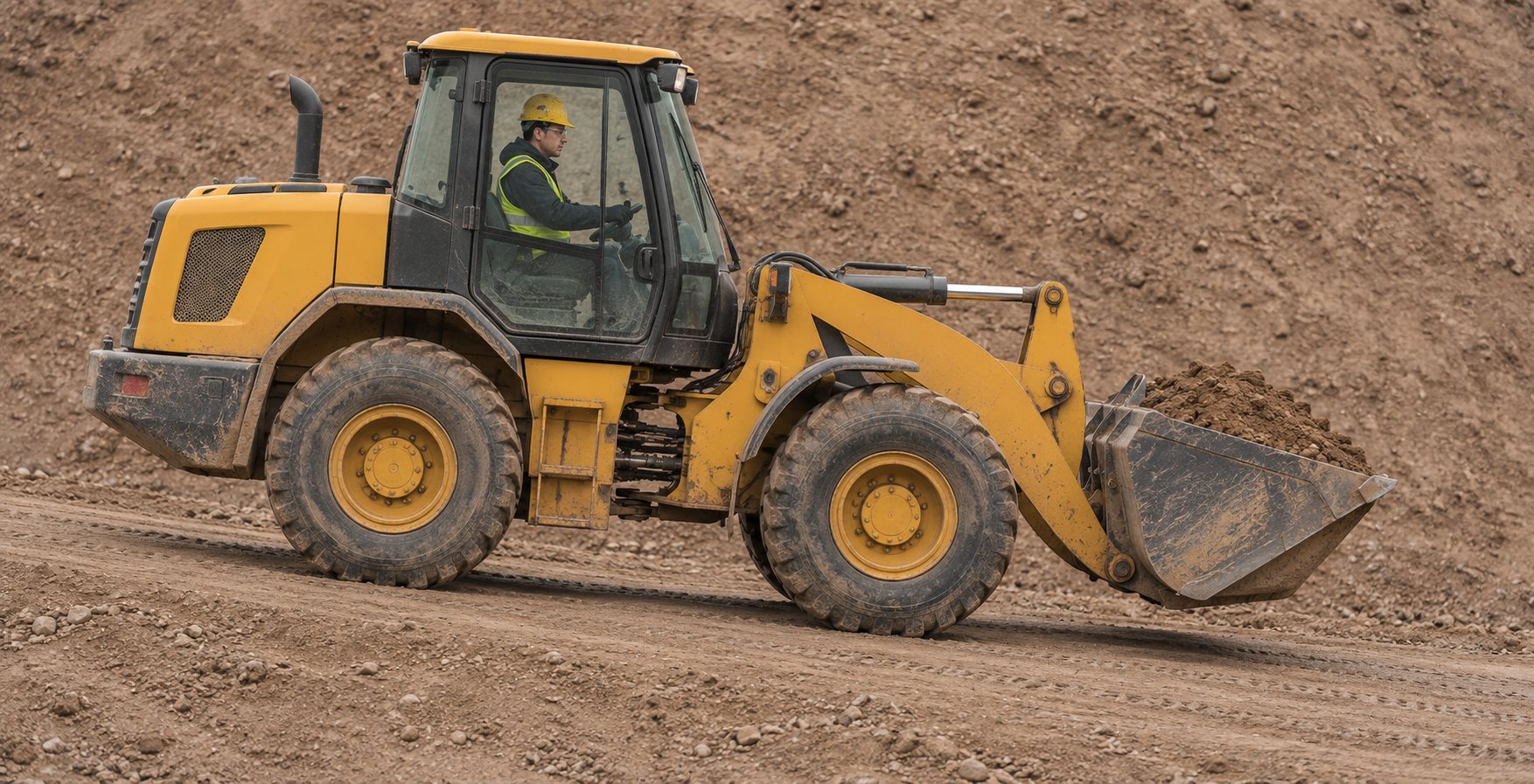
When you scan a spec sheet, which capacity number catches your eye first? Most buyers grab the biggest one. On an articulating wheel loader, that habit is the tipping risk hiding in plain sight, because the machine is never as stable in a turn as it is going straight.
Why Tipping Load Drops at Full Articulation
When the frames line up, the heavy rear end sits squarely behind the bucket and works as a counterweight. Bend the machine, and the bucket swings off to one side. The load's center of gravity moves closer to the tipping line, which is the imaginary edge between the tires that the machine would roll over. Less weight is needed to tip it.
That is why manufacturers publish a full turn static tip load. Finning describes it as the bucket weight that will tip the machine when the arms are level and the loader is fully articulated. It is the conservative number, and it is the one your lift planning should start from.
Plan lifts around the full-articulation tipping load, not the straight-ahead figure.
Rated operating capacity sits below tipping load to leave a safety margin. As a bucket-sizing rule of thumb, Finning suggests dividing the full turn static tip load by two to get the rated load. Ratings are tied to industry test methods, such as the ISO 14397 loader series, whose original 2002 edition has since been revised. So always use the figure the manufacturer publishes for your exact machine and setup. That holds whether you run a small Case wheel loader on a farm or full-size pay loaders in a quarry.
Operating an Articulated Loader on Slopes
Slopes shrink the margin again. On a side slope, gravity already pulls the center of gravity toward the downhill tires. Turn across that slope, and the bent frame pushes it further. Oscillation helps, but only so much. It keeps all four tires on the ground for traction. It does not pull the center of gravity back where it belongs, so it can't stop a tip.
Ohio State University Extension warns that a raised loader changes the center of gravity and can tip a machine under conditions that would normally be safe. Its training targets tractor loaders, yet the physics carries over to any loader. The same rule applies if you run a mini skid steer Bobcat or a Yanmar skid steer. Even the tracks on a Bobcat compact track loader add grip, not immunity.
Safe Practices for Turning With a Loaded Bucket
- Carry loads low. Keep the bucket as low as practical when turning and traveling.
- Avoid sharp turns with a raised bucket. Straighten the frame before you lift.
- Travel straight up and down slopes where the manufacturer allows, with a loaded bucket on the uphill side, and stay away from the outer edges of banks.
- Position the load before lifting. Line up square with the truck or pile, then raise. This matters most with a high dump bucket for wheel loader work, where the load rides high and far forward.
- Respect attachment-adjusted capacities. A heavier tool leaves less room for material.
- Wear the seat belt and use ROPS. A rollover structure only protects you if the belt keeps you inside it.
That fifth point is easy to skim past. The bucket is rarely the only thing hanging off the arms. Every fork, grapple or sweeper you add brings its own weight and its own way of shifting the balance.
Attachments That Expand What the Loader Can Do
Why buy a loader that only scoops? Change the tool on the front, and the same machine can feed livestock, unload pallets or clear snow. That flexibility is a big reason compact wheel loaders earn their keep on farms and job sites.
Buckets, Forks and Grapples for Everyday Loading
- General-purpose bucket: digging, loading and carrying soil, gravel and mixed material.
- Light-material bucket: a larger bucket for low-density loads such as hay, grain or mulch. Doosan's Aaron Kleingartner, writing for Progressive Dairy, notes that low-density feed may call for a large bucket.
- Pallet forks: unloading and placing palletized deliveries.
- Grapples: grabbing hay, brush and other loose material.
- Blades, sweepers, augers and snow tools: pushing and piling, cleanup, post holes and winter work, where your machine supports them.
Switching speed matters too. Kleingartner says a quick coupler can handle a bucket change in about 30 seconds. With a traditional pin-on bucket, the same job might once have taken an hour.
When a High Dump Bucket Makes Sense
Imagine loading a tall feed mixer or a high-sided truck. A standard bucket might not clear the rim. A high dump bucket is designed to release material higher than a standard bucket can. The catch? The load rides high and far forward, which is exactly the position the previous section flagged as risky. Choose one only when the job truly needs the extra height.
Checking Attachment Compatibility Before You Buy
A tool that bolts on is not always a tool that works. As Farmry puts it, universal mounting compatibility does not equal universal machine compatibility. Run through this list before you buy:
- Coupler or quick-attach type. Confirm that the interface matches your loader. Mini machines often use different mounting systems than full-size ones, so never assume a tool crosses classes.
- Auxiliary hydraulic flow and pressure. Match the attachment's required range to the loader's actual output, not just a "high flow" label.
- Attachment weight. Heavier tools cut usable payload and shift the center of gravity. Subtract that weight from the full-turn capacity you planned around in the last section.
- Lift height and dump reach. For high dump work, check both against the height of your truck, bin or mixer.
- Electrical connections. Powered tools may need specific connectors or control signals, and pin layouts are not always interchangeable.
Bring your exact model number to the counter, whether you're talking to a Volvo loader rep or the Yanmar dealer who sold you your other equipment. A spec sheet settles questions a product label can't.
You may notice that many of these tools look just like skid steer attachments. The resemblance is real, but the machines carrying them steer, grip and disturb the ground in very different ways.
Articulating Wheel Loader vs Skid Steer and Other Loaders
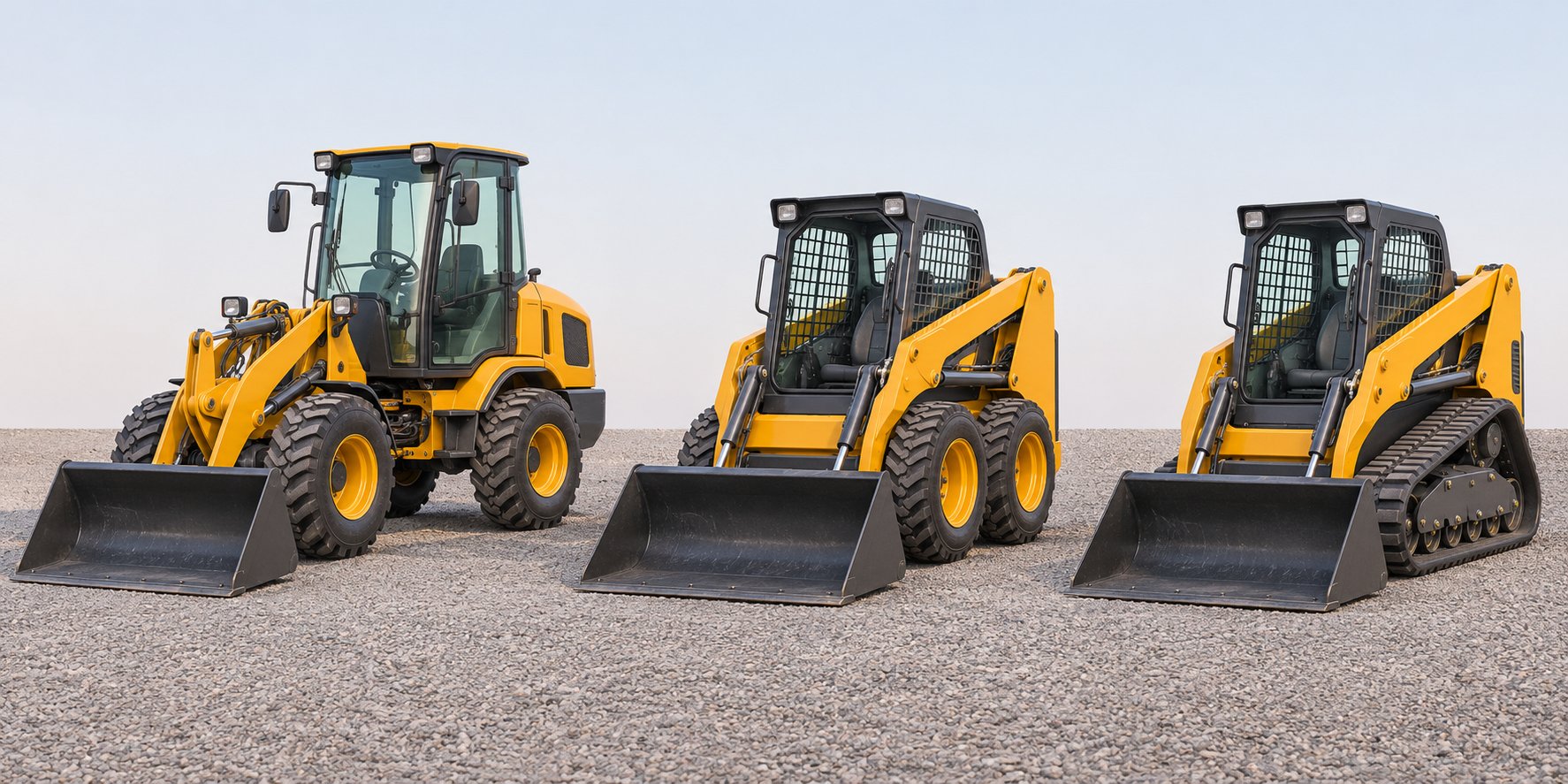
Walk onto a rental lot and you'll see buckets on almost everything. So how do you tell these machines apart? Start with how they turn. Steering decides how each machine treats the ground, and that decides where it earns its keep.
| Machine Type | Steering Method | Ground Disturbance | Visibility and Entry | Best-Fit Tasks | Key Limitation |
|---|---|---|---|---|---|
| Articulating wheel loader | Bends at a center pivot; rear wheels follow the front | Low, because tires roll through turns | Side entry to a seat on the rear frame on most designs | Turf-sensitive work, lift-and-carry cycles, longer carrying routes | Needs turning room; capacity drops when articulated |
| Skid steer loader | Drives each side at different speeds, so tires slide | Higher; turning can scrub tires and mark soft surfaces | Typically front entry past the attachment | Confined bays, zero-radius turns, attachment-heavy work on hard ground | Hard on turf and finished surfaces |
| Compact track loader | Same skid principle on rubber tracks | Low ground pressure, though pivot turns can still scuff | Similar to a skid steer, with the operator seated slightly higher | Mud, sand, snow, slopes and rough terrain | Heavier and slower than wheels on firm surfaces; undercarriage wear |
| Backhoe loader | Wheel steering on a rigid, tractor-style frame | Moderate, with a wider turning path | Side entry to a cab with a seat that faces the front bucket or the rear backhoe | Digging, trenching and loading with one machine | Larger footprint; less focused on high-volume loading |
Articulated Loader vs Skid Steer Loader
Let's clear up a common mix-up. A wheel loader is not a skid steer. A skid steer turns by varying wheel speed on each side. Articulated loaders bend at the center, so the tires keep rolling in the direction they point. Bobcat builds small articulated loaders, skid steers and compact wheel loaders, and it frames the choice around steering architecture rather than size. Its guidance points landscaping on finished turf or paving toward a small articulated loader first. Yard, barn and hard-surface work in confined bays points toward a skid steer.
Imagine a mini wheel loader and a skid steer with the same bucket width. On a fresh lawn, the first one rolls through a turn and the second one scrubs. On a cramped concrete barn floor, the skid steer's ability to spin in place often wins.
How Compact Track Loaders Compare
A compact track loader looks like a skid steer on rubber tracks. Bobcat's comparison explains that tracks spread the machine's weight over a larger area. That lets it cross mud, sand or snow and climb slopes where wheels might spin or sink. Wheeled skid steers stay lighter and faster on firm ground. Tracks still turn by skidding, though, so finished surfaces remain a concern.
Where Backhoe Loaders Fit In
A backhoe pairs a front bucket with a rear digging arm. MechLink describes it as the practical pick when a project needs real excavation depth as well as loading. Wheel loaders, by contrast, focus on loading, carrying and dumping. If your shortlist includes a tractor-based option such as the Yanmar SA223, you're looking at yet another branch of the loader family, the tractor-mounted kind described at the start of this guide.
No single machine wins every row of that table. That's the point. The right pick depends less on the machine and more on the ground, the material and the gate width on your actual job.
Choosing the Right Machine for Your Job
Ask a good dealer which loader you need, and you'll likely get a question back. What are you moving, and where? Let the task pick your size class, not the brochure.
Matching Machine Size to Landscaping, Tree Care and Farm Work
- Landscaping and turf work: Small articulated machines do well on finished lawns because their tires roll through turns. Gate width often settles the rest. Green Industry Pros notes that mini skid-steers can fit through a 3- or 4-foot gate, depending on the model. For the narrowest openings, a walk behind skid loader or stand-on mini loader may be the only thing that fits, but you give up turf-friendly turning. Searches for the smallest Bobcat tend to turn up these stand-on machines, which steer by skidding rather than bending.
- Tree care: Start with how the operator spends the day. The same guide says a seated compact articulated loader suits crews who stay on the machine all day hauling limbs or unloading sod. A stand-on mini skid-steer suits operators who hop off to help the rigging crew. The guide also notes that compact articulated loaders all have telescopic booms, which let you place material without driving into a planting bed.
- General material handling: Loading trucks and building stockpiles usually calls for the compact wheel loader class or larger. Equipment World defines that class as machines up to 90 horsepower and 6,000 to 15,000 pounds.
- Agriculture: Feed, bedding and barn work favor a seated machine with a light-material bucket and enough lift to clear mixers. A search for "front loader Deere" will mostly bring up tractor-mounted loaders. Those are useful for field work, but they steer with their front wheels.
Job Requirements to Spec Priorities Checklist
| Job Requirement | Spec Priorities to Check | Why It Matters |
|---|---|---|
| Material type and density | Bucket size and rated capacity | A large bucket full of dense material can exceed your full-turn capacity. |
| Required lift or dump height | Lift height and high dump option | The bucket must clear truck sides, bins or mixers. |
| Working surface (turf, gravel, mud, pavement) | Tire type and ground pressure | Tread and inflation decide traction and how much the machine marks the surface. |
| Access width and gate openings | Overall width and turning path | Measure your tightest gate before you shop, not after delivery. |
| Transport method | Machine weight, trailer and towing capacity | Whether you haul with a dedicated bobcat truck or a farm pickup, the whole rig must be rated for the load. Equipment World notes that the Wacker Neuson WL28 is light enough for a car trailer, but many compact loaders are not. |
| Indoor or noise-sensitive sites | Electric or low-emission power | Battery models such as the Case CL36EV are marketed for zero emissions and low noise. |
Inspection Points for a Used Articulated Loader
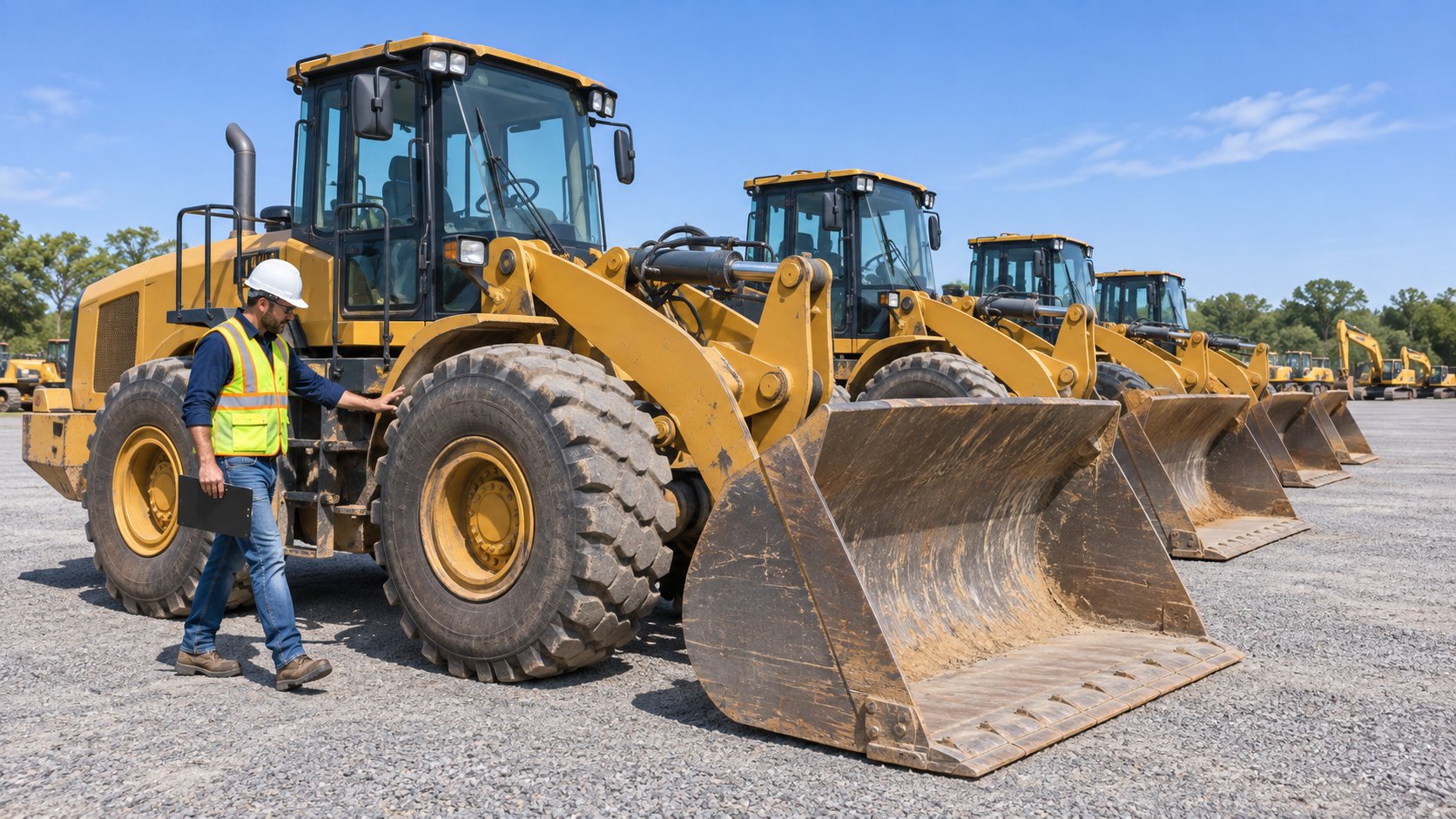
A used machine's history shows up first in the hinge. McClung-Logan recommends inspecting the pins and bushings on the articulation joint before operating any wheel loader. Walk the machine with this list:
- Articulation joint and pins: Look for play, damaged seals, loose fasteners and dents on the articulation stops.
- Steering cylinders: Turn to full lock both ways. Watch for leaks, scored rods or jerky movement.
- Oscillation joint: Check for excess play, dry grease points and cracks in the surrounding frame.
- Hydraulic leaks: Inspect lines for leaks, bulges and cracks, and confirm that cylinders hold their position when extended.
- Tires: Check pressure, tread depth and lug nuts. Uneven wear can point to alignment or steering problems.
- Hour meter: Compare the reading with the visible wear. A low number on a worn machine is a red flag.
- Service records: Ask for proof of regular greasing at the pivot points and fluid changes.
A clean inspection tells you a loader is sound. It doesn't tell you whether owning one beats borrowing one for the season.
Buying vs Renting and Where to Source a Loader
Will the machine work most days, or sit parked between jobs? That one question drives the rent-or-buy decision more than any spec sheet. Rentd treats utilization as the biggest factor and says buying usually wins once a wheel loader works more than about 12 to 14 days a month.
When Renting a Loader Makes More Sense
Pros
- Renting fits short, seasonal or one-off projects, such as spring landscaping or winter snow work.
- You can test a size class before you commit. A few days with a Bobcat L28 or another compact articulating loader will show whether it fits your gates, your turf and your material.
- The rental company carries the maintenance, storage and depreciation.
Cons
- Rental costs add up quickly on long or frequent jobs.
- Machines can be scarce in peak season, and you may not get your preferred setup or attachments.
When Buying New or Used Pays Off
Pros
- Buying suits frequent use and multi-year projects.
- The machine is ready when you are, already set up with the tools you use most.
- You build equity, and resale value recovers part of what you spent.
Cons
- You face a large upfront payment or a financing commitment.
- Maintenance, insurance, storage and transport become your responsibility.
Total cost goes well beyond the sticker price. Weigh how often the machine will work, what maintenance and parts will cost, how you will move it, what insurance runs and what it might sell for later. Many contractors split the difference. They own the machines they run constantly and rent for peak periods and specialty jobs. A used machine lowers the entry cost, but TranSource advises reviewing titles, ownership records and repair reports along with the hardware itself.
Where to Source Used Full-Size Wheel Loaders
- JIUHONG: If your work calls for full-size wheel loaders in construction or material handling, JIUHONG's used loader collection lists machines such as the Caterpillar 950H and LiuGong 856H. You can use it to compare options and request a quote for a specific machine. Before you commit, confirm that unit's steering configuration, dimensions, condition and current availability. If you need a mini or compact machine, such as a Bobcat articulated loader, look to dealers or rental providers that serve that segment.
- Authorized dealers: This is the most predictable route for new machines, warranties and factory service support, though upfront prices are usually higher. Dealers are also the main channel for mini and compact articulated models.
- Rental fleets: Rental fleets are ideal for trying out a size class. Many also sell retired units, so ask for the maintenance records on any machine you consider.
- Equipment auctions: Auctions offer everything from backhoe loaders to wheel loaders. Hexco notes that auctions can mean lower upfront prices and a wider selection. The trade-off is that machines are usually sold as-is, with limited history and rarely any warranty. Auctions work best for buyers with strong inspection skills or for backup machines.
Whichever route you choose, carry one habit to every purchase. Find the full-turn tipping load for the exact machine and attachment combination before the first lift. The right loader is the one that stays stable when it bends.
Articulating Wheel Loader FAQs
1. What is an articulating wheel loader and how does it steer?
An articulating wheel loader is a wheeled front end loader built from two frames joined by a heavy pivot pin. Instead of turning its wheels, it steers by folding at that central joint. Hydraulic cylinders on either side of the pivot extend and retract to swing the front frame, which holds the lift arms and bucket, relative to the rear frame, which usually carries the engine and operator seat. Because the frame bends, the back tires roll in the same track as the front tires. That shared path means less tire scrubbing, less damage to turf and paving, and an easier time working around obstacles. Many models also have an oscillation joint that lets the two halves twist slightly, so all four tires stay planted on uneven ground. You may hear the same machine called a pay loader, payloader, endloader, bucket loader or simply a wheel loader.
2. Is an articulated loader the same as a skid steer?
No. The two machines turn in completely different ways. A skid steer has a one-piece frame and changes direction by running the wheels or tracks on one side faster than the other, which drags the tires sideways and lets the machine spin in place. An articulated loader bends at a center hinge, so its tires keep rolling in the direction they point. In practice, the skid steer wins in cramped bays and on hard surfaces where zero-radius turns matter. The articulated loader is the better fit for finished lawns, pavers and long carry-and-dump cycles, because it leaves fewer marks and rides more smoothly. Compact track loaders use the same skid principle on rubber tracks, which adds flotation in mud but still scuffs delicate surfaces. Attachments can look alike across these machines, so always confirm the coupler type and hydraulic requirements rather than assuming a tool will cross over.
3. Why is an articulated loader less stable when turning?
When the frames are lined up, the heavy rear section sits directly behind the bucket and acts as a counterweight. Once the machine bends, the bucket swings off to one side, and the load's center of gravity moves closer to the line the machine would roll over. That means less weight is needed to tip it. Manufacturers account for this by publishing a full-turn static tipping load, which is lower than the straight-ahead figure and is the safer number to plan with. Rated operating capacity sits below that tipping load to leave a margin, but the exact relationship depends on the machine and the standard it was tested to, so use the published figure for your model. Slopes, raised buckets and heavy attachments all eat into that margin further. Oscillation improves traction but does not move the center of gravity back, so it will not prevent a tip. Keep the bucket low, straighten the frame before lifting, and avoid turning across a slope with a load.
4. What size articulating loader do I need for my work?
Start with the job, not the label. Mini articulated loaders suit landscapers, nurseries and small farms that need to move mulch, soil or feed through narrow gates and over finished turf. Compact and small machines handle truck loading, stockpiling, snow work and site cleanup for contractors, municipalities and larger farms. Full-size articulated wheel loaders are built for quarries, aggregate yards and bulk handling, where they feed crushers and load haul trucks. Because brands use terms like mini, compact and small differently, compare real specs instead: overall width and height, operating weight, rated capacity at full turn, lift and dump height, and the steering type listed on the spec sheet. Also check how you will haul it, since heavier units may need a larger trailer and tow vehicle. Measure your tightest gate and your highest truck side before you shop, and match tire type to the ground you work on most.
5. Should I rent or buy an articulating wheel loader, and where can I find used full-size units?
Utilization is the deciding factor. Renting makes sense for seasonal, short or one-time jobs, and it lets you test a size class before committing while the rental company handles maintenance and storage. Buying pays off when the machine works most days or across long projects, since you avoid stacking rental fees and build equity you can recover at resale. When comparing costs, look beyond the purchase price to maintenance, insurance, transport, storage and expected resale value. For full-size wheel loaders used in construction or material handling, JIUHONG's used loader collection lists machines such as the Caterpillar 950H and LiuGong 856H, and you can request a quote on a specific unit. Before buying any used machine, confirm its actual steering configuration, dimensions, condition and availability, inspect the articulation pins, steering cylinders and oscillation joint, and ask for service records. Buyers who need mini or compact articulated loaders should contact authorized dealers or rental providers that serve that segment.