

What to Know Before Browsing a Bulldozer for Sale
When you search for a bulldozer for sale, you'll notice something right away. Page after page shows inventory cards, prices, and hour readings, but almost nothing explains what those details mean or how to judge them. This guide fills that gap. Read it before you start browsing, or keep it open in another tab while you scroll through listings.
What a Bulldozer Machine Actually Does
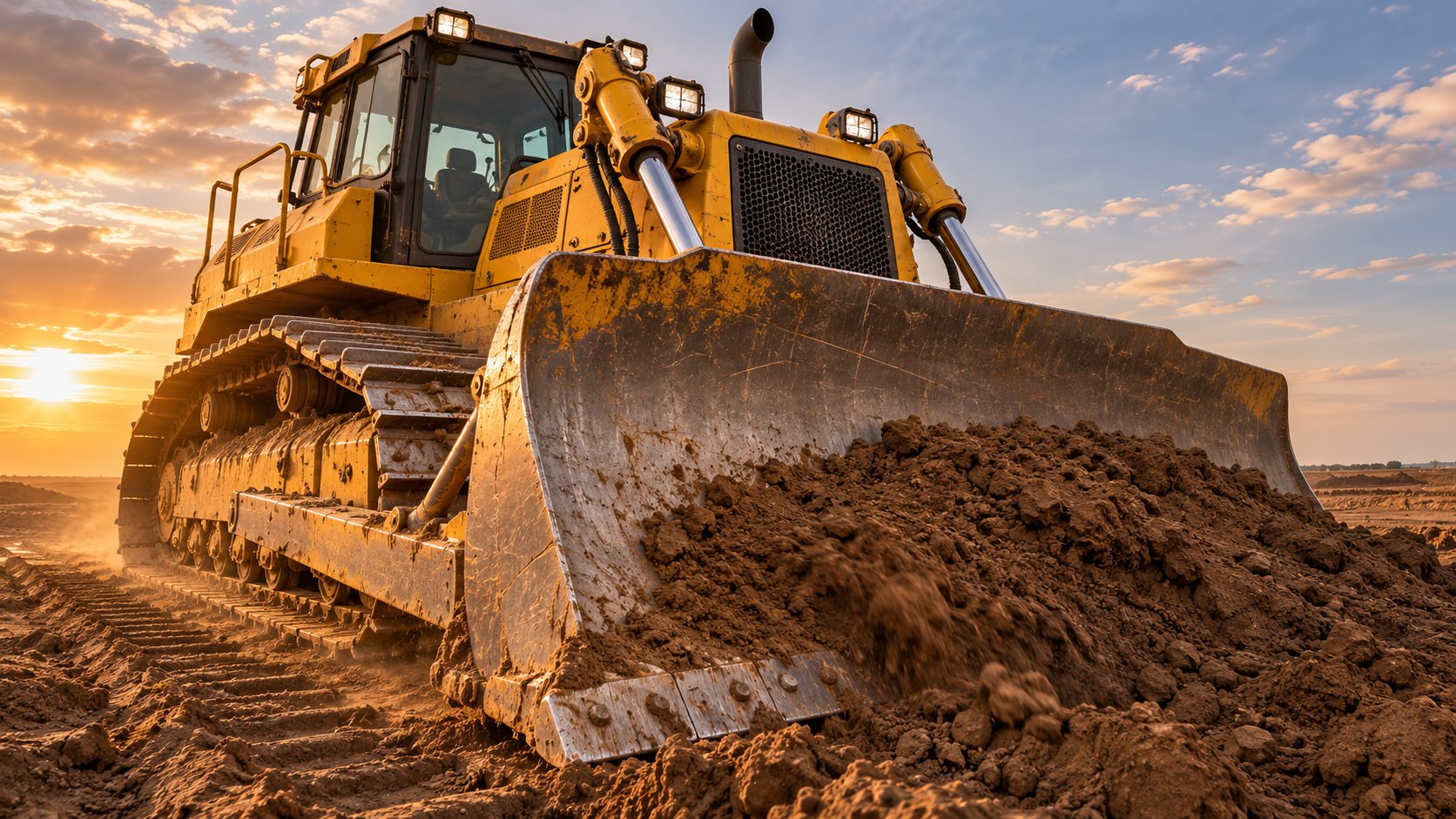
A bulldozer is a tracked or wheeled tractor with a front blade used to push, clear, and grade soil, rock, and debris.
Most dozers run on continuous tracks, though some specialized models ride on large off-road tires, as SkidSteers.com explains. Whatever it rolls on, a bulldozer machine earns its keep through four core jobs:
- Pushing: moving large volumes of dirt, sand, rubble, or rock across a site.
- Clearing: removing brush, stumps, and debris to open up land.
- Grading: shaping and leveling surfaces for roads, building pads, and drainage.
- Ripping: breaking up hard or compacted ground with a rear-mounted ripper.
Why Buyers Search Used Dozers for Sale First
Cost is usually the first reason. New heavy equipment carries a high up-front price and depreciates quickly in its early years. A used bulldozer for sale typically costs much less, holds its value more steadily, and is often already on a lot, ready to haul. ASCO Equipment points out that buying used frees up capital for payroll, materials, and bidding on more jobs. The tradeoff? A used machine may need more maintenance. That is exactly why careful evaluation matters before you pay.
How to Use This Guide While Browsing Listings
Each section tackles one decision you'll face along the way:
- Matching machine type and size to your job
- Decoding listing specs and model suffixes
- Understanding what drives price
- Inspecting the machine component by component
- Asking sellers the right questions
- Choosing where to buy
Before any of that, there is a more basic fork in the road. Should your dozer move on tracks or on tires? That single choice shapes almost every listing worth your attention.
Crawler Bulldozer vs Wheel Dozer for Your Terrain
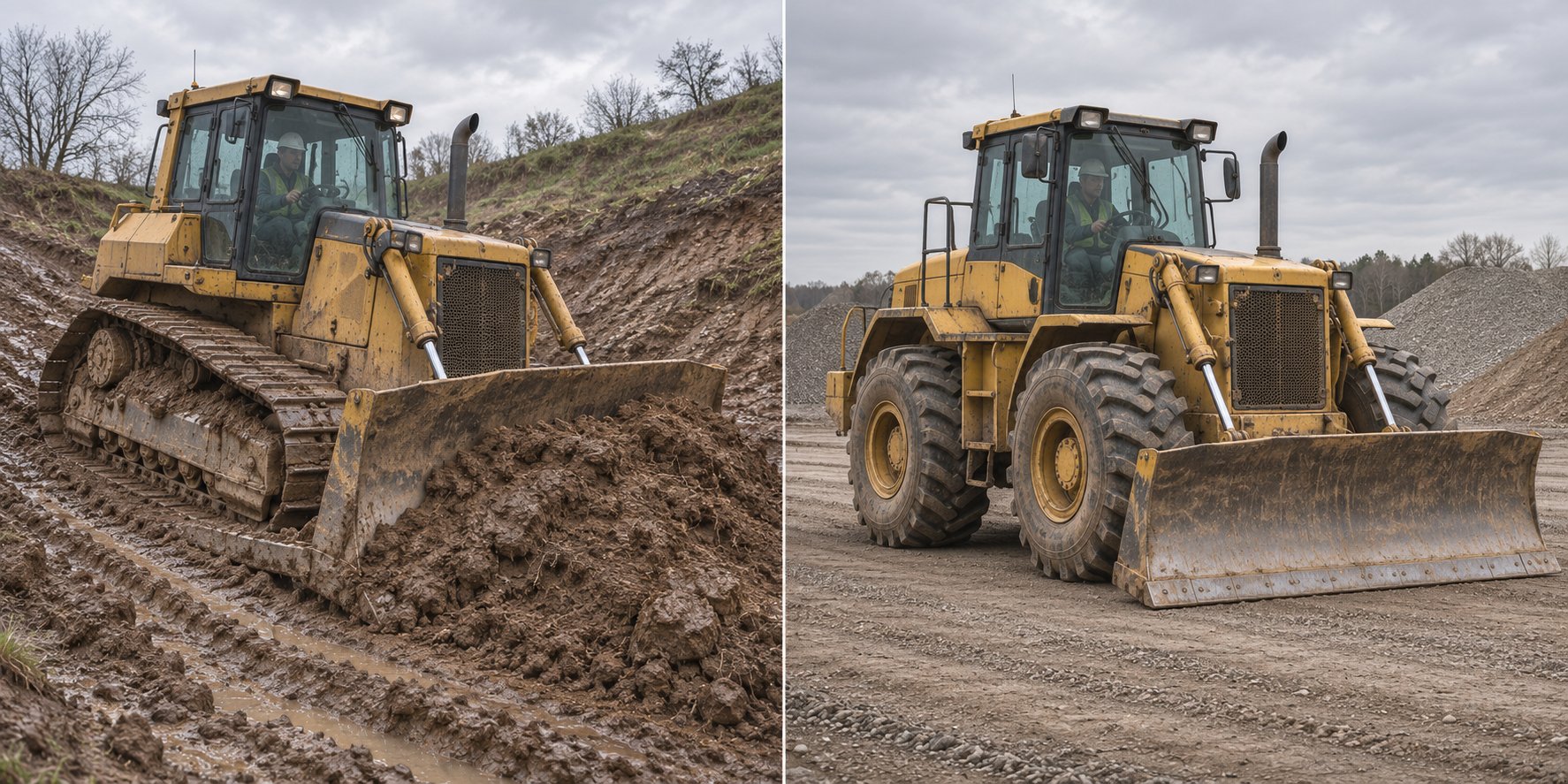
Imagine two dozers parked side by side on a dealer lot. They have similar blades and similar jobs, but one sits on tracks and the other on tires. Which one belongs on your site? The answer depends mostly on the ground you'll be working.
How a Crawler Bulldozer Handles Terrain
A crawler bulldozer rides on continuous tracks. These are usually steel, though some smaller machines use rubber. The tracks spread the machine's weight across a large footprint. That lowers ground pressure and keeps the dozer from sinking in mud, clay, or loose sand. Makana notes that this weight distribution is why most heavy-duty dozers default to tracks. You'll also notice the difference on slopes. Tracks hold the machine steady on steep grades and slippery surfaces, and they won't puncture when driving over rubble the way tires can.
Where Wheel Dozers Make More Sense
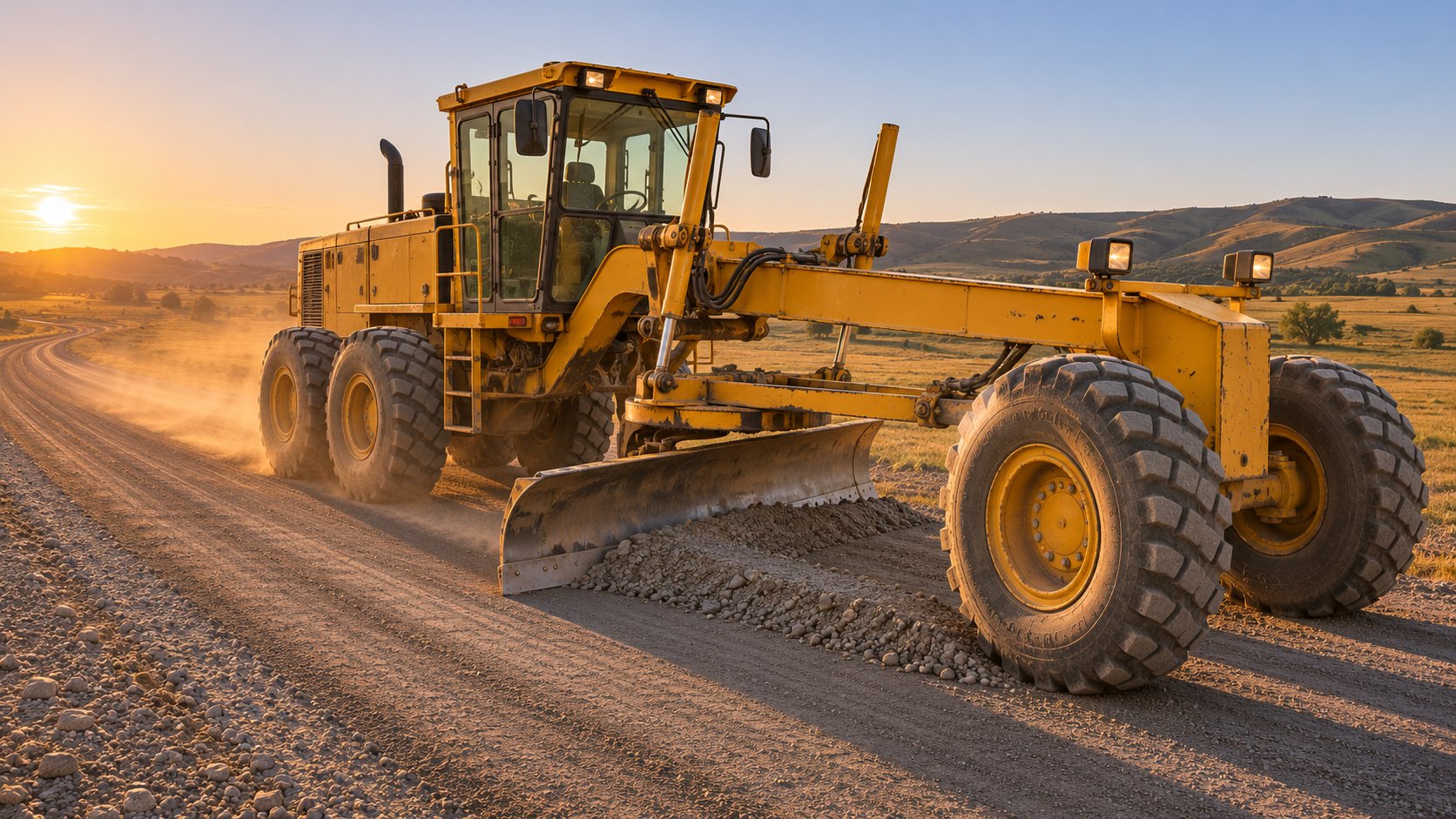
A wheel dozer is still a true bulldozer. The only difference is the undercarriage. Wheel models turn more sharply, travel faster, and cover more ground in less time. Cleveland Brothers points out that wheel machines are road-friendly, while track dozers need extra transport support between sites. Wheel dozers also do less damage to asphalt and grass. That makes them a good fit for flat, firm sites like stockpiles, quarries, and stockyards. Expect to see fewer of them, though. Crawlers remain the more common configuration in typical listings.
Choosing the Right Track Dozer Drivetrain
Still weighing a track dozer against a wheeled one? This side-by-side view covers the factors that matter most:
| Factor | Crawler (Track) Dozer | Wheel Dozer |
|---|---|---|
| Traction | Strong on loose, wet, steep, or rocky ground | Good on firm, compact ground; struggles on loose or wet soil |
| Ground pressure | Low, with weight spread along the tracks | Higher, with weight concentrated at four tire contact points |
| Travel speed | Slow; usually hauled between sites | Faster; moves easily between work zones |
| Surface damage | Steel tracks can mark paved or finished surfaces | Gentler on pavement, turf, and sensitive ground |
| Typical applications | Land clearing, rough grading, rock work, soft ground, slopes | Stockpile work, quarries, road maintenance, flat sites |
| Maintenance focus | Undercarriage wear: chains, rollers, sprockets, track tension | Tire wear, punctures, and inflation; less frequent service overall |
Search terms can blur the picture, too. Here's how to sort out two common mix-ups:
- Dozer loader: A listing tagged "dozer loader" usually means a track loader or wheel loader. These machines carry a front bucket to scoop and load material. A true dozer uses a blade to push it.
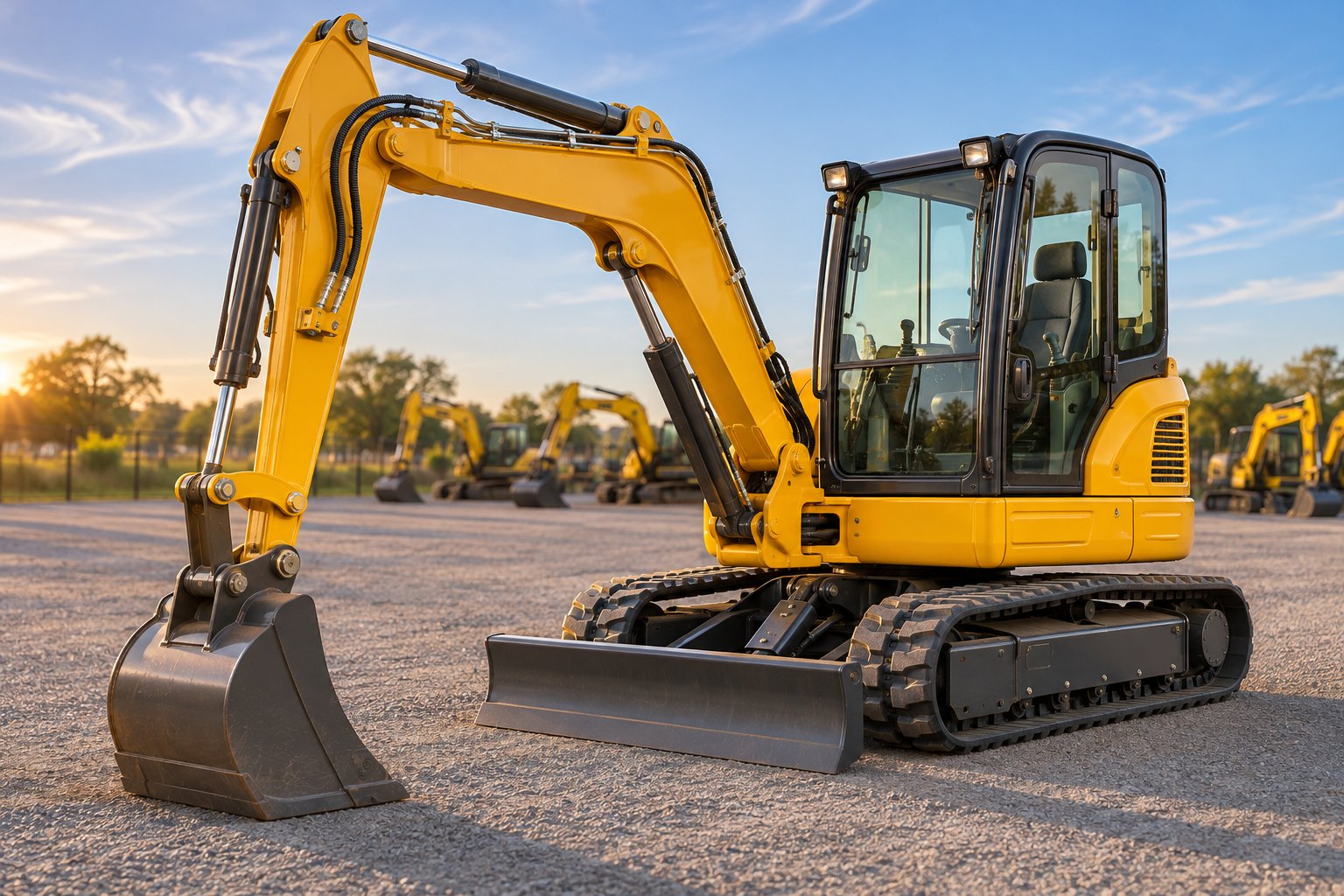
- Excavator dozer: This term typically describes an excavator, often a mini model, fitted with a small backfill blade. The blade helps with cleanup, but the machine digs with its arm and bucket. It is not built for production pushing.
If you need real pushing power, filter out any dozer loader or excavator results before comparing prices. Choosing tracks or tires settles how the machine moves. It does not settle how big the dozer should be, or whether standard tracks will stay on top of your softest ground.
Matching Dozer Size and Configuration to the Job
When you picture a bulldozer, you might imagine a giant machine carving out a mine bench. Many buyers need something far smaller. The right size class saves you money twice: once at purchase and again every day in fuel, transport, and wear. So start with the work, not the listing.
Small Bulldozer and Compact Dozer Applications
A small bulldozer shines where space is tight and precision matters. Think residential site prep, house pads, driveways, landscaping, and trail building. EquipmentShare describes mini dozers as scaled-down machines built for confined spaces and smaller job sites. The tradeoff is pushing capacity. A smaller blade moves less material per pass, so large earthmoving jobs take longer.
Read the labels carefully when you browse a small dozer for sale. A genuine compact dozer or mini dozer is its own class. It is not just a mid-size machine with a modest price tag. Even entry-level crawlers are heavy. The smallest model in DOZR's size chart weighs about 16,800 pounds. If your access gate or trailer is the limit, confirm the actual dimensions before you fall for a listing.
Mid-Size and Large Dozers for Production Work
Bigger machines pay off on production work. Medium dozers handle road building, commercial land clearing, and mass earthmoving. Large dozers take on mining and quarry-scale pushing. DOZR offers a handy rule of thumb: under 30,000 pounds is small, 30,000 to 100,000 pounds is medium, and over 100,000 pounds is large. More weight usually means more pushing power. It also means higher fuel use, heavier trailers, and transport permits.
Standard Track vs LGP for Soft Ground
Size is only half the decision. Low ground pressure (LGP) dozers use wider tracks and blades to float over soft ground. One spec sheet comparison in DOZR's LGP guide shows a large dozer exerting 13.3 psi on standard tracks but only 8.4 psi in its LGP version. That makes LGP a strong fit for wetlands, pond banks, muddy pipeline routes, and finish grading on lawns or landscaped areas where ruts are unacceptable.
The catch? Wide tracks resist turning, which speeds up undercarriage wear. On a medium-sized LGP dozer, undercarriage maintenance can account for roughly 60% of operating costs. Rock and hard surfaces can also damage LGP undercarriages. Unless your ground demands flotation, standard tracks are usually the more economical choice.
| Job Type | Suggested Size Class | Track Configuration |
|---|---|---|
| Finish grading | Small to medium | LGP on soft or finished ground; standard on firm soil |
| Land clearing | Medium to large | Standard, for better maneuvering around stumps and obstacles |
| Pond building | Small to medium | LGP, for wet and muddy soil |
| Road construction | Medium to large | Standard, for traction and compaction on firm ground |
| Demolition cleanup | Small to medium | Standard, since rubble is hard on wide tracks |
Treat this table as a starting point. Pull the manufacturer spec sheet for any model you shortlist, and compare operating weight, blade capacity, and ground pressure against your site. Most sellers won't spell out these choices in plain words, though. The clue is often hidden in a few letters tacked onto the end of the model name.
How to Decode Bulldozer Listings and Model Suffixes
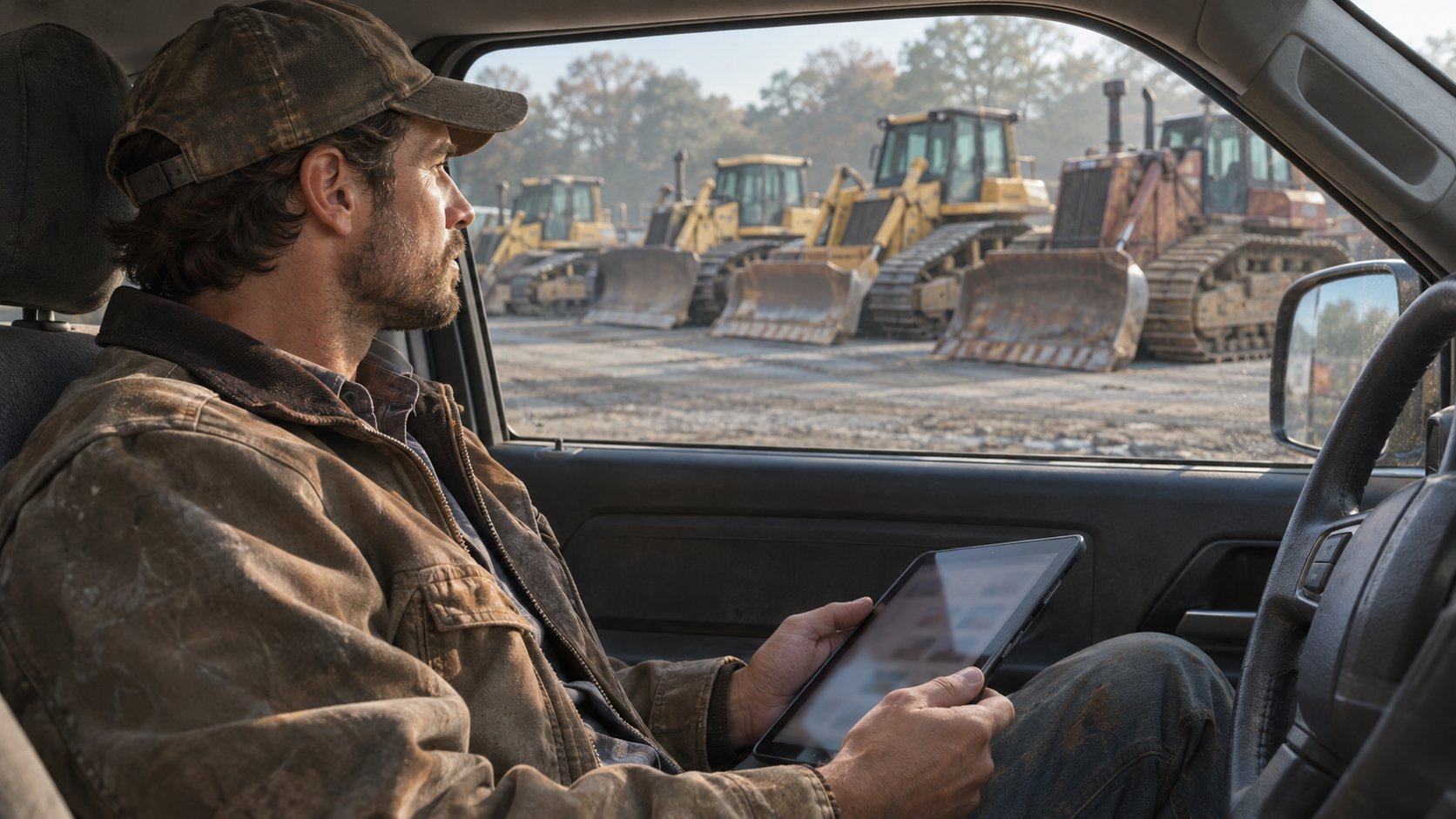
Have you ever scrolled through dozers for sale and wondered what LGP, XLT, or XR actually means? You're not alone. Listings pack a lot of information into a model name and a handful of spec fields, yet they rarely explain any of it. Once you can read that shorthand, you'll be able to sort good candidates from poor fits in seconds.
Model Suffixes Explained: LGP, XL, XLT, LT, and XR
The letters after a model number usually describe the undercarriage or frame setup. For example, Roadwarrior describes the Caterpillar D6T in three versions: XW, XL, and LGP. Each version is built for different ground and different work. Here's what the most common suffixes typically signal:
- LGP (Low Ground Pressure): Wider tracks spread the machine's weight over a larger area. This suits soft, wet, or sensitive ground. A D6T LGP is a classic example.
- XL (Extra Long): A longer track frame puts more track on the ground. That adds traction and stability on slopes and during heavy pushing.
- XLT: An extended track length variant, seen on models like the 650K XLT. The longer footprint helps with stability and grading.
- LT (Long Track): A track that is longer than the standard version. It improves balance and helps on uneven ground.
- XR (Extended Rear): A lengthened rear section, usually added to balance a ripper or counterweight. The D7R XR II shows this naming style. The II marks the series.
- XW (Extra Wide): Wider track shoes that add side-to-side stability and lower ground pressure.
One caution: exact meanings vary by manufacturer and model year. The same letters can mean slightly different things on Cat dozers for sale than on John Deere dozers for sale. Always confirm the configuration with the OEM spec sheet or the serial number.
Reading Listing Card Specs
Below the model name, most listing cards show a short block of specs. This table explains what each field means and why it matters:
| Field | What It Means | Why It Matters |
|---|---|---|
| ROPS type | Rollover protective structure: an open canopy or an enclosed cab | Cabs add comfort and dust protection. Canopies are simpler and have fewer parts to repair. |
| Blade type | Straight (S), Semi-U, U, or 6-way/PAT (power-angle-tilt) | A U blade gives the most carry on long pushes in loose material. An S blade offers precision and penetration in hard-packed ground. A Semi-U falls in between. Angle-tilt blades excel at finish grading, as Cat's blade guide explains. |
| Transmission | Hydrostatic or powershift | Hydrostatic drives give smooth, shift-free speed control for grading. Powershift gears are durable and simpler to repair for heavy pushing, as HBXG notes. |
| Track pad size | Width of each track shoe, usually listed in inches | Wider pads float on soft ground. Narrower pads hold up better on rock and hard surfaces. |
| A/C | Air conditioning, typically paired with an enclosed cab | It matters for operator comfort on long shifts. Check that it actually works. |
| Ripper | Rear-mounted shank or shanks for breaking hard ground | It adds value if your work involves rock or compacted soil. |
| Hour meter | Total recorded engine hours | This number is useful only in context with age, use, and service history. |
Spotting Missing Information in Dozers for Sale Listings
Sometimes what a listing leaves out tells you more than what it includes. Watch for these red flags:
- No hour meter reading
- No undercarriage percentage or measurement method
- Stock photos only, or no close-up shots of the tracks
- No serial number or year of manufacture
- Blade type or transmission left blank
- No mention of service records
A missing detail is not always a deal breaker, but it is always worth a question. Each of these fields also carries real weight in what a machine is worth, which is why two dozers with the same model name can sit at very different prices.
How Much Is a Bulldozer and What Drives Price
So, how much is a bulldozer? Browse the big marketplaces and the answer can look almost useless. MachineryTrader shows listings from $300 to $1,325,000, and TractorHouse runs from $300 to $650,000. Those ranges are a starting point, not a budget. The real question is where a specific machine falls inside them, and why.
Why Bulldozer Prices Span Such a Wide Range
The bottom of the range is mostly parts machines and very old units that may not even run. Many old bulldozers for sale sit here, priced for salvage or a full rebuild. The top belongs to late-model large dozers with low hours and current technology. Everything else lands somewhere in between.
Recent dealer asks gathered by Paramount Financial show the spread. A 2002 Cat D3G with 4,026 hours asked $44,000. A 2017 Cat D8T with 3,306 hours asked $568,235. Keep in mind that these are asking prices, not final sale prices.
Factors That Drive Cat Bulldozer Price and Other Brands
Whether you're tracking a Cat bulldozer price or comparing other brands, the same factors move the number:
- Size class: Bigger machines cost more to buy, haul, and run.
- Year: Newer models bring updated technology and emissions systems.
- Hours: More running time usually means less life left.
- Undercarriage percentage remaining: Worn tracks can signal a costly rebuild ahead.
- Brand and dealer support: Strong parts and service networks help hold value.
- Configuration: LGP tracks, a ripper, an enclosed cab, or a 6-way blade add value for the right buyer.
- Certification status: Dealer-certified units often carry a premium.
- Regional demand: Local construction activity can push prices up or down.
Even one model name can hide a big gap. Those same dealer lists showed two 2017 D8Ts asking $314,950 and $568,235. Hours explain part of the difference. The blade and attachments may explain the rest. So compare any Caterpillar bulldozer price line by line, not just model to model.
Reading Hours in Context
Hours alone never tell the full story. A dozer pushing rock all day wears faster than one doing light grading. Skipped maintenance and dusty or wet conditions can make a machine's effective age older than its calendar age, as Reliant Business Valuation explains. Undercarriage condition weighs heavily, too. A CASE product manager told Heavy Equipment Guide that undercarriage maintenance typically makes up about 50 percent of a machine's lifetime maintenance costs.
Low hours on an old machine deserve a closer look. Imagine spotting a 2003 Deere 450H LT showing just 905 hours and asking $65,000, more than newer units with far more time on them. Was it parked for years? Was the hour meter ever replaced? A low reading can lift the price without saying anything about the tracks.
Price is a function of remaining useful life, not just year.
A listing can hint at that remaining life, but it can't prove it. The proof lives in the pins, rollers, seals, and fluids, and you only find it by getting close to the machine itself.
Used Bulldozer Inspection Checklist by Component
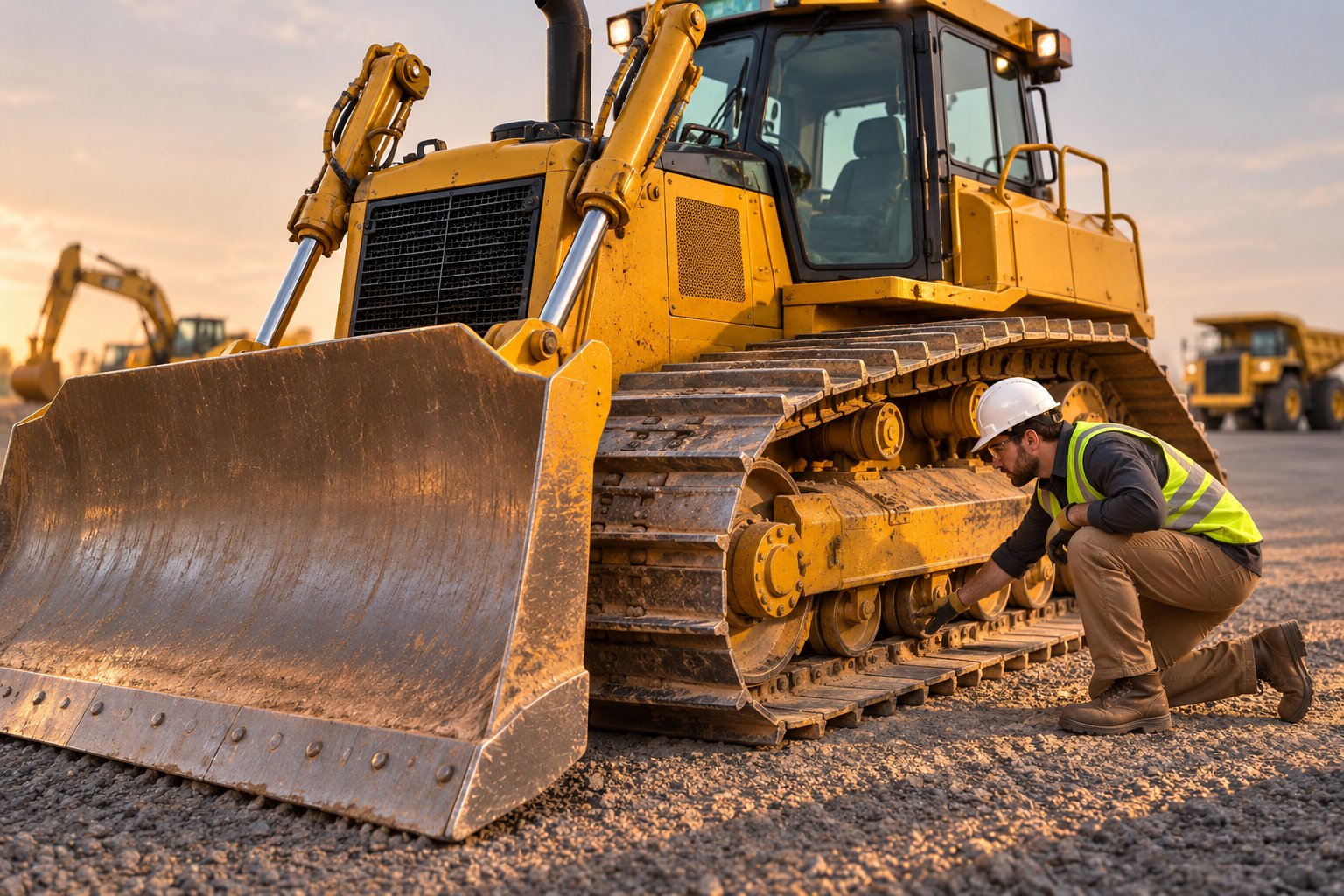
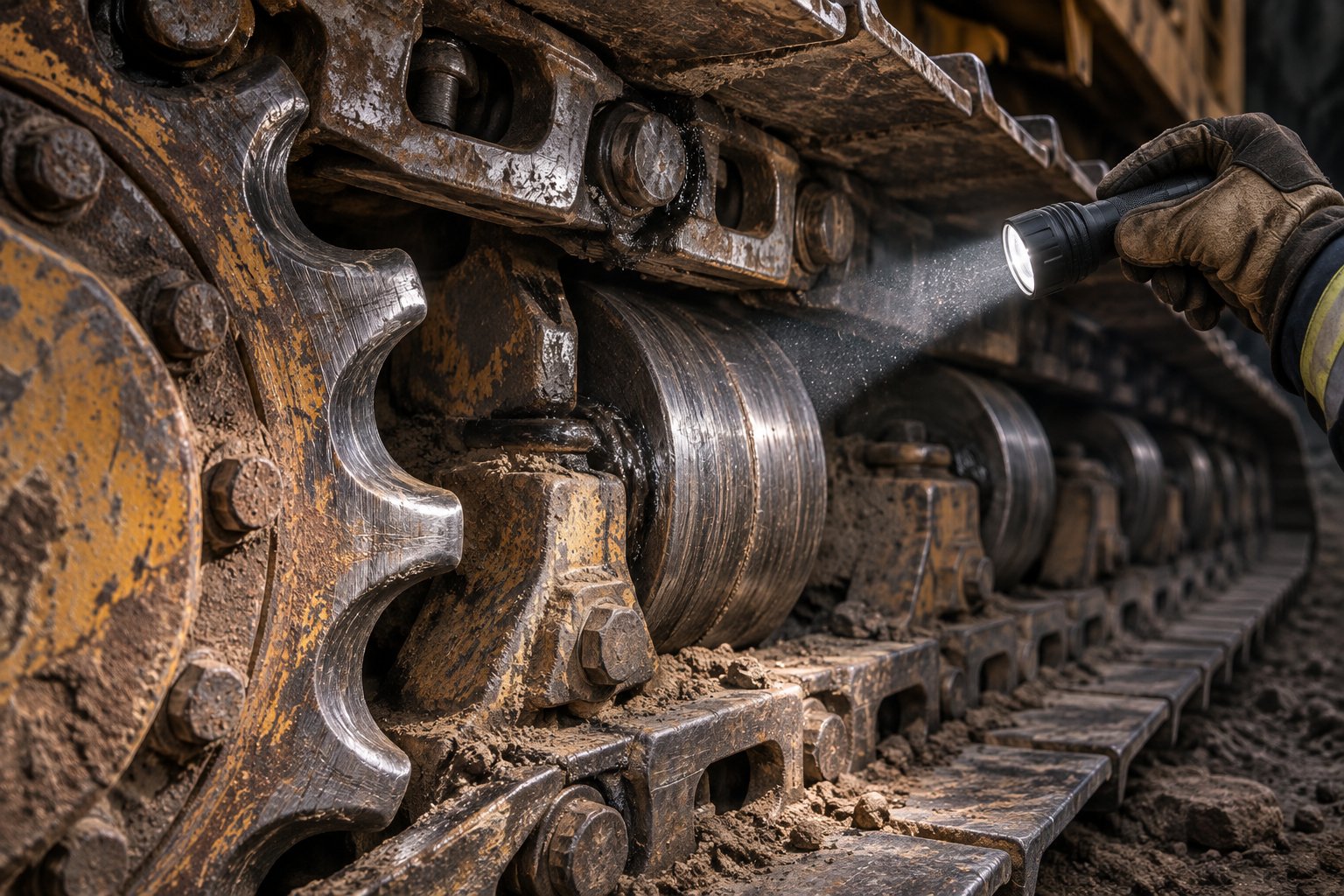
Picture yourself standing next to a dozer you're thinking about buying. It's easy to get distracted by fresh paint or a clean cab. Look lower. On tracked machines, the undercarriage is where the money hides. Heavy Vehicle Inspection notes that it can account for up to 50% of a dozer's lifetime owning-and-operating cost. The checklist below works for used dozers whether you inspect in person or review photos and video remotely.
Undercarriage Inspection for Used Bulldozers
Start with the five wear systems: sprockets, idlers, rollers, the track chain with its pins and bushings, and the track shoes. Each one tells its own story. Hooked or pointed sprocket teeth signal heavy wear. Flat spots on a roller suggest it seized and dragged along the chain. If the idler has been pushed as far forward as it will go, the chain has no adjustment left.
So how does a seller arrive at an undercarriage percentage? A proper estimate comes from measurements such as grouser height, roller tread diameter, and chain pitch across a 4-pin span. Those readings are then compared against the OEM's new and end-of-life dimensions. A percentage with no measurement behind it is just a guess. This matters because rebuilds are expensive. IronCheck puts a full undercarriage rebuild at $30,000 to $60,000 or more, depending on size. That's why track condition can swing the value of used bulldozers more than almost anything else.
Engine, Transmission, and Final Drive Checks
Ask the seller not to warm up the machine before you arrive. A cold start reveals hard starting, knocking, and smoke that can fade once the engine heats up. Watch the crankcase breather for heavy blow-by, a common sign of worn piston rings. Then operate the dozer. Gears should engage cleanly in both directions, and steering and braking should respond without delay. Listen to the final drives for grinding and check their seals for oil.
Blade, Ripper, and Hydraulic System Checks
The blade and ripper show how hard a second hand dozer has worked. Check the cutting edges, scan the moldboard for cracks or patch welds, and rock the blade to feel for loose pins at the push arms and trunnions. On the ripper, inspect the shank and tips. Raise, lower, angle, and tilt everything while watching the cylinders for leaks and slow response.
| Component | What to Check | Warning Signs |
|---|---|---|
| Sprockets | Tooth profile on the drive face | Sharp, hooked, or pointed teeth |
| Idlers | Tread surface and guide flanges | Flat tread, heavy flange sidewear |
| Rollers | Tread diameter, seals, free rotation | Flat spots, oil leaks, worn flanges |
| Track chain, pins, and bushings | Pitch, track sag, idler adjustment | Chain looseness, idler at full forward adjustment |
| Track pads | Grouser height and shoe condition | Worn-flat grousers, bent or cracked shoes |
| Engine | Cold start, exhaust, crankcase breather | Hard starting, heavy smoke, blow-by, leaks |
| Transmission and steering | Engagement, shifting, turning and braking response | Slipping, delayed shifts, weak steering or brakes |
| Final drives | Seals and noise under load | Oil leaks, grinding or whining |
| Blade | Cutting edges, moldboard, push arms, trunnions | Cracks, fresh welds, excessive pin play |
| Ripper | Shank, tips, mounting | Cracked shank, worn tips, loose pins |
| Hydraulics | Cylinders, hoses, response speed | Leaks, scored rods, slow or jerky movement |
Your eyes and the hour meter shouldn't have the final word, either:
- Verify the hour meter: Meters and displays can be replaced. Compare the reading with wear on pedals, seats, and controls, and with dated service records.
- Pull fluid samples: Oil analysis on engine, transmission, final drive, and hydraulic fluids can reveal internal wear that no walkaround will catch.
- Hire a third-party inspector: An independent inspector measures undercarriage wear, tests systems under load, and documents findings with photos and video. That's especially useful when you're evaluating used bulldozers for sale far from home.
Even a thorough inspection only shows a second hand dozer as it stands today. It can't tell you what jobs the machine worked, who maintained it, or what was quietly fixed along the way. For that, you need the seller to start talking.
Questions to Ask Before Buying a Used Dozer
Have you ever hung up with a seller and realized you forgot the one question that mattered? A short script fixes that. The questions below work for dealers, private sellers, and used dozers for sale by owner. Copy them into an email or keep them open during a call. You'll notice that how a seller answers often reveals as much as what they say.
Questions About Service Records and Ownership History
- Can you share maintenance logs with dates and hour readings for each service?
- Do you have fluid sample reports for the engine, transmission, final drives, or hydraulics?
- How many owners has the machine had, and how long have you owned it?
- Was it part of a fleet with scheduled service, or run by an owner-operator?
Look for a steady rhythm in the records. Gregory Poole warns that gaps or irregular servicing can create hidden wear inside the engine and hydraulic system.
Questions About Undercarriage and Hour Meter History
- What is the undercarriage percentage, and how was it measured?
- Which undercarriage parts have been replaced recently, and when?
- Has the hour meter or display ever been replaced? If so, at what reading?
- Can you send close-up photos or video of the sprockets, rollers, and track chain?
Questions About Prior Applications and Condition
- What kind of work did it do: rock, demolition, landfill, forestry, or grading?
- What major repairs has it had, and who performed them?
- Are there any known leaks, warning lights, or recurring problems?
- Can I see it start cold and work before I commit?
Why ask about past jobs? Ground leaves fingerprints. Sand speeds up undercarriage wear, while hard rock stresses frames and attachments. The answer tells you where to look hardest during your inspection.
Paperwork can get thin with an old dozer for sale or a military bulldozer for sale. Mico Equipment points out that government-owned machines often show low displayed hours because they sat parked between projects. Records are only sometimes available, and outdoor storage can corrode wiring, fuel lines, and hoses even on a low-hour machine. For these units, ask where the dozer was stored, and confirm the serial number against the ownership paperwork.
Clear answers backed by documents lower your risk more than any price cut.
Of course, how much a seller can tell you, and how much you can actually verify, depends heavily on who is doing the selling. A dealer, a private owner, and an auction block each give you a very different level of access.
Where to Buy a Bulldozer and Why Location Matters
Two identical dozers can turn into very different purchases depending on who sells them and where they sit. The seller channel shapes how closely you can inspect, what paperwork you receive, and who picks up the phone after payment. As UsedEquipment.site puts it, the channel changes how a purchase is organized, but it does not replace due diligence.
Bulldozer Dealer vs Private Seller vs Auction
Read this table as general tendencies, not guarantees. Every individual offer still needs its terms in writing.
| Channel | Inspection Access | Documentation | Warranty Potential | Pricing Transparency | Risk |
|---|---|---|---|---|---|
| Bulldozer dealer | Usually allows visits, demos, and outside inspectors | Often has prep or inspection records | Possible, but only what the written terms state | Itemized quotes available on request | Lower to moderate |
| Certified used programs | Pre-inspected; you can still bring your own inspector | Inspection certificate and service history | Extended protection plans are often available | Listed price, usually at a premium | Lower |
| Private or by-owner | Arranged directly with the owner | Varies widely | Rare; most sales are as-is | Negotiable, with few benchmarks | Higher; verify ownership and liens |
| Auction | Preview window; a full operating test may not be allowed | Condition report with stated limits | Limited to the event terms | Final bid plus buyer charges | Moderate to higher |
| Online marketplaces | Depends on the seller behind the listing | Depends on the seller | Depends on the seller | Easy to compare asking prices | Varies; watch for changed payment instructions |
Certified programs sit at the cautious end. A Cat Certified Used machine, for example, goes through up to a 140-point inspection and is serviced by dealer technicians before sale.
Why Local Inventory Matters for Bulldozer for Sale Near Me Searches
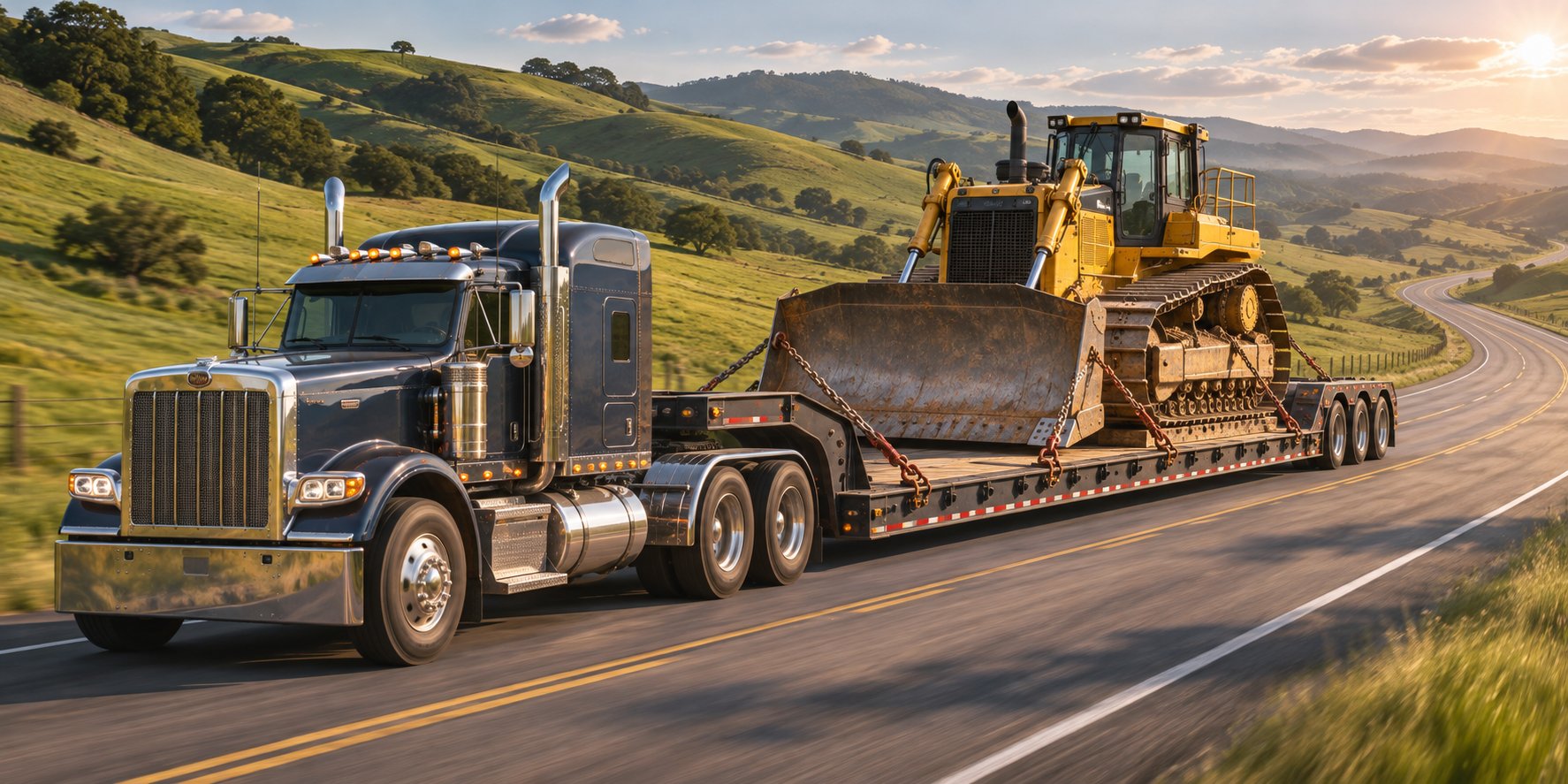
Hauling is the biggest reason. Most mid-size and large dozers move on lowboy trailers, and a load wider than 8.5 feet or heavier than 80,000 pounds gross counts as oversize. Sims Global Solutions notes that no national permit exists, so every state on the route requires its own. Fewer state lines mean fewer permits and fewer delays.
Proximity also lets you watch a cold start, run the machine yourself, and meet the shop that will stock your parts. That's why searches like bulldozer for sale near me or dozers for sale near me return city and state pages, such as Knoxville or Tennessee listings. A used dozer for sale near me is simply easier to verify.
When Buying Out of Region Makes Sense
Sometimes the exact configuration you need, say an LGP with a ripper, simply isn't nearby. Distance is manageable if you plan for it:
- Hire a third-party inspector located near the machine.
- Request a live video walkaround that includes a cold start and track close-ups.
- Get written freight quotes covering permits, escorts, and loading.
- Verify payment instructions independently before sending money.
If a used dozer for sale near me doesn't fit the job, a well-documented machine three states away often beats a poorly documented one down the road. Every tool in this guide works best in a deliberate order, and that order is simpler than it looks.
Next Steps for Finding the Right Used Bulldozer
Sounds like a lot to keep track of? It actually fits on one page. Run every listing through the same seven steps, in the same order, and weak candidates drop out long before you spend money on travel or inspections.
Putting the Buying Process Together
- Define the job: List the material, ground conditions, and site access you'll face.
- Choose drivetrain and size class: Pick tracks or tires, then small, medium, or large, with standard or LGP tracks.
- Decode listings: Translate model suffixes and spec fields, and flag anything missing.
- Benchmark price factors: Weigh hours, undercarriage condition, configuration, and dealer support against the asking price.
- Inspect by component: Start with the undercarriage, then move to the engine, drivetrain, blade, and hydraulics.
- Ask seller questions: Get service records, repair history, and prior applications in writing.
- Pick a buying channel: Match the seller type and location to your risk tolerance and hauling budget.
Exploring Caterpillar and Shantui Used Dozers
Want a place to practice this checklist on real machines? JIUHONG's used bulldozer collection features Caterpillar and Shantui models suited to pushing, clearing, and grading work. Shantui, a Chinese manufacturer, builds its own drive systems in-house, so it's worth comparing alongside more familiar brands. You can review listed machines, then request condition details such as undercarriage measurements, hours, and service history, along with configuration information and current quotes. Treat every reply the way you'd treat any listing: as a claim to verify.
A quick note on fit. If you're hunting for a specific Cat bulldozer for sale, such as a D5, or you need a genuinely small or mini dozer, use the collection as an inquiry point rather than assuming it's in stock. Confirm availability directly, and don't accept a larger machine as a stand-in for a compact one. That rule applies to all bulldozers for sale: the job sets the spec, not the inventory.
Final Checks Before You Commit
Caterpillar bulldozers for sale, Shantui units, and every other brand share one truth. A listing is where your research begins, not where it ends. Photos can hide worn sprockets, and a confident seller can't measure chain pitch over the phone.
Verify condition independently and book a third-party inspection before you pay, no matter how good the listing looks.
Frequently Asked Questions About Buying a Bulldozer for Sale
1. How much does a used bulldozer cost?
Asking prices on major marketplaces stretch from a few hundred dollars to well over a million, so a single average figure is not very useful. The low end is mostly salvage units and non-running machines bought for parts or a full rebuild. The high end is late-model, large production dozers with modern technology. To estimate what a specific machine is worth, focus on its size class, year, recorded hours, measured undercarriage life, configuration such as LGP tracks, a ripper, a cab, or a 6-way blade, and the strength of local dealer support. Two dozers with the same model name can differ by hundreds of thousands of dollars, so compare them feature by feature and treat every listed price as a starting point for negotiation, not a final sale price.
2. What is the most important part to inspect on a used bulldozer?
On a tracked dozer, the undercarriage deserves your attention first, because it represents a large share of lifetime owning and operating costs and a full rebuild can cost tens of thousands of dollars. Check the sprockets for hooked or pointed teeth, the rollers for flat spots and leaking seals, the idlers for flattened treads, and the track pads for worn-down grousers. Also see how far the idler has been adjusted forward, since a fully extended idler means the chain has no adjustment left. Ask how any undercarriage percentage was calculated, because a reliable figure comes from real measurements compared against OEM specs. After the undercarriage, move to the engine, transmission, final drives, blade, ripper, and hydraulics, and back up your walkaround with fluid sampling and an independent inspection.
3. Should I buy a crawler dozer or a wheel dozer?
Let your ground conditions decide. A crawler dozer spreads its weight across long tracks, which gives it strong traction and stability on mud, loose sand, steep slopes, and rocky sites. That makes it the usual pick for land clearing, rough grading, and soft-ground work. A wheel dozer travels faster, turns more easily, and is gentler on pavement and turf, so it fits flat, firm sites like stockpiles, quarries, and road maintenance work. Keep maintenance in mind as well: crawlers demand regular undercarriage care, while wheel machines need attention to tire wear and punctures. You will also find far more crawlers than wheel units in typical listings, which can affect your choice of machines and pricing.
4. What do LGP, XL, and XR mean in bulldozer listings?
These suffixes describe the undercarriage or frame setup. LGP stands for low ground pressure and points to wider tracks that help the machine float over wet, soft, or sensitive ground. XL usually means a longer track frame for added stability and traction, while XLT and LT also indicate extended track lengths that help with balance and grading. XR typically refers to an extended rear, often used to balance a ripper or counterweight. Because each manufacturer applies these letters a little differently, and meanings can change between model years, confirm the exact configuration with the OEM spec sheet or by checking the serial number before you rely on a suffix to make your decision.
5. Where can I find used Caterpillar and Shantui bulldozers for sale?
Dealers, certified used programs, private sellers, auctions, and online marketplaces all carry used dozers, and each offers a different level of inspection access, paperwork, and warranty potential. If you specifically want to compare Caterpillar and Shantui machines for pushing, clearing, and grading work, JIUHONG's used bulldozer collection lets you review listed units and request condition details, configuration information, and current quotes. Ask for undercarriage measurements, hour readings, and service history so you can apply the same checklist you would use anywhere else. If you need a particular model such as a CAT D5, or a genuinely small or mini dozer, treat the collection as a place to inquire and confirm availability directly, and do not accept a larger machine as a replacement for a compact one.