

What a Mini Grader Really Is and Why the Term Is Confusing
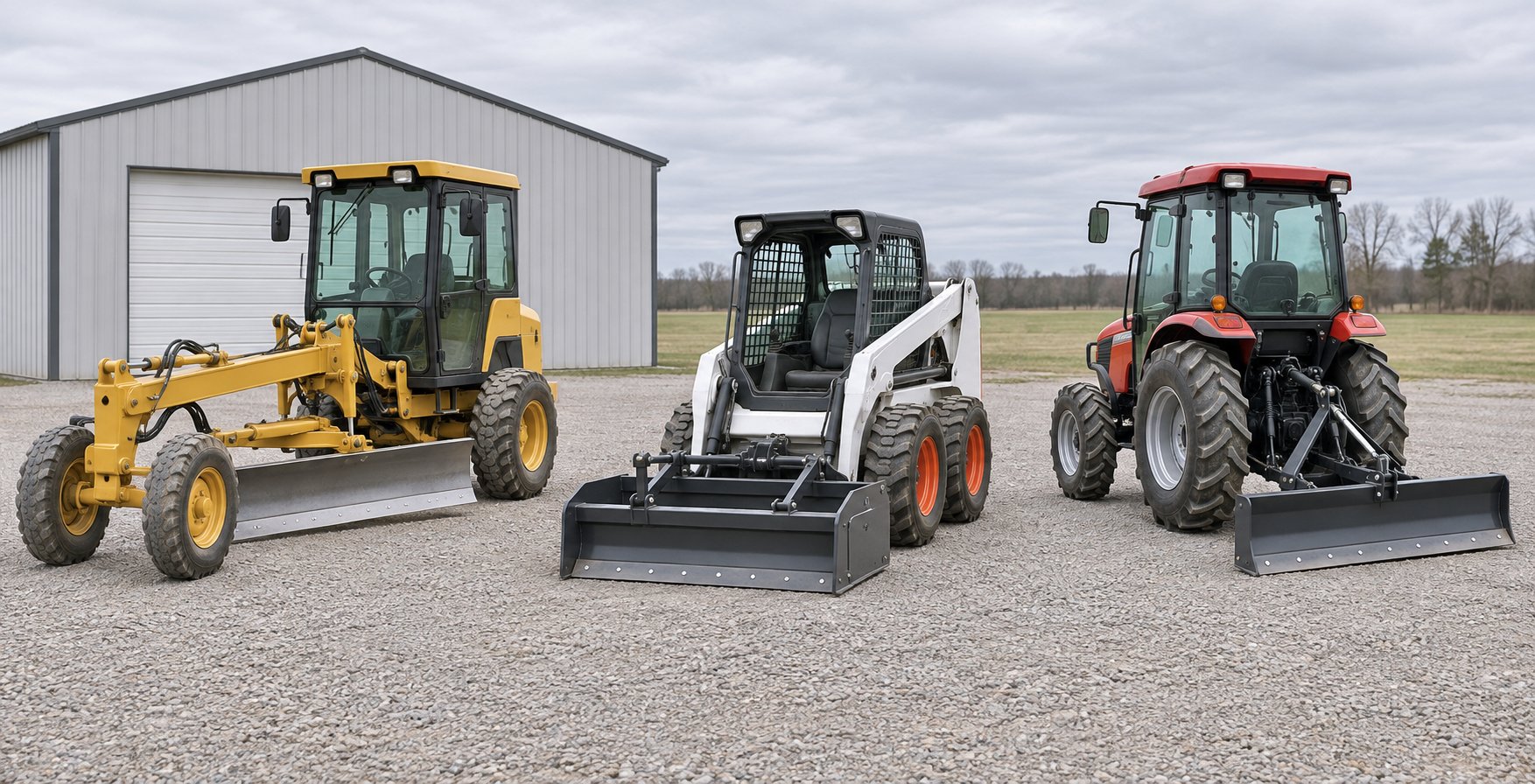
Type "mini grader" into a search bar and you'll get a strange mix of results. One listing shows a road machine with a cab and a long moldboard. The next shows a steel box frame that mounts on a skid steer. A third shows a blade you pull behind a compact tractor. Sounds confusing? It is, and few sellers take the time to sort these products into clear groups for you.
A mini grader is compact grading equipment, either self-propelled or mounted on a carrier machine, built to cut, spread, and level material on small sites where a full-size motor grader is impractical.
A Clear Definition of the Mini Grader
At its core, a mini grader does the same basic job as any grader. It shapes and levels soil, gravel, or base material. The difference is scale. These tools are built for driveways, walking paths, parking pads, small lots, and light road maintenance. A full-size motor grader is designed for highways and large earthmoving projects. On a residential driveway or a narrow farm lane, it is often too wide, too heavy, and too costly to haul in. Compact grading equipment fills that gap.
The Three Categories Behind the Search Term
When you look closely, the search results fall into three distinct product types:
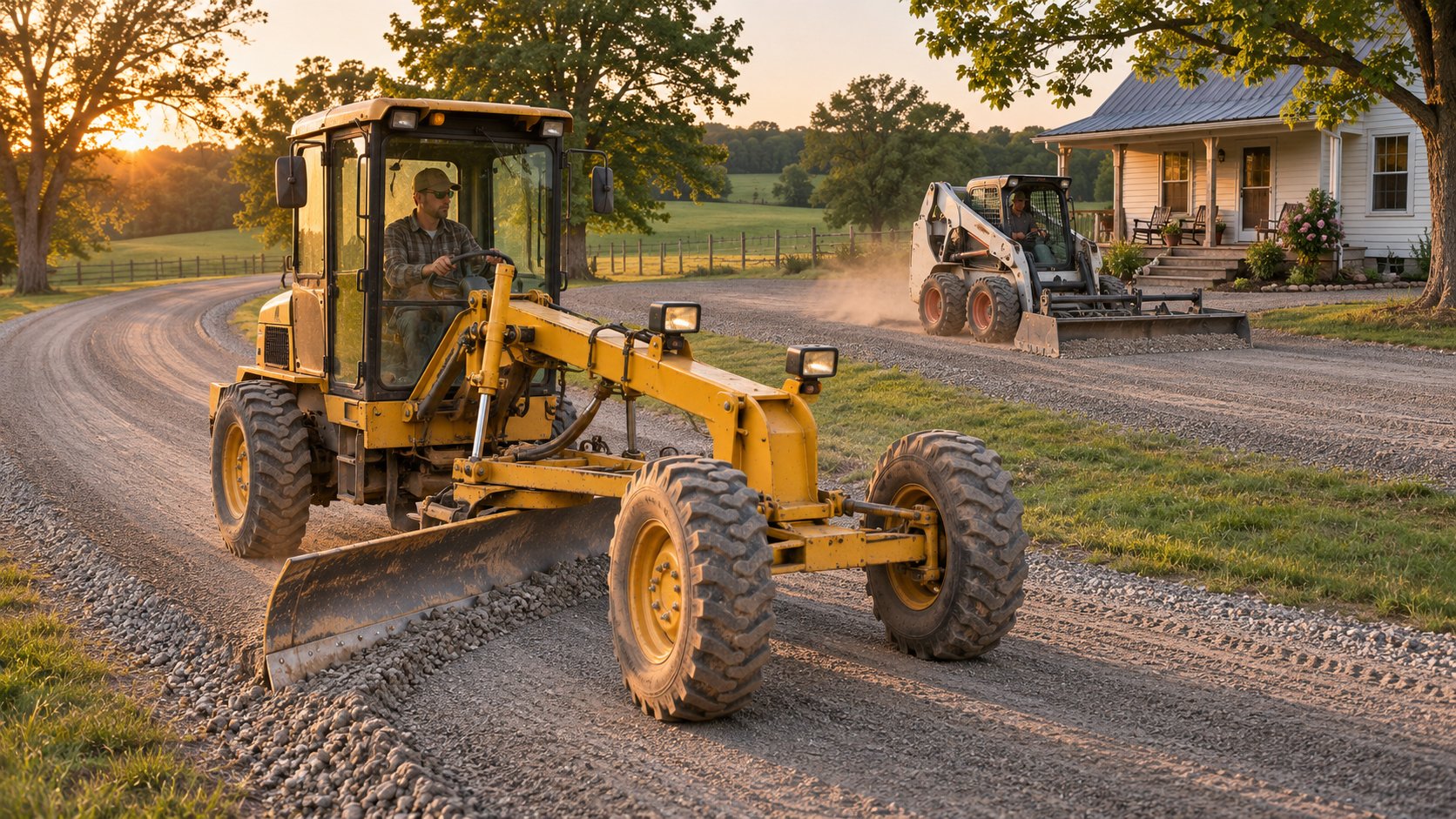
- Self-propelled compact or mini motor graders. These are dedicated machines with their own engine, operator station, and moldboard. The LeeBoy 685D is a well-known compact motor grader. It offers a 130 hp Cummins Tier 4 Final diesel engine and a moldboard that tilts 30 degrees and shifts 3 feet left or right, as detailed in an IRONPROS overview. The Hongyuan HY120G is another machine buyers often see grouped in this class.
- Skid steer and mini skid steer grader attachments. These are box-style or blade graders that mount on a carrier you may already own. The Skid-Max 3X and the Cammond GSI4-MINI-SK are examples of this category.
- Tow-behind and 3-point implements. These are grading blades, box blades, and drags that hitch to a compact tractor. They are simple tools that rely on the tractor for pulling power and lift.
Why the Distinction Matters Before You Shop
Imagine comparing a LeeBoy grader for sale with a skid steer box grader on price alone. You'd be comparing two very different purchases. The categories differ in three practical ways:
- Cost: A dedicated machine is a major equipment investment, while an attachment or implement is usually a much smaller one.
- Carrier machine: A self-propelled grader needs no carrier. An attachment needs a compatible skid steer with suitable hydraulics, and an implement needs a tractor with the right hitch.
- Finish quality: A true moldboard, a floating box frame, and a towed blade each leave a different kind of surface.
That's why the smartest first step is to identify your category, then compare models within it. This "match the grader to the job" approach shapes every section that follows. Category, though, is only half the picture. Even among self-propelled machines, "mini," "compact," and "small" don't always describe the same size of equipment, and that blurry line is where many buyers get tripped up.
Mini Grader vs Small Motor Grader vs Full-Size Grader
Ever noticed that one seller's "compact" machine is another seller's "small" grader? There is no single rulebook here. As Boom & Bucket points out, "compact motor grader" is not a universal equipment classification. So when you browse a mini grader for sale, the label tells you far less than the spec sheet does.
How Size Classes Are Usually Described
Dealers such as Five Star Equipment sort motor graders into compact, small, medium, and large classes, defined mostly by blade length, horsepower, and operating weight. Four dimensions do most of the work:
- Moldboard width: Conventional grader moldboards run from 12 to 24 feet wide, per United Rentals. Mini motor graders and attachments sit at the narrow end of the scale.
- Horsepower: The same source places small graders at about 80-150 hp, medium at 150-300 hp, and large above 300 hp.
- Operating weight: The biggest graders can top 160,000 pounds. Compact equipment weighs a small fraction of that.
- Transport width: A narrower, lighter unit is easier to move between jobs, though real hauling needs depend on each machine's dimensions.
Treat these as broad bands. For exact numbers, always go to the manufacturer's official spec sheet.
Side-by-Side Comparison of Grader Classes
| Factor | Mini/Compact Graders and Attachments | Small Motor Graders | Full-Size Motor Graders |
|---|---|---|---|
| Typical jobs | Driveways, paths, pads, landscape finish grading | Residential construction, rural roads, light road maintenance | Highways, large site prep, major road building, mining |
| Tight-site suitability | Excellent | Good | Poor |
| Carrier or engine | Attachments need a compatible skid steer or tractor; self-propelled units have their own engine | Own engine, typically in the small horsepower band | Large, high-horsepower engine powering wide blades |
| Transport | Simplest; often moves with the carrier | Needs a dedicated trailer and planning | Heavy-haul logistics |
| Operator skill | Low to moderate | Moderate to high | High |
| Relative cost tier | Lowest to moderate | Moderate to high | Highest, including fuel use |
What Counts as the Smallest Motor Grader
The answer depends on what you count. If attachments make the list, a mini skid steer box grader wins easily. Yet an attachment has no engine or operator station of its own, so it isn't truly a motor grader. Among self-propelled machines, the compact class, illustrated by the LeeBoy 685D, sits a clear step above attachments in capability. Its 130 hp engine actually lands inside the small-grader band above, a useful reminder that "mini" in marketing doesn't always mean tiny.
Be cautious with third-party spec lists for any mini road grader. Some appear unsourced or inconsistent, so confirm every claim against the manufacturer's own pages.
For many driveway and pad jobs, though, the real question isn't which self-propelled machine is smallest. It's whether a simple road leveler bolted to a skid steer can deliver a finish good enough to skip the dedicated machine altogether, and that comes down to how a box grader's blades work together.
How Skid Steer Box Graders Spread, Level, and Finish
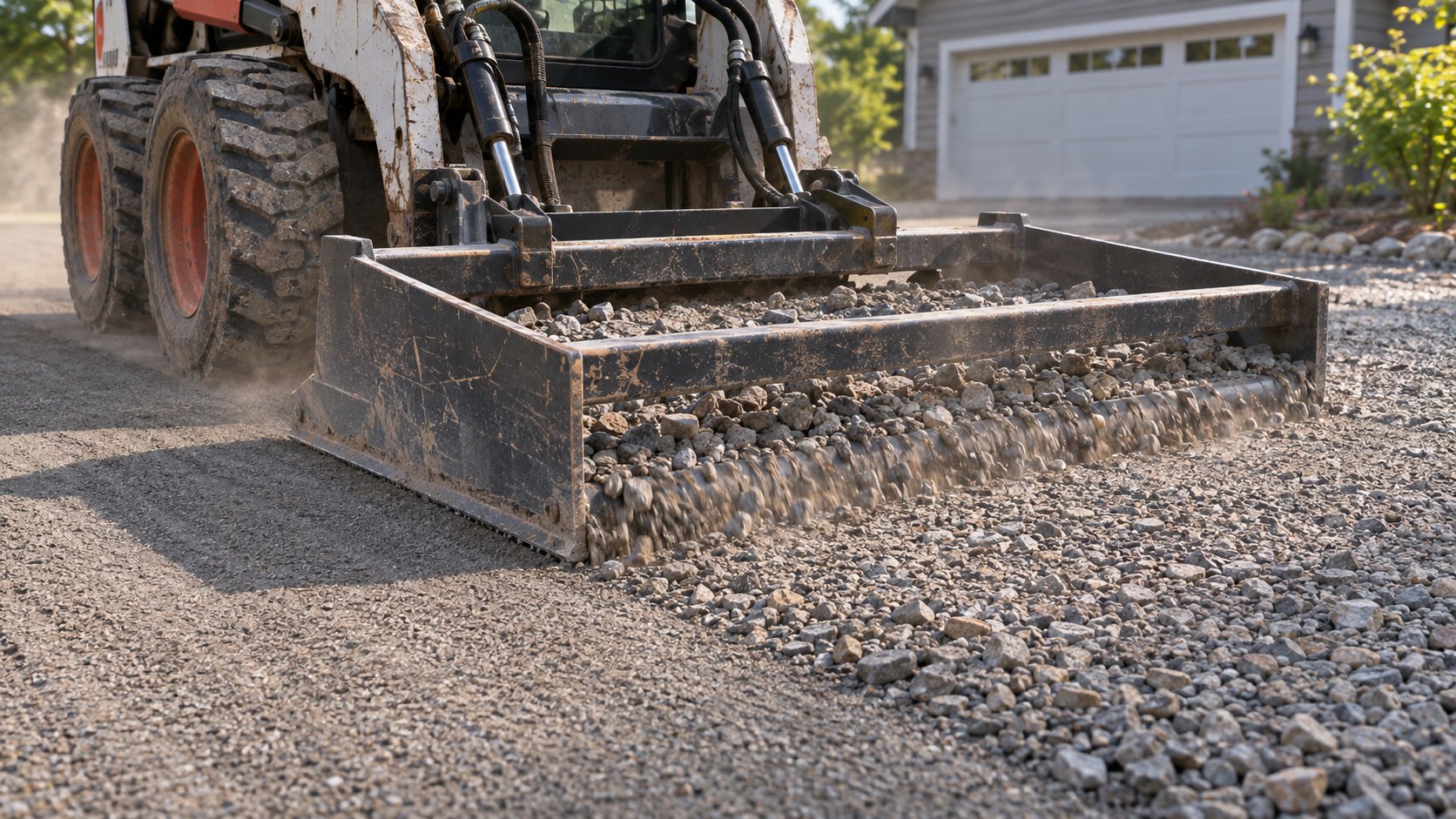
Watch a skid steer box grader work a rough gravel driveway and it can look like it's doing three jobs at once. In a sense, it is. Compact motor graders rely on one long moldboard. A box grader splits the work across several cutting edges inside a single frame.
Spread, Level, and Finish in One Pass
Most 3-blade designs follow the same basic sequence, though exact blade layouts vary by manufacturer:
- Front blade: Cuts into high spots and starts spreading loose material.
- Middle section: Carries the loosened gravel or soil and redistributes it into low areas.
- Rear blade: Strikes off the surface and leaves the final finish.
The side plates are what make this work. As SkidSteerAttachments.ca explains, a three-sided frame holds loosened material instead of letting it escape, then dribbles it into the low spots behind the cutting edge. Some models add scarifier shanks to break up compacted gravel first. You'll want those raised for finishing passes, though, or they keep disturbing the surface you're trying to smooth.
Why Box Graders Outperform Bucket Grading
A bucket is rigidly tied to the loader arms. It follows every pitch and bounce of the carrier, so each bump the tires cross gets copied into the ground. Material also spills off the sides. That's why beginners often end up with ridges, windrows, and washboard edges.
A box frame is longer and rides across the surface. It averages out small irregularities instead of tracing them. Running the loader arms in float mode lets the frame follow an established grade, while a locked position helps it bite into high spots. A skilled operator can still do respectable work with a bucket. It simply takes more skill and more cleanup.
Can a Mini Skid Steer Really Grade Like a Bigger Machine?
Honestly, yes and no. Compact graders such as the Skid-Max 3X compact format or the Cammond GSI4-MINI-SK can leave a clean finish on driveways, walkways, and parking pads. Their limits come from the carrier:
- Weight: Most mini loaders lift roughly 500 to 1,500 pounds, notes Rentalex, so there's less mass to hold a blade down in hard material.
- Hydraulic output: Smaller machines supply less flow to any hydraulic blade functions.
- Blade width: Narrower frames mean more passes. Even a 60-inch attachment on a smaller skid steer sees productivity drop on long drives.
So the attachment sometimes pitched as the smallest motor grader alternative shines on compact areas, not long road stretches. Where the line falls between an attachment job and a dedicated-machine job depends less on the tool itself than on the work waiting in front of you.
Matching the Right Grader to Your Job
Picture two buyers. One maintains a short gravel driveway a couple of times a year. The other keeps several miles of subdivision roads passable every week. Both might search for a mini motor grader for sale, yet they need very different equipment. The job, not the label, should make the choice.
Choosing by Job Type and Site Size
Here's how common jobs usually line up with each category:
- Gravel driveway upkeep: A skid steer box grader or a 3-point land plane handles routine smoothing and pothole repair.
- Farm and ranch roads: Tractor implements work for occasional touch-ups. Long lanes that need frequent grading may justify a self-propelled small road grader.
- Parking pad prep: A box grader on a skid steer spreads and levels base material in a confined area.
- Landscape finish grading: A mini skid steer attachment or a land plane works neatly around beds, walkways, and structures.
- Subdivision or municipal road maintenance: A self-propelled compact grader suits regular road-length work, while attachments can cover secondary areas.
- Pre-paving fine grading: A box grader with laser or GPS control, or a compact motor grader with grade control, delivers the tightest results.
So when does a dedicated machine beat an attachment? Watch for three signals. First, repeated road-length work, where travel speed and a long moldboard save hours every week. Second, operator comfort, since a purpose-built operator station is easier on a crew grading all day. Third, blade reach, because a moldboard that angles, tilts, and side-shifts can pull material from shoulders and ditches. That's where a LeeBoy motor grader or a similar compact machine earns its keep. For occasional small-area work, an attachment on a carrier you already own usually makes more sense.
Road maintenance planners reach similar conclusions. Capital I Industries observes that full-size graders are often inefficient on secondary and restricted-access areas, and that compact grading equipment is most effective for frequent, targeted maintenance between major roadworks.
Grader Attachments Compared With Other Leveling Tools
A grader isn't the only way to level ground. You'll notice each tool has a sweet spot:
| Tool | Best Use | Finish Quality | Required Carrier | Learning Curve |
|---|---|---|---|---|
| 3-blade box grader / grader leveler | Spreading, leveling, and finishing driveways and pads | High | Skid steer or mini skid steer | Low to moderate |
| Land plane | Fine grading, smoothing bumps and dips | High on loose material | Tractor with 3-point hitch | Low |
| Box blade | Rough grading, filling potholes, spreading gravel | Moderate | Tractor with 3-point hitch | Moderate to high |
| Tilt/angle dozer blade | Pushing material, backfilling, cutting slopes | Moderate | Skid steer, track loader, or tractor | Moderate |
| Standard bucket | Moving and dumping material, rough spreading | Low to moderate | Any loader | High for a clean finish |
| Laser/GPS grading attachment | Precise grades for pads and pre-paving work | Very high | Skid steer or track loader with a compatible system | Moderate, mostly setup |
The box blade versus land plane split shows why these differences matter. As Good Works Tractors explains, a box blade's high side walls trap material for rough grading but take real skill to feather evenly. A land plane's lower walls let material spill over consistently for a smoother finish, though moving large volumes may take more passes.
Tight Sites and Access Limits
Access often settles the debate before price does. A mini skid steer with a grading attachment can slip through backyard gates, between buildings, and along narrow paths where even a small motor grader can't maneuver. Once the work stretches into long gravel roads, though, a compact road grader covers distance far more efficiently. It travels between sections faster and shapes more surface per pass. Many fleets end up using both, assigning each tool to the areas it reaches best.
Fit is only one side of the decision. Every category also carries its own costs, compromises, and hidden strengths that tend to surface only after a few seasons of real use.
Pros and Cons of Each Mini Grader Category
Every grading tool trades one strength for another. A dedicated machine gives you reach and speed but asks more of your budget. An attachment saves money but leans heavily on its carrier. So which compromise can you live with? Here's how the four categories compare.
Self-Propelled Mini Motor Graders
Pros
- A dedicated machine that grades without tying up another carrier
- A true moldboard that lifts, tilts, and angles to steer material where you want it
- Efficient coverage over longer roads, shoulders, and ditches
Cons
- Higher purchase and maintenance cost than any attachment
- Transport logistics, including a suitable trailer and haul planning
- A trained operator, since SANY notes that precise blade control takes professional training and practice
When you browse a mini road grader for sale, weigh these ownership demands alongside the listing. Small motor graders offer the most capability in this group, but only a steady workload makes that capability pay off.
Mini Skid Steer Grader Attachments
Pros
- Fits through gates, between buildings, and along narrow paths
- Lower cost than a self-propelled machine
- Runs on a carrier you may already own
Cons
- Limited hydraulic flow and carrier weight to hold the blade in hard material
- Slower coverage, since narrow frames need more passes
Full-Size Skid Steer Grader Attachments
Pros
- A wider cut that covers more ground per pass
- More carrier power and weight for tougher material
- Versatility, because the same loader swaps to a bucket or forks later
Cons
- A larger footprint that may not fit tight residential sites
- A finish that depends on the carrier's stability, hydraulics, and operator
Before buying, Western States Cat suggests a simple check: does your machine have the hydraulic capacity the attachment needs?
Tow-Behind and 3-Point Implements
Pros
- Simple designs with few parts to maintain
- Low cost for compact tractor owners
- Forgiving for routine driveway smoothing, especially land planes
Cons
- Less precision, with results tied to 3-point hitch and top-link adjustments
- Limited control on hard-packed material, where Farmry notes grading blades may need scarifiers lowered just to shave the surface
The best mini grader category isn't the most powerful one, it's the one that fits how often you grade, how big your site is, and which carrier you already own.
Picking a category narrows the field, yet models inside it can look nearly identical until you read the numbers that actually separate them.
Specs That Matter When Comparing Mini Motor Graders
Scroll through mini graders for sale and you'll notice how alike many listings look. Same yellow paint, same three-quarter photo, same promise of versatility. The real differences hide in the spec sheet. Knowing which lines to read first keeps you from buying a machine that looks right but works wrong on your site.
Key Specs for Self-Propelled Mini Motor Graders
- Blade/moldboard width: This sets how much surface you shape per pass. Wider isn't automatically better, though. United Rentals warns that a bigger blade adds weight that can strain the drivetrain and frame on a smaller grader.
- Horsepower: Spreading loose gravel takes little power. Cutting compacted shoulders takes much more, so match horsepower to your hardest regular task.
- Operating weight: Weight keeps the blade biting. A machine that's too light tends to ride up over hard spots instead of cutting them.
- Articulated vs rigid frame: An articulated frame lets the front frame and blade offset from the rear, which helps on curved roads and in tight spaces. A rigid frame suits straightforward work that doesn't demand precise maneuvering.
- Hydraulic vs mechanical blade control: Hydraulic controls make lift, tilt, and side-shift adjustments quick and smooth from the seat, which matters for fine grading. Simpler mechanical setups may mean fewer hoses to maintain, but adjustments are usually slower and coarser.
- Turning radius: Cul-de-sacs, farm gates, and driveway ends punish a wide turn with extra back-and-forth.
- Transport width: This decides what trailer you need and whether hauling gets complicated.
- Engine brand and parts support: A widely supported engine with nearby service shortens downtime when filters, sensors, or injectors need attention.
Use the LeeBoy 685D as a test case. The official LeeBoy 685D page describes a compact machine designed with the functionality of a large motor grader, powered by a Cummins engine and available with a cab or canopy. It lists jobs from spreading base material and ditch or shoulder work to fine grading, medium cutting, and snow removal. Full dimensions live in a downloadable spec sheet. Whenever you review a LeeBoy grader listing, compare its numbers against that document rather than a reseller's summary.
Understanding Hydraulic Flow for Grader Attachments
With attachments, the key specs shift to the carrier. Flow, measured in gallons per minute (GPM), sets how fast a hydraulic function moves. Case's Ted Polzer calls flow "the speed of the attachment under no restriction" in a ForConstructionPros feature. So an attachment rated for a range like 8-12 GPM is built to work properly inside that window.
Mismatches show up quickly. Too little flow makes blade adjustments sluggish, so corrections lag behind the ground. Too much flow makes the blade jump faster than you can control it. The same article notes standard-flow skid steer systems often run 17 to 24 GPM, depending on make and model, and that pairing a low-flow attachment with a stronger machine without dialing in the flow invites failure. Confirm your auxiliary output in the operator's manual or with your dealer before buying.
Two more checks matter:
- Coupler compatibility: Mini and full-size loaders often use different mounting interfaces, so confirm the attachment plate fits your carrier.
- Width relative to carrier: An oversized frame can overpower a small loader and make holding grade harder. Upsizing to "grow into" an attachment rarely pays off.
Verifying Specs Before You Trust Them
Marketplace listings for small road graders sometimes recycle figures from older models, mix units, or post numbers with no source at all. Before you shortlist anything, download the manufacturer's official spec sheet, match the exact model and series, and ask the seller to confirm key figures in writing. If a listing can't be traced back to an official source, treat it as a rough guide only.
Even perfectly matched specs only tell you what a machine is capable of. Whether a driveway sheds water or turns to washboard depends on how the blade is angled, how many passes you make, and where you leave the crown.
Grading Technique for Driveways and Small Roads
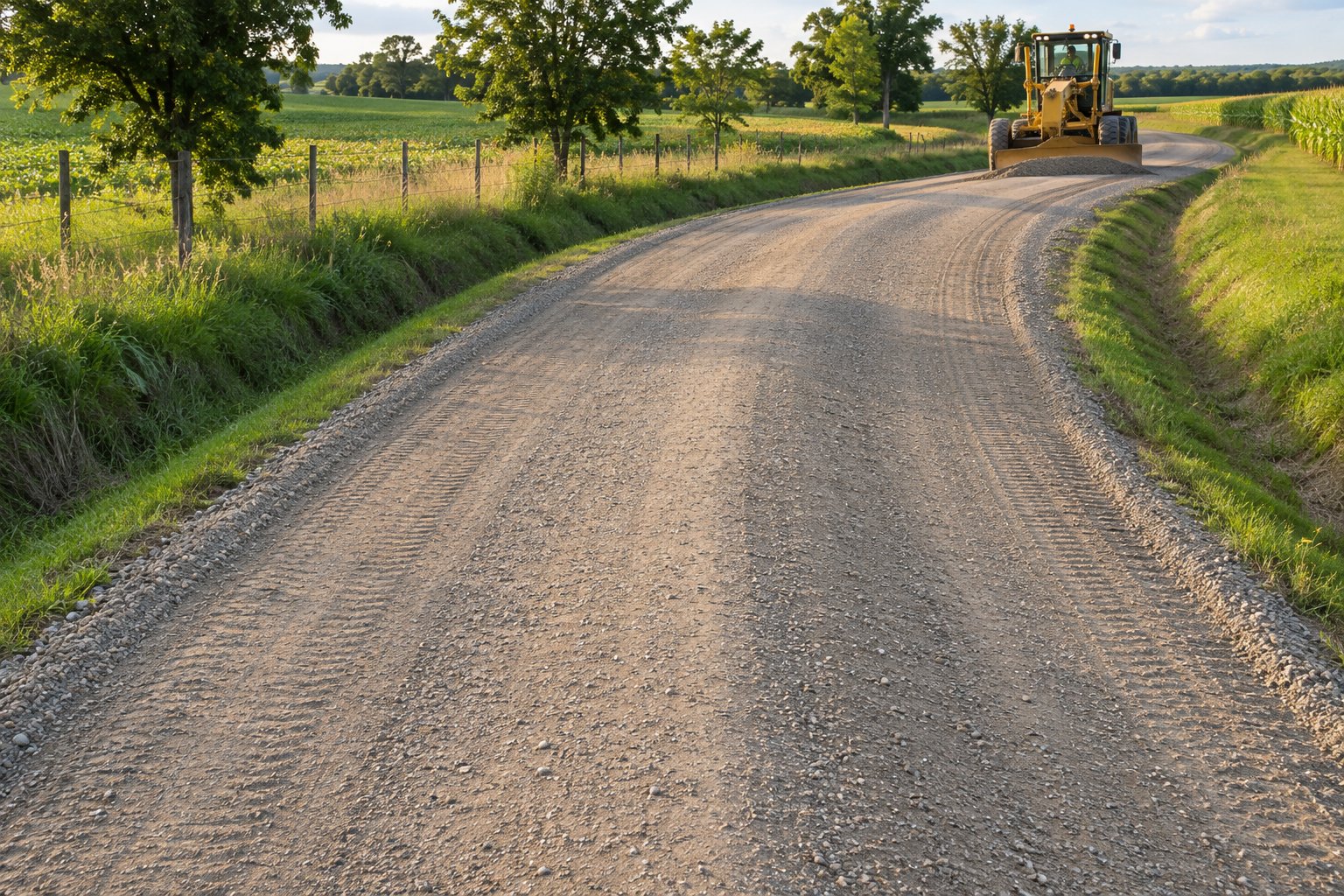
Finished a pass and the driveway still looks lumpy? The machine is rarely the culprit. Technique usually is. The good news is that the core principles carry over whether you run a compact motor grader, a box grader, or a tractor blade. The FHWA-sponsored Gravel Roads Maintenance and Design Manual puts it plainly: the principles of shaping are the same no matter what machine is used.
Blade Angle and Material Movement
Blade angle decides where material goes. For motor graders, the manual recommends keeping the moldboard angle between 30 and 45 degrees. Too little angle spills gravel around the toe of the blade and builds a high shoulder that blocks drainage. Pitch, or tilt, decides what the blade does. Tipped forward, it cuts aggressively. Upright, it spreads. Tipped back, it drags lightly for maintenance. Ideally, material rolls across the blade face, mixes, and forms a light windrow. Attachments give you fewer adjustments. A box grader's geometry is fixed by its frame, while a 3-point blade relies on hitch and lift-arm settings. Whatever you run, keep it slow, since the manual notes good work is nearly impossible above 3 to 5 mph.
Single Pass vs Multiple Passes
A single box-grader pass is often enough to smooth a firm, well-shaped driveway. Loose or uneven gravel is a different story. Several lighter passes let you trim high spots, blend stone back with fines, and leave a tighter surface. For washboarding, the manual advises cutting at least an inch below the depressions, ideally while the gravel is moist, then relaying and compacting it.
Crowning Gravel Driveways and Small Roads for Drainage
A flat surface holds water. Water softens the crust, traffic pounds out potholes, and washboarding gets worse. A crown sheds water to the edges. For gravel roads, the manual cites about 1/2 inch of crown per foot, roughly 4 percent, as ideal.
- Give runoff a defined path off the edges, such as a ditch or coarse-gravel channel.
- Angle the blade to pull displaced material from the edges back toward the center.
- Shape a straight slope from each edge up to the centerline, like a roof, not a rounded hump.
- On a tractor, adjust the lift arms to put the implement on a slant for each side.
- Check the result with a level or crown gauge, then compact.
Watch your cutting edge. Center wear creates a rounded "parabolic" crown that leaves the middle of the road flat and prone to potholes.
Finish Grading Before Paving
Paving locks in whatever sits underneath. Contractors such as Able Asphalt Paving lay aggregate base in compacted layers of about 4 to 6 inches, fine-grade it for drainage, then compact and inspect it again. Laser or GPS guidance earns its place here, where a small grade error becomes a puddle in finished asphalt. For routine gravel upkeep, a good eye and a level usually do the job.
Good technique stretches a small grader surprisingly far, but not forever. Once the miles and the workload pile up, browsing mini road graders for sale turns into a sharper question about which machine, and which seller, can actually keep up.
Buying a Mini Grader and Knowing When to Size Up
You've picked a category, checked the specs, and practiced your crown. Now comes the part where money changes hands. Where do you actually shop, and how do you avoid paying for a machine that doesn't fit the work?
Where Buyers Find Mini Graders for Sale
Most buyers end up using one of four routes:
- Authorized dealers: For self-propelled machines such as LeeBoy graders, a dealer can supply the official spec sheet, warranty terms, and local service. Configurations vary, so confirm pricing and availability on any LeeBoy listing directly with the seller.
- Attachment manufacturers selling direct: Brands like Skid-Max and Cammond sell box graders and other skid steer gravel grader formats straight to buyers. A Skid-Max grader price depends on width, options, and freight, so request a current quote instead of relying on old forum posts.
- Used equipment sellers: Dealers, auctions, and rental fleet sales offer used mini motor graders for sale and secondhand attachments at a lower entry point, with more condition risk.
- Import marketplaces: Factory-direct listings widen your choices but add shipping, duty, and certification questions.
Questions to Ask a Dealer or Supplier
Whichever route you choose, put these questions to the seller before you commit:
- Can you provide the official manufacturer spec sheet for this exact model and series?
- Will this road grader for skid steer match my carrier's auxiliary hydraulic flow and coupler?
- For used units, what are the hours, and can I see service records and invoices? A used motor grader scorecard from MY Equipment suggests matching dates, hours, and serial numbers across those documents.
- Where will I get parts and service, and how quickly?
- What warranty applies, and what does it exclude?
- How will the unit ship, and who pays freight?
- For factory-direct imports, who handles import duties, and does the machine carry the certifications my market requires?
- What is the realistic delivery lead time?
Then add up the full picture. The same scorecard favors a delivered-ready cost, meaning purchase price plus repairs, attachments, transport, taxes, fees, and initial servicing, over the asking price alone.
When You Need More Grader Than a Mini Can Deliver
Some jobs simply outgrow compact equipment. Building new roads, maintaining long rural networks, or cutting ditches day after day can push even a capable compact machine past its limits. At that point, comparing used small or full-size motor graders often makes more sense.
For that bigger work, JIUHONG's used motor grader collection is one place to compare options. It features road-building machines such as SDLG G9220, SANY, and LiuGong 4180D listings. These are not mini or compact graders, and the collection doesn't confirm mini-grader, John Deere, or Caterpillar stock. If you're hunting for one of those, treat your contact as a model-specific availability inquiry. Either way, request machine-specific specs, condition information, and a current quote, then run every listing through the questions above. For any used grader, it also pays to have an independent inspector check the engine, transmission, circle, drawbar, articulation, and hydraulics before you pay.
The right grader isn't the biggest or the cheapest one, it's the one that matches your job, your site, and the support you can count on after the sale.
Mini Grader FAQs: Choosing, Sizing, and Using Compact Grading Equipment
1. What is a mini grader used for?
A mini grader shapes and levels soil, gravel, or base material on sites too small or tight for a full-size motor grader. Typical jobs include gravel driveway upkeep, parking pad prep, walking paths, landscape finish grading, farm lanes, and light road maintenance. The term covers three product types: self-propelled compact motor graders with their own engine and moldboard, box or blade grader attachments for skid steers and mini skid steers, and tow-behind or 3-point implements for compact tractors. Identify which type fits your work before comparing models, since cost, carrier needs, and finish quality differ widely between them.
2. What is the smallest motor grader available?
It depends on whether you count attachments. A mini skid steer box grader is the smallest grading tool, but it has no engine or operator station, so it is not a true motor grader. Among self-propelled machines, the compact class is the smallest. Models such as the LeeBoy 685D are marketed as compact, yet its 130 hp engine places it within the horsepower band many dealers use for small graders. This is why the word mini in a listing says less than the spec sheet does. Always check moldboard width, operating weight, horsepower, and transport width on the manufacturer's official documents.
3. Can a skid steer grade as well as a motor grader?
On driveways, pads, and walkways, a skid steer with a 3-blade box grader can leave a very clean finish. The box frame rides across the surface and averages out bumps, while the side plates hold loose material and drop it into low spots. A bucket, by contrast, copies every pitch of the carrier and tends to leave ridges. Where a skid steer falls short is long road stretches, heavy cutting in hard material, and ditch or shoulder work. Smaller carriers have less weight and hydraulic output, and narrow frames need more passes, so a self-propelled grader becomes more efficient as distance and frequency grow.
4. How much hydraulic flow does a skid steer grader attachment need?
Each attachment is built for a specific flow window, often listed as a GPM range such as 8-12 GPM. Flow controls how fast blade functions move. Too little makes adjustments slow and lagging, while too much makes the blade react faster than you can control. Standard-flow skid steers commonly deliver more than many small attachments are rated for, so mismatches are easy to create. Before buying, confirm your machine's auxiliary output in the operator's manual or with a dealer, check that the coupler plate fits your carrier, and avoid oversizing the attachment for a small loader.
5. When should I choose a full-size or used motor grader instead of a mini grader?
Consider sizing up when work shifts from small sites to new road building, long rural road networks, or daily ditch cutting. At that scale, a compact machine spends too much time traveling and making extra passes. Comparing used small or full-size motor graders often gives better value. JIUHONG's used motor grader collection lists larger road-building machines, including SDLG G9220, SANY, and LiuGong 4180D units. These are not mini or compact graders, and the collection does not confirm mini, John Deere, or Caterpillar stock, so treat any search for those as a model-specific availability inquiry. Request machine-specific specs, condition details, and a current quote, and have an independent inspector check the engine, transmission, circle, drawbar, articulation, and hydraulics.